



 20.28°C Kathmandu

Sat, Oct 17, 2026
Columns
Who holds Nepal’s energy switch now?
Nepal ended load-shedding through better governance. Then the river came down..png&w=900&height=601)
bookmark
Apsana Kafle
Published at : September 5, 2026
Updated at : September 5, 2026 22:15
Energy insecurity is probably the quietest daily crisis Nepalis live with, second only to food. After all, many generations here grew up surrounded by energy scarcity, cooking with collected firewood, doing homework under dim candlelight during 18-hour-a-day load-shedding, and waiting endlessly outside of petrol pumps or Liquid Petroleum Gas (LPG) depots. The scarcity is embedded so deeply in our national mindset that whenever we survive a political or economic shock, the first question we ask is: “Will there be electricity, cooking gas or fuel to carry on with our lives?”
The chronic desperation was also recently captured when a video of people swimming into raging floodwaters to retrieve LPG cylinders that were floating downstream went viral. To outsiders and critics, it may be incomprehensible to risk life for a cylinder, or inhuman to steal. But to me, the image reflects a survival instinct forged by years of institutional failure.
The era of load-shedding finally ended when Nepal Electricity Authority, under Kulman Ghising’s leadership, reformed hydropower generation to address optimal use, transmission, and demand issues and improved governance. For an ordinary Nepali, this was the first time in recent memory that a public institution could be trusted. Even after a decade, the end of load-shedding is a gold standard for judging all public governance systems and possibilities.
Nepal sits on an estimated 83,000 MW of hydroelectricity with a commercial viability of 40,000 MW. That figure became a national mantra appearing on party manifestos, donor strategies, pitches for private developers, and, eventually, in the household stock market portfolios. Nepal’s prosperity had been given a delivery mechanism, and the mechanism was water.
The momentum that followed was real. By 2025, the country had roughly 3,435 MW installed and another 4,063 MW under construction. Major and micro hydropowers lit homes which had never been on the grid; surplus moved across borders to India and Bangladesh; and construction work kept locals in their districts, rather than the Gulf, for job opportunities. For over a decade, hydropower was the thing that the country had gotten right.
The same urgency that ended load-shedding and earned the sector its credibility pushed developers through Free, Prior and Informed Consent with Indigenous Peoples. These included projects financed by Multilateral Banks violating their own safeguards mechanisms, including the recently destroyed Upper Trishuli (UT 1) project. Speed of progress was not the side effect of the boom—it was the key method used.
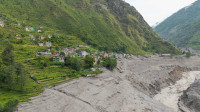
On August 26, a flash flood mercilessly washed away 12 hydropower stations, severely affecting 15 others along the Bhotekoshi and Trishuli rivers. More than 1,200 people have lost their lives, and thousands are missing; among them, many were employees and contractors of the hydropower stations. Preliminary estimates put recovery and reconstruction at around $1.3 billion, with a major estimation allocated to the restoration of the energy systems.
The financial figure is recoverable; the other loss isn’t. A decade of steady power and progress in the hydropower sector built a slow and steady trust and confidence in the system—to plan an evening, run and operate businesses, reform policies with the assumption that the switches remained on. Then the flood washed away the plants. It is only after we ask, “Did we actually solve the darkness, or simply give the switches to turn off from mismanaged humans to climate catastrophe?”
The question matters more now than it would have a decade ago because we have since connected other things to the switch, and the biggest plug is the Electric Vehicle (EV) sector. Low and zero duties on EVs, open market access for international manufacturers, and a rapid expansion of public charging stations moved Nepal’s transportation sector from imported crude oil to domestic waters. It worked. By 2025, we ranked second in the world to electrify our transport system.
A question now sits on the same foundation the water has exposed. What does losing 10 percent of national generation capacity in one morning actually mean? Someone like a taxi driver, who might have financed an electric vehicle last year, now sits worrying whether he switched too soon. Questions like this harden fast.
We have to rebuild deliberately and strategically to protect our power grids, civic trust built over the last decade, our commitment and policies on EV and net-zero targets. First, we need to realise that hydroelectricity alone cannot carry 95 percent of Nepal’s electricity grid, as disaster frequency rises across the Himalayas. Every project must go through a stringent Environmental Impact Assessment, hazard risk evaluation, and Free, Prior and Informed Consent process. We cannot treat infrastructural failures as unavoidable acts of climate change. In Nepal, extreme weather and climate catastrophes are the new operational reality, and our designs must withstand them.
Second, capital investment should shift from expansion to resilience. Before we plan to add megawatts, we should ask harder questions: Did we invest enough in disaster-resilient engineering, early warning systems, and insurance to protect the lives and capital we had already committed? The answer now lies on the riverbeds of Bhotekoshi, Trishuli and Narayani. Third, we must diversify our sources of clean energy and, as we build grids and connect new plugs, we need to continue to reflect on whether we are simply trading switches or actually solving the problem.
Nepal has proved that it can defeat darkness caused by human mismanagement; the harder work now is to build a system that holds even when the hand on the switch belongs to climate.
Apsana Kafle
Kafle works in the public and energy policy sector.




Most Read from Columns
Before you take credit for Khula Manch, read its history

Shah went to the UN to speak for Nepal, then left before he could make the most of it

Bhotekoshi flood wasn’t a freak event. It’s the Himalaya doing what it does

Lesson learned after the death of Ronaldo
Why passive neutrality won’t take Nepal anywhere
Editor's Picks

Dashain paints the country in festive colours
Buying a goat for Dashain? Look for the green mark

Explained: Why does an hour long flight to Dhangadhi cost more than a flight to New Delhi?
Bhotekoshi flood wasn’t a freak event. It’s the Himalaya doing what it does

How Tenzing Sherpa became Nepal’s breakout star at the Asian Games
E-PAPER | October 17, 2026

×