This topic has broader meanings than we commonly use in everyday parlance. It struck me for two reasons. First, as an academic, I was drawn to this topic raised at a recent discourse programme. Second, I found the expression ‘political times’ an eloquent subject for discussion. I want to briefly discuss the role of art in political times and share my ideas about theatre and the arts we have been dealing with in our times. I will mainly focus on the current Nepali scenario, as far as possible. The reason is that we are facing challenges related to construction, demolition, synthesis and divisions, all at the same time. And politics has become the dominant lexicon in our society; legislative assemblies, government, opposition parties and the media have, as always, become the most-used topics in Nepal today.
All times are political, in general terms. This invites an extensive discussion. In Nepal, practitioners and critics of the arts and theatre, especially, have always worked in a spirit of collaboration, engaging with one another’s ideas. In that sense, there is a need to dig into the question—which forms of art have more political features in this country?
On the evidence of my long experience, I want to say the following at the outset before discussing the current situation and the problems of interpretation. In Nepal, literary writers have always written freely, except in some cases when the writings were geared to placate the spirits of a certain segment of society; they have evoked the political aspect of writing in literature. I am alluding to literary criticism and writing, especially those produced to propagate certain ideologies. But in general, literary writers exercised full freedom to write about life and art. Discussions were articulated in the field of literary writing more than in other fields. There is a substantial output of such writings in Nepal’s major languages, documented in the literary and artistic discourses produced in those languages. In my own case, I have always used the Nepali vernacular for writing.
Literary writers and theatre people have always responded to the country’s political changes. The political change of 2025 that ushered in the present structure and transformation made politics the most prominent aspect of consciousness in Nepal. Its impact has been so strong that other discussions of social changes taking place for a long time have either been put under ‘erasure’, to use the term of the French philosopher Jacques Derrida, or have been given less attention. But the changes taking place are drawing the attention of people in society.
The important aspect of this change is a state of ambivalence, a condition of change that lacks a coherent and clear picture. Political analysts have proposed different interpretations of the situation. Yet political interpreters have observed that the current changes have created conditions that demand open discussion. This is a common feature of changing times; the mood of such times creates different conditions of meaning. I want to cite an expression—the title of an article by the well-known Nepali political columnist, CK Lal, who sees the condition of this change in Nepali society as sandhyakalko sunauloudasi, or, as I translate, “a golden melancholia of the evening times”. I have cited only one title here. Depending on the nature of their perception, analysts use metaphors to express the conditionalities of political times.
As a theatre person, I want to share my impressions of a melange of enthusiasm and dismay caused by the current political changes in Nepal. No single political party, ideology or development is responsible for the creation of a studied mood in the realms of theatre and the arts. Based on the audience’s response, I have noticed, with little dismay, that no compelling mood or experimental euphoria has made an impact on them. Political issues dominate the stage today. The thrust of theatre’s energy lies in its fiercely critical position and understanding. My experience and karma say that theatre generates energy if it works steadily, staging plays that reflect the spirit of change and the transformations of various kinds in society.
For theatre practitioners and creative writers, social change occurs in two main conditions. First, when conditions of expression and freedom are constrained, they should stage plays with a free spirit. Second, theatre should stage plays that introduce innovations. But theatre is a medium that can be manipulated and turned into propaganda. Today’s Nepali theatre is free. But to keep up the spirit of freedom and free expression, it has to do one thing. They should not give in to adverse conditions; they should keep up the spirit of the times and the tradition of the medium, that is, staging plays that express freedom.
The case of the arts is quite similar, but unlike theatre, they do not directly evoke the spirit of rebellion through the visual medium. Paintings, especially, are versatile media of artistic expression. They have continued to experiment and perpetuate the tradition of the various forms of art. As someone closely associated with both theatre and the arts for a long time, I have seen theatre people and artists share some experiences, but also follow different modes of operation as per their medium. But as someone holding a middle position, I must say that performativity in both arts and theatre is the mantra for creating power. We can see in some unlikely spaces that meetings of the spirits of performance theatre and the arts have always happened in Nepal.
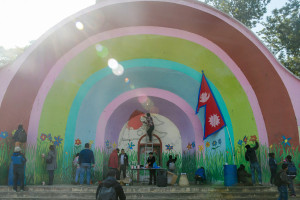
People’s uprisings, protests and artistic presentations have become meeting points, with architecture playing a mediating role. Political changes should not be seen as constraining factors. In Nepal today, we are poised to write the history of a unique order that brings about social change and societal transformation. From the perspective of people like us who come from the areas of theatre, arts and literature, today’s challenges for transformation combine creativity, change and judgement. These are the most important ingredients of the dynamic and creative changes we are bracing for today. One important mantra that theatre people, artists and writers should imbibe more than ever is to maintain a spirit of freedom and creativity and to continue working by combining individual spirit with the efforts of creatively engaged and committed communities and groups.




 16.03°C Kathmandu

.png&w=900&height=601)