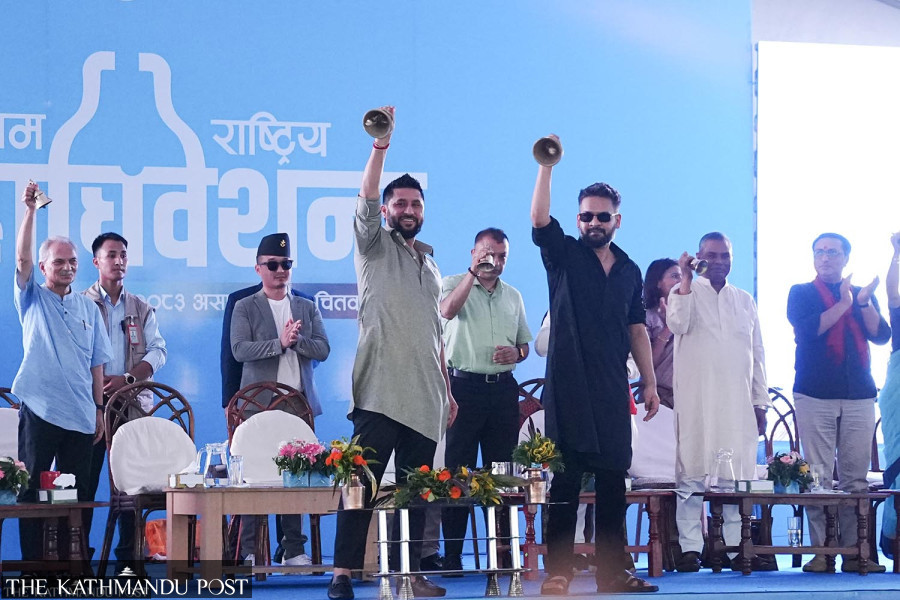
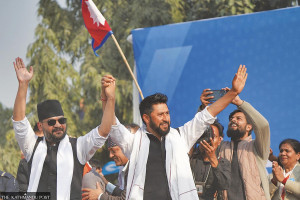
The ruling Rastriya Swatantra Party (RSP) convened its first General Convention in Chitwan on Sunday. The crucial gathering is scheduled to conclude today. Launched merely four years ago, the party has risen dramatically, riding high on social media-based popularity.
Thousands of people, especially the youth eager to establish alternative politics, have enthusiastically participated in the convention. That includes significant numbers of Dalits. But the RSP convention has failed to seriously consider the issues Dalits face contemporarily. An overview of the performance of the RSP government in the past three months leaves little room for optimism.
Convention ignores Dalit issues
By the time this article is published, the RSP convention will have debated and passed many important policies and programmes. But caste discrimination and untouchability will likely not be on the agenda. The RSP leadership seems not to acknowledge caste as a problem at all. It’s great that we have a man from a lower-middle caste of the Madhesi community as prime minister, breaking the long tradition of hill so-called ‘upper castes’ leading the country, but unfortunately, he doesn’t seem to know—or care—about caste hierarchy.
This may be in part because he grew up in a relatively wealthy family in Kathmandu and has been married to a Brahmin woman. Research in neuroscience, psychology and sociology shows that childhood greatly shapes leadership. Prime Minister Balen Shah hasn’t seen how his own people are perceived and treated in parts of southern Nepal and northern India.
It’s not just about the prime minister, however. Urban upper castes from the upper or middle class dominate the party. Not experiencing, or at least witnessing, the lives of Dalits in remote hills and plains, they are highly insensitive to the problems of caste exclusion and humiliation.
The country’s education system has also rendered the youth caste blind. Under the shadow of Brahmanic teaching, our school and college curricula hardly ever describe and analyse the rigid caste hierarchy standing on the direct instructions of sacred texts like the Manusmriti.
Fake promises
I wouldn’t be surprised, however, if the party chairman, Rabi Lamichhane, used his excellent oratory skills to show great sympathy towards Dalits in his concluding address to the convention.
Lamichhane has already fooled us once. On April 7, he spoke to the parliament, displaying great sympathy for Dalits. He apologised to the Dalit community on behalf of his party and government. Furthermore, he pledged to make sure nobody would be humiliated based on caste.
His words matched the written pledge of the RSP government to officially apologise to Dalits and to introduce reform measures. Sadly, these were lies. The party chair’s remarks do not qualify for a state apology. The prime minister himself must do it. And, no reform steps have been taken to date.
There’s nothing substantial for promoting Dalit rights, neither in the government policies and programmes, nor in the national budget. Lamichhane’s lofty words have simply proven hollow.
Justice died in police custody
The true colour of the RSP and its government is apparent in the case of the alleged murder of Shri Krishna BK in police custody in Khurkot, Sindhuli, on April 20.
Many Dalit rights defenders, including the RSP’s members of parliament, and the National Dalit Commission, had raised serious doubts about the police claims of Shri Krishna’s suicide, and had asked the Balen government to conduct an independent investigation into this suspicious custodial death.
The RSP government did not heed our call. The Police Headquarters apparently carried out a probe and typically whitewashed the police officials’ suspected crime, which led to BK’s death. The police report is said to be at the Ministry of Home Affairs, but it has not been released. Moreover, Lamichhane is said to have forced all RSP Dalit parliamentarians to shut their mouths.
The body of the deceased had been brought to the TU Teaching Hospital for further tests, but the post-mortem test results were not published. It is said that the government and some Dalit MPs paid a certain amount to the mother of the victim, forcing her to cremate the body.
Nobody knows how this was done and whether the mother was convinced or coerced to receive her son’s body. But the newly re-appointed Home Minister, Sudan Gurung, told the National Assembly on June 19, that the police investigations found no evidence of foul play—that is, it was a case of suicide.
The police organisation cannot truly investigate the potential crimes of police officials. So, as in many other cases, suspected criminals involved in the custodial death of a Dalit man have evaded punishment.
So much for the slogans of good governance. The Balen Government and the RSP leadership have denied justice to the victim’s family in Sindhuli. Unlike the previous governments, the current prime minister and ministers are not accessible enough to hear our views and suggestions. So, in a way, seeking justice for the victims of caste hatred has become more complicated under the RSP administration. There is no transparency, accountability, or a sense of responsibility towards the downtrodden.
Dalit institutions dismantled
The fact that the RSP is not interested in Dalit issues is also reflected in the termination of at least two important state bodies created for safeguarding Dalit rights. The Balen government has dismantled the Dalit Development Committee and the Badi Development Board.
Created before the National Dalit Commission, the Dalit Development Committee had not been able to function properly due to very little funding and the appointment of party puppets instead of capable officials. Badi Development Board faced similar problems. The RSP government didn’t bother to discuss the matter with the concerned communities, let alone revive and revamp the crucial institutions before dismantling them.
While it is exciting to see a newly formed party, the RSP, trying to replace the authority of the old guard and to generate new energy amongst the young, there is a possibility of Dalit lives and properties—their dignity and rights in general—face more danger at the hands of the current administration.
A graduate of Oxford University, Pariyar is a Dalit rights activist who has worked in universities in Australia and England. Pariyar is affiliated with the Nepali Communist Party.




 16.01°C Kathmandu