



 14.81°C Kathmandu

Sat, Oct 24, 2026
Columns
Nepal’s currency peg: Time for reassessment?
Nepal maintains exchange rate stability and financial openness with India, limiting its monetary independence.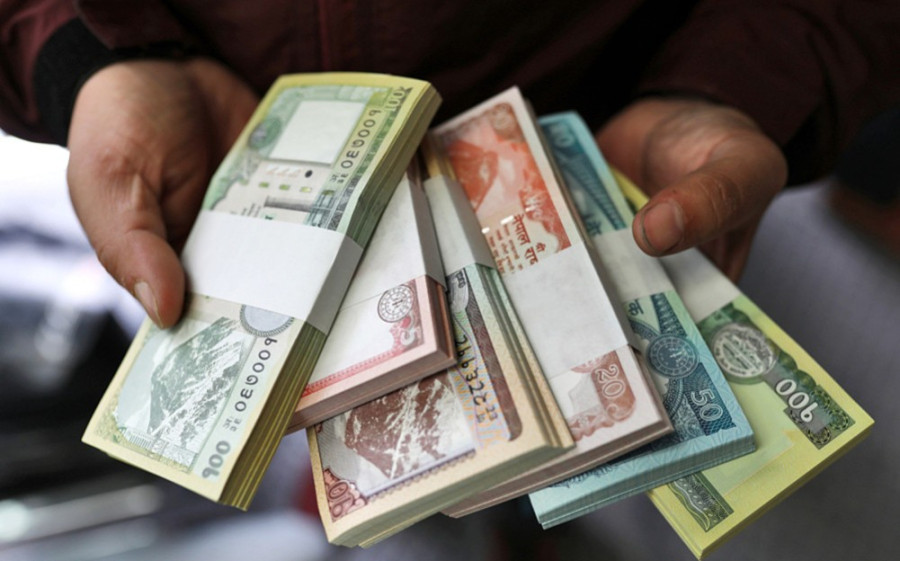
bookmark
Urja Singh Thapa
Published at : April 21, 2026
Updated at : April 21, 2026 18:55
Nepal does not truly run its own monetary policy. A small, import-dependent economy that needed stability, credibility and a simple nominal anchor, it adopted a system that effectively outsourced monetary discipline to the Reserve Bank of India. At a time of institutional fragility, the logic was clear.
In theory, a central bank steers the economy through interest rates, liquidity management and the exchange rate. But Nepal’s framework is constrained by the ‘Impossible Trinity’: It is not possible to simultaneously maintain a fixed exchange rate, allow capital mobility and retain an independent monetary policy. Nepal has effectively chosen exchange rate stability and financial openness with India, leaving little room for monetary independence. In doing so, policy is implicitly aligned with conditions set across the border.
For example, during Covid-19, the Nepal Rastra Bank sought to cut interest rates to stimulate a struggling economy, but was constrained by its fixed peg to the Indian Rupee. Cutting too aggressively would have triggered capital flight from India and caused the peg to collapse. With financial openness already chosen, the NRB had no choice but to wait and follow the Reserve Bank of India’s moves rather than respond to Nepal’s own conditions.
The timing for this debate is not accidental. As of early 2026, Nepal’s foreign exchange reserves have surged to an unprecedented $23 billion—enough to cover 18 months of imports. This abundance reopens the debate: If we have the ‘insurance’ of $23 billion, why are we still paying the ‘premium’ of lost monetary independence? However, these reserves aren’t built on the back of a manufacturing boom, but a spike in remittance inflows.
The case for rethinking the peg is not simple with real constraints.
Nepal free float
First, consider Nepal’s trade structure and what would happen under a freely floating exchange rate. In a simple counterfactual, let’s consider no peg. The Nepali rupee is fully determined by market supply and demand, with value changing freely.
Start with an import example. A Nepali importer needs Indian rupees to buy petrol from India. To get them, they sell NPR in the foreign exchange market. This increases the supply of NPR and raises demand for INR, causing the NPR to depreciate. Consequently, even if global oil prices do not change, petrol becomes more expensive in Nepal because more NPR are needed to buy the same amount of foreign currency. In this situation, the exchange rate directly absorbs external pressure and quickly passes it into domestic prices.
Now extend this to the rest of the economy. The effects are not the same for everyone. Households that depend on imported goods face higher prices for fuel, food and other essentials, which reduces their real income. Firms that use imported inputs face higher costs, which they either pass on to consumers or absorb by reducing profits and investment. Banks may also feel indirect pressure if higher costs and inflation make it harder for borrowers to repay loans.
Exporters may benefit because their goods become cheaper for foreign buyers, and they receive more NPR when they convert their earnings. But this benefit is often limited because exports are small in scale and do not respond quickly. Even remittance earners gain only partly, since higher exchange rates are usually offset by higher local prices. As a result, a floating exchange rate creates quick and broad increases in costs, while the benefits are smaller, slower and uneven.
The preconditions
A strong, independent currency requires an economy that produces what the world demands. At present, Nepal’s growth model is heavily consumption-driven. We are ‘exporting people’ through remittances rather than exporting goods and services such as hydropower, high-value agriculture or IT services. Without a broader and more competitive export base, currency flexibility has limited foundations.
Trade structure reinforces this constraint. Nearly 70 percent of Nepal’s trade is with India, meaning that de-pegging in a highly concentrated trade system would be like loosening a lifeline while still tied to it. Any move towards greater exchange rate flexibility, therefore, first requires reducing this dependence by expanding and operationalising trade links beyond India.
Institutional capacity is equally important. If Nepal is to eventually run an independent monetary policy, the NRB must move beyond managing the exchange rate to actively managing inflation. Currently, inflation sits at a stable 3.62 percent, largely because it is ‘imported’ from India’s own price stability. This would require deeper forex markets where prices are truly determined by supply and demand, rather than derived from the INR–USD rate, as well as credible inflation targeting supported by data quality, policy independence and effective interest-rate signalling.
Finally, there is the oft-overlooked constraint of the open border. As long as capital and goods can move relatively freely across the border with India, any significant divergence in exchange rates would create strong incentives for arbitrage, informal trade and currency substitution. In such a setting, exchange rate misalignment would quickly translate into reserve pressure. Any transition towards flexibility would therefore also require stronger financial monitoring systems and, at a minimum, a more digitised form of financial oversight, even if the physical border remains open.
The monetary ‘middle ground’
One option is a currency basket, in which the Nepali rupee is linked not only to the Indian rupee but also to other major currencies such as the US dollar or euro. This reduces overdependence on a single currency and cushions the economy from shocks originating in India, while still maintaining exchange rate stability for trade and pricing.
Another option is a crawling peg, where the exchange rate is adjusted gradually over time based on fundamentals such as inflation differences between Nepal and India. Instead of sudden shifts, the currency moves in small, predictable steps, allowing the real exchange rate to adjust slowly without disrupting trade or triggering instability.
Both approaches sit between rigidity and full flexibility, preserving the stability benefits of the current system while introducing enough movement to prevent long-term misalignment.
The question is not whether Nepal should reclaim monetary independence, but whether it can expand its export capacity, strengthen its financial institutions and reduce the concentrated dependency on a single neighbour. The goal, then, is not to abandon the anchor overnight, but to gradually outgrow the need for it. The uncomfortable truth is that, until the underlying structure of the economy changes, that calculus has not fundamentally shifted.
Urja Singh Thapa
Thapa has a master’s degree in Economics from Vanderbilt University, US.





Most Read from Columns



Editor's Picks





E-PAPER | October 24, 2026

×