Sometimes I wonder if it was Kautilya, who, after writing Arthashastrain the 4th century BC, unknowingly sowed the seed for the perpetual misconception that points towards economics as the essence of statecraft. The title he chose probably created this misconception because it does not do justice to what is inside the book. Agreed that the ‘economic science’ included in the book parallels modern-day microeconomics, encompassing detailed market regulations, labour laws and agriculture.
In addition to that, however, there are other important fundamentals that introduce one to the nuts and bolts of statecraft. The Saptanga theory or the seven pillars of the state, elaborately explains the elements that make up the state, such as Swami, Amatya, Janapadh, Durga, Kosha, Danda and Mitra. Likewise, the book mentions centralised bureaucracy with more than 35 specialised departments. It talks of the ethics of leadership, which is described under Rajdharma. Foreign policy and diplomacy are elaborated in the Mandala theory and Shadgunya, or the six-fold policy. Calling the ultimate treatise on statecraft Arthashastra, especially in modern times, can create misconceptions.
The rapid rise of ‘economism’ after the Second World War, especially in the erstwhile USSR and Mao’s China, is another reason why this misconception prevails. In the early 90s, the ‘It’s the economy, stupid’ slogan coined by James Carville during Bill Clinton’s election campaign that resonated with the American voters at that time, mainly due to the Bush-era recession, almost instantly became a catchphrase nationally and internationally. Despite the economic success that the Clinton administration enjoyed, the Democrats could not get reelected because of factors such as healthcare reform failure, welfare debates, the Lewinsky scandal, NAFTA and deregulation.
To fully understand statecraft, a comprehensive understanding of authority (democratic or otherwise); welfare or citizens’ well-being; security or protection from threats; diplomacy; public economy or leveraging resources for the greater good; and nationhood and identity is imperative. Any sensible text on statecraft talks mainly about three things: wise administration, economic prosperity and moral leadership. Therefore, economic prosperity is part and parcel of statecraft, not the be-all and end-all of it.
When International Financial Institutions or other neoliberal agencies lead projects on good governance, a majority of those projects underperform because the reductionism in economics impedes the economists working on those projects from fully comprehending the nuanced nature of governance. Governance cannot be explained by quantifiable models of supply, demand and incentives. What economics fails to understand is that statecraft involves intangibles such as legitimacy, identity and strategic trust which can neither be easily measured nor tabulated. There is this lack of understanding about how numbers are not enough, debt ratios and GDP growth do not capture social cohesion, a factor that is extremely crucial in the paradigm of good governance. The technocratic aspect that is interwoven into the study of economics, which assumes rational actors and stable institutions, cannot factor in the realities of politics, which is often emotional, messy, and, of course, power-driven.
Some of the blunders caused by economists such as Rogoff and Reinhart’s hypothesis that ‘high public debt slows growth’, that inspired austerity measures, worsened political instability and unemployment, especially in countries like Greece. Policies inspired by Milton Friedman’s legacy of deregulation caused the 2008 financial crisis. European Central Bank economists who pushed austerity during the Eurozone Crisis caused recessions in Southern Europe, fueling populism and weakening trust in the European Union. Even globalisation champions such as Krugman and Bhagwati, who advocated for free trade and global integration, failed to see how their recipes could lead to hollowing out of industries in developed economies, fueling populist backlash such as Brexit and Trump’s rise. They underestimated the political consequences of dislocation.
Here in Nepal, with three economists leading the Ministry of Finance, Nepal Rastra Bank and National Planning Commission, dangers of economism loom large. They must be constantly reminded that numbers aren’t enough in statecraft; markets aren’t self-correcting, and deregulation without safeguards can destabilise the entire state; and globalisation is not neutral because economic efficiency may come at the cost of sovereignty and identity.
The thought that Nepal can finally achieve a rare technocratic alignment that could drive coordinated fiscal, monetary and development policy seems to have created a new wave of hope. What no one seems to be worrying about, however, is the risks in overreliance on economic orthodoxy, political pushbacks and failure to balance economic growth with legitimacy and inclusivity.
The recent repeal of fifteen ‘outdated’ laws was carried out citing the need to modernise Nepal’s economic framework. The repeal of the Black Market Act and Revenue Leakage Control Act can be interpreted as particularly concerning because for Nepal, which has a weak systemic oversight coupled with blotched supremacy of the rule of law, the repeal risks weakening trust in governance and exposing citizens to exploitation. Although Nepal is said to have a reasonably strong legal framework for consumer protection and anti-corruption, enforcement is below par. Weak institutional capacity, pressure/interest groups’ interference, and limited public awareness are impediments to fairness. Randomly repealing laws without fixing the gaps in the system can have serious repercussions.
Likewise, cornerstones of economics, such as aggregate thinking that flattens differences across ethnic groups, uniform policy bias which misleads the policy process to produce ‘one size fits all’ policies, must be avoided. More importantly, failure to integrate cultural recognition, linguistic rights, and ethnic representation into the governance framework depletes social equity as well as efficiency and effectiveness. This, then, will directly impact the democratic health of the state.
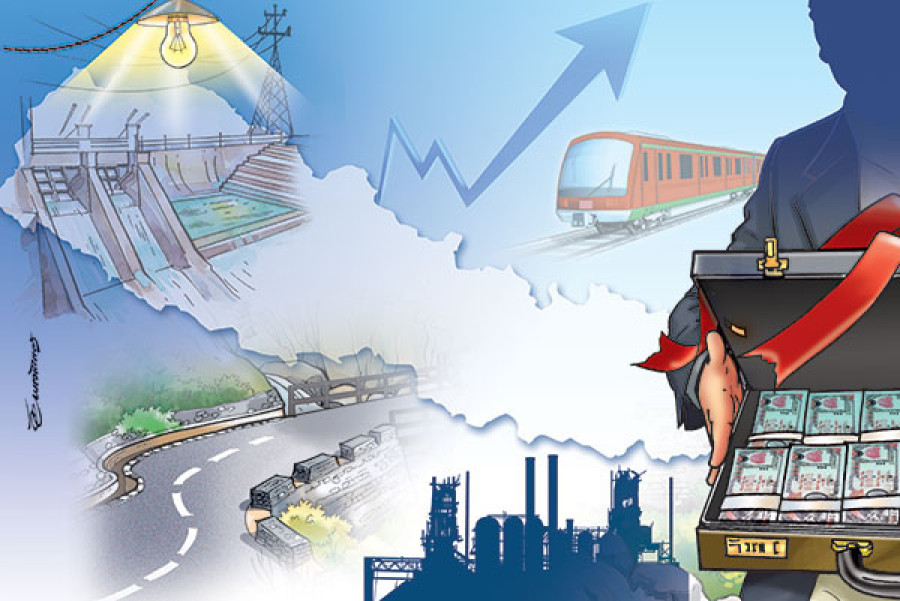
The three economists positioned strategically in the Ministry of Finance, the Central Bank and the Planning Commission must understand that statecraft in Nepal is much more complex than looking at it merely as an economic agency. Measurable economic growth at the national level does not assure political stability unless it is accompanied by narrowing the gap between the quintessential haves and have-nots.
Incentivising the private sector is fine, but if they intend to jumpstart development, they must understand the pulse of the peripheral groups and use it to draw the statecraft framework.




 21.05°C Kathmandu