Nepal continues to experience political uncertainty in the aftermath of the Gen Z uprising. Although the Election Commission has already scheduled the next House of Representatives election for March 5, major political parties remain unsettled, and the overall electoral process has not gained the expected momentum. The case concerning the dissolution of the House of Representatives is still before the Supreme Court, with petitions filed by the CPN-UML and some of the Nepali Congress lawmakers. At this critical moment, the court must interpret constitutional provisions not in isolation but in harmony with the broader democratic pulse of the nation, including civic movements, evolving public sentiment, and continuing demand for transparency and accountability. Constitutionalism, after all, is not just a legal construct; it is a lived democratic practice shaped by public legitimacy.
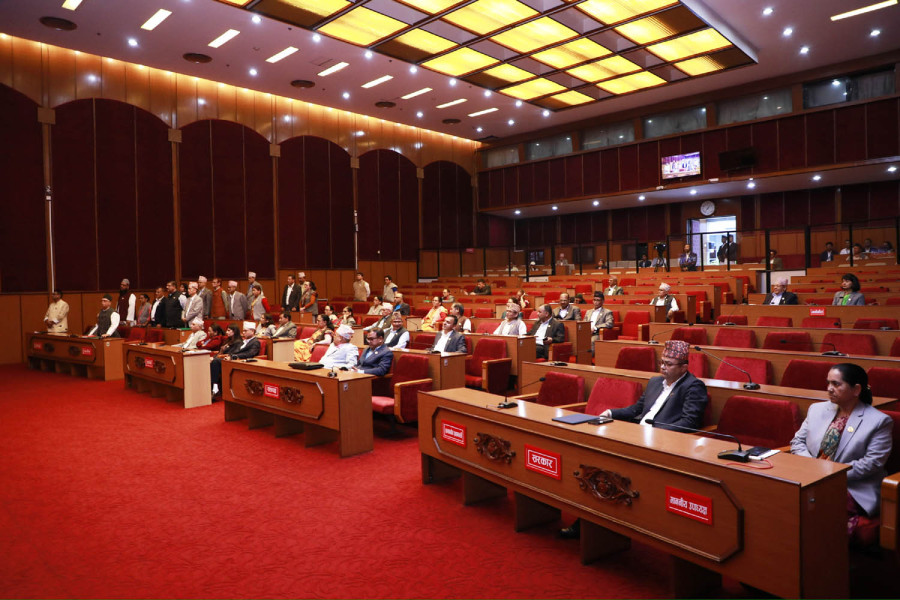
While debates on the Lower House election dominate political discourse, the National Assembly (Upper House) stands at an important juncture. The tenure of one-third of its members will expire on March 4, and the election for these positions has been scheduled for January 25. Nineteen seats will fall vacant: 18 elected through the provincial electoral college and one nominated by the president. This cycle includes significant representation from major political forces—eight from the UML, seven from the Maoist Centre and others from smaller parties—creating the possibility of notable shifts in party balance depending on electoral alliances. These developments provide an opportune moment to reflect on the National Assembly’s role, performance and the reforms it urgently requires.
Nepal’s Upper House is the product of over seven decades of constitutional experimentation. The concept of bicameralism first appeared in 1948. Nepal’s first democratic two-chamber parliament emerged 11 years on. After repeated cycles of dissolution, reinstatement and redesign across political regimes, the 2015 Constitution institutionalised a federal bicameral legislature intended to ensure continuity, stability and balanced representation across federal, provincial and local governments. With 59 members serving staggered six-year terms, the Upper House was designed as a permanent chamber capable of maintaining institutional memory, providing territorial balance and contributing thoughtful legislative review within a young and evolving federal system.
The Inter-Parliamentary Union (IPU), a global organisation representing 183 national parliaments, defines upper houses as bodies that provide legislative review, protect minority and regional interests, strengthen constitutional balance and promote deeper deliberation. Different scholars reinforce this view. For instance, Arend Lijphart, in Patterns of Democracy (2012), identifies upper houses as essential components of consensus democracy, especially in plural and federal systems.
Despite its constitutional promise, Nepal’s Upper House faces several structural and operational limitations that restrict its effectiveness. Constitutionally, the Upper House cannot originate money bills, has no role in government formation, cannot dismiss a prime minister, and lacks oversight authority over constitutional bodies such as the Commission for the Investigation of Abuse of Authority (CIAA), Public Service Commission, and Election Commission—powers vested solely in the Lower House. Procedurally, bills passed by the Upper House can remain pending indefinitely in the House of Representatives, diminishing the upper chamber’s influence in the legislative process. Representation remains another concern.
Although an upper house should ideally serve as a reservoir of expertise, Nepal’s nomination practices often prioritise political loyalty over merit. The absence of formal expertise criteria, coupled with uneven professional backgrounds, undermines the chamber’s deliberative strength. Moreover, the committee system remains weak: Committees lack technical staff, research support, fiscal analysis capacity and mechanisms for follow-up, all of which are essential for evidence-based lawmaking and parliamentary oversight. Nepal also lacks institutional channels for integrating provincial voices into national lawmaking, an important hallmark of mature federations. This absence limits the Upper House’s ability to serve as a platform for coordination across federal and sub-federal levels.
International experience offers valuable insights for addressing these challenges. Across federal and parliamentary democracies, upper houses play diverse but significant roles in legislative scrutiny, fiscal oversight, intergovernmental coordination and protection of territorial balance. The United Kingdom’s House of Lords illustrates how an unelected, expertise-driven chamber can add tremendous value through detailed legislative review and strong committee functions, despite limited veto powers. South Africa’s National Council of Provinces provides a contrasting federal model, where provincial delegations vote as unified blocs and hold decisive authority over laws affecting provincial competencies—an institutionalised form of cooperative federalism. Brazil’s Federal Senate is among the world’s strongest upper houses, combining equal state representation with extensive fiscal powers, including impeachment trials and control over public borrowing. Similarly, the US Senate, with its exclusive authority over appointments, treaties and impeachment trials, demonstrates how equal representation and staggered terms can provide stability, checks on majoritarianism and strong committee scrutiny.
Switzerland’s Council of States underscores the importance of equal territorial representation and consensus-based federalism. As a coequal chamber to the National Council, it ensures that smaller cantons maintain influence in national lawmaking. Germany’s Bundesrat represents a unique intergovernmental model where members are delegates of state governments, giving provinces a formal voice in national decisions and requiring their consent on laws. India’s Rajya Sabha reflects a moderate-strength upper house within a parliamentary system, blending indirect elections, staggered terms and nominated experts to safeguard federal balance and provide high-quality debate. Australia’s Senate, elected through proportional representation, is exceptionally powerful within the Westminster tradition and is well known for its strong committee oversight, which enables robust review of legislation, budgets and executive action.
Drawing from these experiences, a clear reform agenda emerges for Nepal. First, improving representation and expertise is essential. India and the UK demonstrate the value of including respected professionals, academics and public figures in the upper house. Nepal should adopt a more merit-based nomination system that prioritises expertise, sectoral knowledge and national contribution. Second, legislative and fiscal scrutiny must be strengthened. Australia, India and the UK show how powerful committee systems can enhance the quality of legislation and budgetary oversight. Brazil highlights how upper houses can play a vital role in monitoring intergovernmental fiscal relations. Nepal must therefore build professional research units, introduce fiscal analysis capacity and empower committees to conduct pre-legislative and post-legislative reviews.
Third, strengthening intergovernmental coordination is central to a functioning federal system. South Africa’s National Council of Provinces and Germany’s Bundesrat illustrate how structured provincial participation can improve the legitimacy and effectiveness of national law-making. Nepal could develop mechanisms requiring consultation, or even consent, on legislation affecting provincial powers. Fourth, a cooperative federal culture must be nurtured. Switzerland demonstrates how bicameralism can promote consensus-building and protect smaller units in a federation. Nepal can foster similar practices through dialogue platforms, joint federal-provincial committees and structured negotiation mechanisms. Finally, upper houses worldwide function best when supported by strong institutional foundations: autonomous secretariats, stable staffing structures, robust research capacity and adequate resources. Nepal’s Upper House must strengthen its institutional backbone if it is to perform its constitutional role effectively.
Collectively, these lessons offer a clear roadmap for reform. With improved membership quality, stronger committees, enhanced federal coordination and greater institutional capacity, the Upper House can evolve into a more robust, informed and federally responsive chamber—one that strengthens democratic accountability, stabilises Nepal’s parliamentary system, and supports the long-term consolidation of federalism.




 19.73°C Kathmandu