If a thief is honest, can he be excused for his sins?
‘Charandas Chor’ at Mandala Theatre Nepal follows a man whose strange honesty challenges ideas of right and wrong. Photos: Courtesy of Mandala Theatre Nepal
Charandas steals honestly. For him, theft is euphoric, and honesty compensates for this felony. Contradictory, right? Caught between pursuit and escape, Charandas lives an extraordinary life.
‘Charandas Chor’, running at Mandala Theatre Nepal, is written by the late Habib Tanvir (1923–2009), a playwright, theatre director, poet, and actor from India. “For what I had to say, in aesthetics, in the performing arts, as well as what I had to say socially, politically–the medium was not the cinema, it was the theatre,” Tanvir said once.
The global theatre community identifies Tanvir as a pioneering Hindi and Urdu playwright with ‘Charandas Chor’ (1975) as his signature play. With global adaptations, including feature films, ‘Charandas Chor’—based on a classical folktale by Vijaydan Detha—still carries a remarkable legacy.
The ongoing play at Mandala Theatre Nepal is the third edition of the Nepali adaptation. This version, translated by Rajan Khatiawada and Aashanta Sharma and directed by Milan Karki, is thoughtfully adapted to present the raw essence of the Tarai region while maintaining a contemporary balance.
Karki’s directional debut through the play is a sensational one. As a student of classical music and theatre, he had long envisioned blending the two. About 14 years ago, ‘Charandas Chor’ was his first theatrical experience. Thereafter, he rewatched the play in India and Sri-Lanka. He knew that ‘Charandas Chor’ would mark his directional debut.
Each character, regardless of their devotion, is grounded in greed.
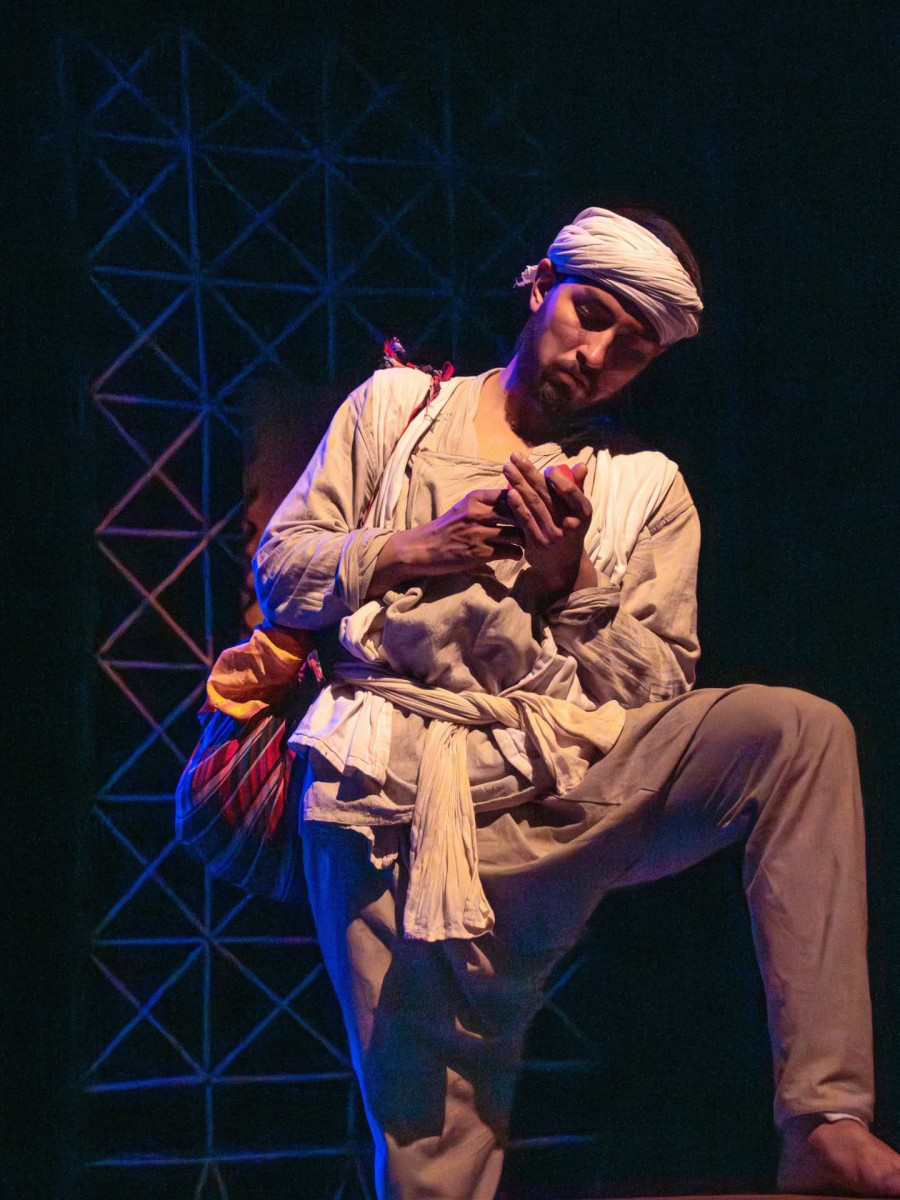
A thief with principles—Charandas, played by Biswa Bijay Bk, opens the show by stealing a gold plate. For him, theft is a drive—a transcendent experience into a blissful world. Amid the chase-and-run between him and the police, Hawaldar Junge, played by Binaya Panta, Charandas encounters ‘churi waali’ and ‘paan waala’, and inevitably, he steals something from them. However, our thief is empathetic and returns the stolen items.
“When he steals, he snatches from the rich, and when he gives, he distributes to the poor,” says Karki while describing Charandas.
Baba, played by Rijan Thing Lama, enters with a musical thunder—a pivotal character who is bound to reshape Charandas’ epiphany. In an attempt to be his chela(student), Charndas proposes four verdicts: to never eat from a gold plate, to never travel on an elephant or horse ride, to reject a royal proposal of marriage and lastly, to never be a leader of a nation.
Each character, regardless of their devotion, is grounded in greed for capital. They are explicitly introduced in the play. Viewers can instantly trace their backgrounds and the emotional assurances they carry.
Satire remains central to the story. Witnessing the dialogue exchanges of debut actors, in particular, leaves a quiet aftertaste of laughter, even after the play.
Gradually, the plot’s core conflict is explored: if a thief is honest, can he be excused for his sins?
Over time, theft had become a matter of dignity for Charandas rather than money. With enough in his pockets, he still planned to heist the Government’s Treasure.
The story is told through a number of songs and dances.
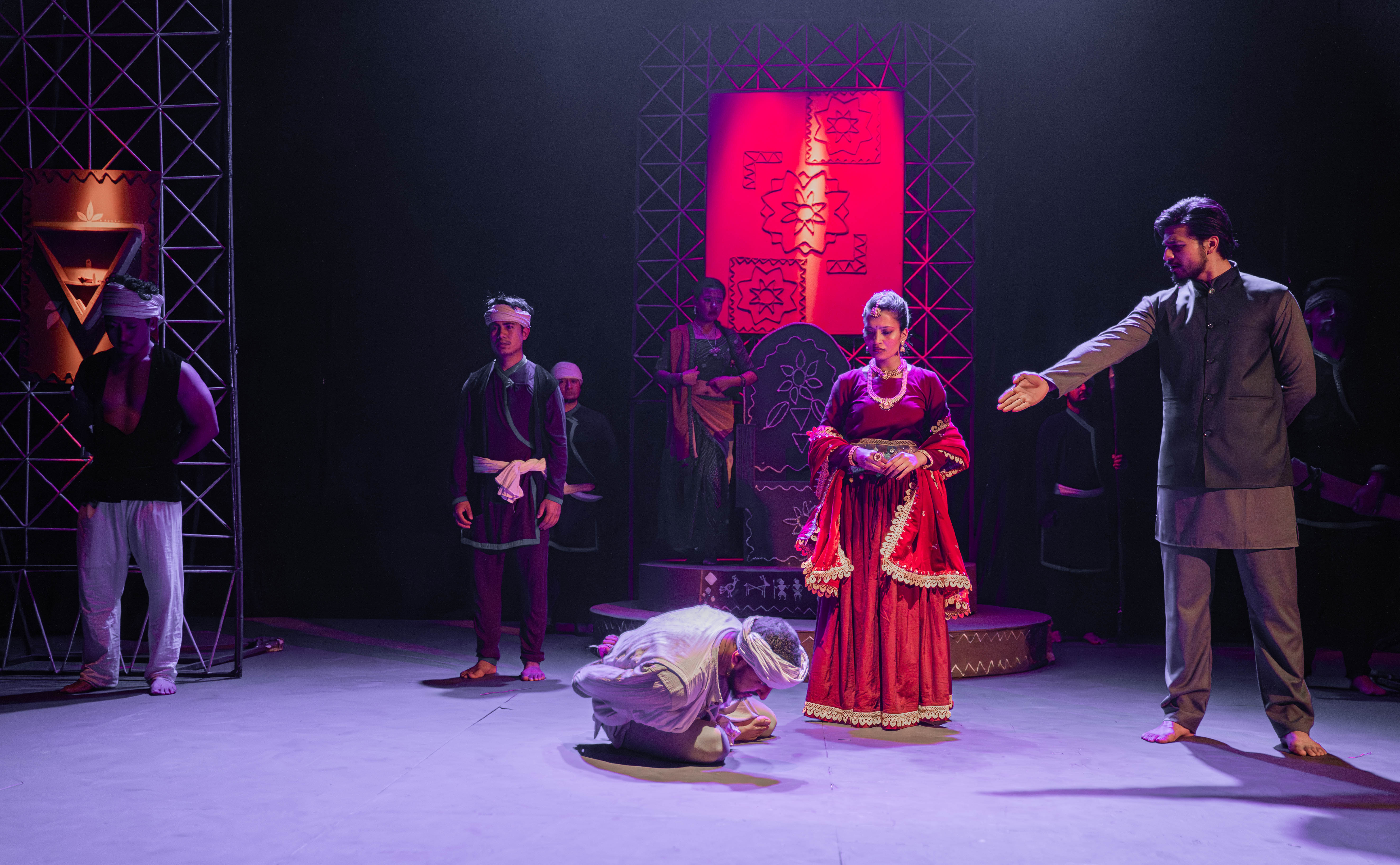
Charandas gets caught and imprisoned in the durbar. The Queen, played by Anushka Karki, stands with her towering presence—a vital feminist stance radiating in the lands of the Tharu community. Climax strikes the play when Charandas, one after another, is made to encounter each of his verdicts. A persistent relapse.
Verdicts carry a significant weight. However, whether we take it as a burden or accept it as part of ourselves is a matter of self-definition. Charandas, a simple human and a thief by profession, navigates his existence within the lines of survival, morality, and honesty.
“Nepal needs a heroic character right now. Releasing this play right after the political uprising was intentionally planned,” says Karki. “In the individualistic torrent of the society, we need people like Charandas Chor—honest, loyal and trustworthy.”
Karki was raised in the vibrant cultural halos of the Tarai region. Through music and dialects, he beautifully subsumes Tharu traditions in the play. “The play has already been adapted several times. I didn’t wish to simply add to the number. I wanted to sprinkle the pleasant smell of Tarai’s sand on the play (maatoko sugandha). That is where my identity is, and that is how I could make the play true to myself.”
Lights, arranged by Umesh Tamang, carefully shape the intensity, focus and emotional resonance of the characters, enhancing the narrative’s rhythm.
Rooted in the vibrant ambience of the tharu traditions, the story is told through a number of songs and dances—a musical, as Tanvir had initially envisioned. The characters are made to push beyond their comfort zones.
The costumes, arranged by Anita Mahat Stri, Chaadani Shrestha, and Nirmala Sahi, deepened the play’s cultural essence. Live background music by Nawaraj Sapkota (vocal), Saurab Chalise (tabla), and Ojash Lama (guitar) complemented the story.
Remarkably staged after just 15 days of pre-production, the play succeeds in immersing its audiences, not only in laughter, but also in a lingering question about morality, power and truth.
___________________
Charandas Chor
Where: Mandala Theatre Nepal, Thapagaun, New Baneshwar




 16.76°C Kathmandu