Two bodies found at Broad Peak avalanche site, names yet to be identified, Seven Summit Treks says; Nimsdai among still missing
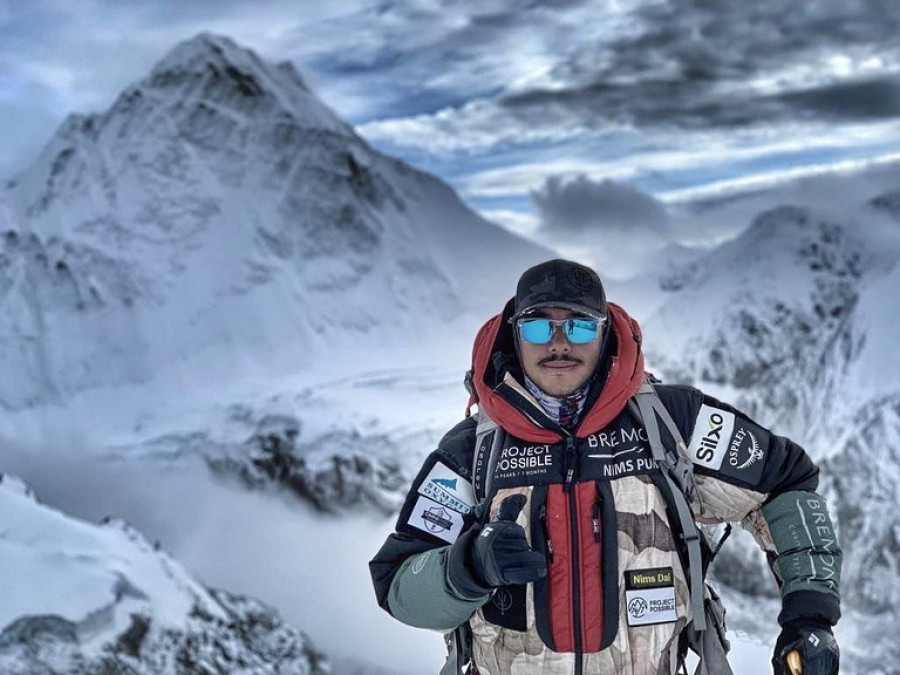
A helicopter is set to fly off from the Pakistani city of Skardu and search operations are expected to start soon, the BBC has learned. Seven Summit official says hope of finding survivors alive is gradually fading. Photo: Courtesy Nirmal Purja via Facebook
Nirmal Purja, Nepal-born mountaineer and former Royal Marine widely known as "Nims Dai," is among ten climbers feared missing after an avalanche hit the 8,047-metre Broad Peak in Pakistan on Thursday. Pakistani mountaineering authorities said there has been no communication with the expedition since the incident.
Two bodies have been found at the site, according to Thaneshwar Guragain, general manager of Seven Summit Treks, though their identities have not yet been established. "Work is under way now to identify who they are," Guragain told Kantipur on Friday.
Guragain said the roughly ten climbers still unaccounted for come from several expedition teams: three from Seven Summit Treks, three from the team associated with Purja, two from Imagine Nepal, and one each from Pakistan and the United States.
He said bad weather had grounded helicopters, forcing rescuers to mount an initial ground search instead. Some climbers swept down by the avalanche were brought back to base camp overland, and it was during that operation that the two bodies were found.
Search operations are expected to start soon, the BBC has learned. A helicopter is set to fly off from the city of Skardu, according to Karrar Haidri, senior vice-president of the Alpine Club of Pakistan.
A tracking device carried by Purja has continued to show movement, according to his business partner.
Speaking to Kantipur on Friday morning, Mingma Gyabu Sherpa, also a member of Nepal's House of Representatives, said data from Purja's tracking device indicated his location had changed after the avalanche.
"Initially, it appeared that he had been swept downhill by the avalanche," he said. "But after the point where the tracking had stopped, the location appears to have shifted again."
He cautioned that the tracking data alone could not confirm Purja's condition but said it provided some indication of activity.
Mingma said they only received detailed information about the incident on Thursday evening, although the avalanche had occurred earlier in the day.
According to the BBC, the climbing team includes an American, a Chinese national, an Omani and five Nepali climbers, in addition to Purja.
Guragain said rescue operations in Pakistan move far more slowly than in Nepal, since they are run mainly by the military rather than through the kind of immediate private helicopter response Nepal allows. Helicopters are limited and subject to lengthy clearance procedures, he said, meaning an effective rescue cannot proceed until weather conditions cooperate.
Asked about the chances of finding the missing climbers alive, Guragain said hope was narrowing sharply.
Mingma said one Pakistani and one Nepali climber had set out overland towards the suspected avalanche site to verify reports that one climber's location appeared to be near the base of the mountain.
"We have received information that one person's location appears to be near the foot of the mountain. A search team has gone there to verify it," he said.
In a separate statement, the Alpine Club of Pakistan said it had remained in constant contact with authorities to ensure all available resources were mobilised as quickly as possible. The club also expressed hope for the climbers' safe rescue and solidarity with their families and the international mountaineering community.
Guragain noted that Nepali Sherpas have been climbing Pakistan's mountains for more than four decades, and described the avalanche as among the starkest reminders of the risks inherent to high-altitude mountaineering. He called it a natural disaster.
Broad Peak, the world's 12th-highest mountain, is widely regarded as one of the most technically demanding peaks for mountaineering expeditions.
Purja rose to international prominence in 2019 after climbing all 14 mountains above 8,000 metres in just over six months, setting a world record. Before becoming a full-time mountaineer, he served in the British Army and later joined the Royal Marines. His climbing career began after a trek to Everest Base Camp in 2012, when he decided to continue to the summit of Everest instead of returning as originally planned, according to the BBC.
The story has been updated with new reporting from Kathmandu.
Suraj Kunwar is a reporter with over two decades experience covering Aviation, Tourism and Mountaineering. He received the IFJ Tolerance Award in 2005.




 20.12°C Kathmandu