In Kathmandu’s squatter eviction drive, animals are collateral damage
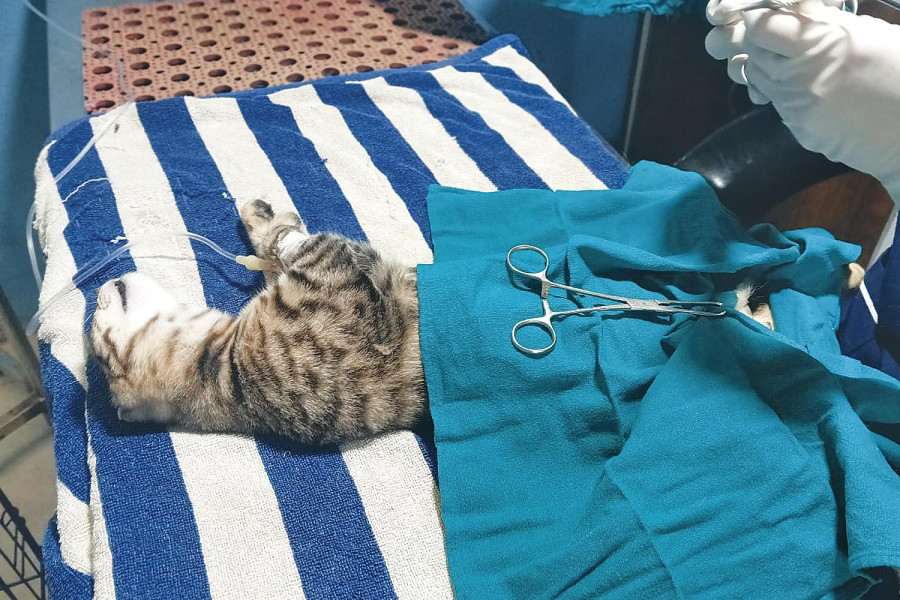
As the Valley's riverbank settlement demolition displaced hundreds of families, the animals fell through every crack in the government's plan.Animal Nepal’s medical response team treated a cat after rescuing it from the rubble. Photo: Courtesy of Prem Roka
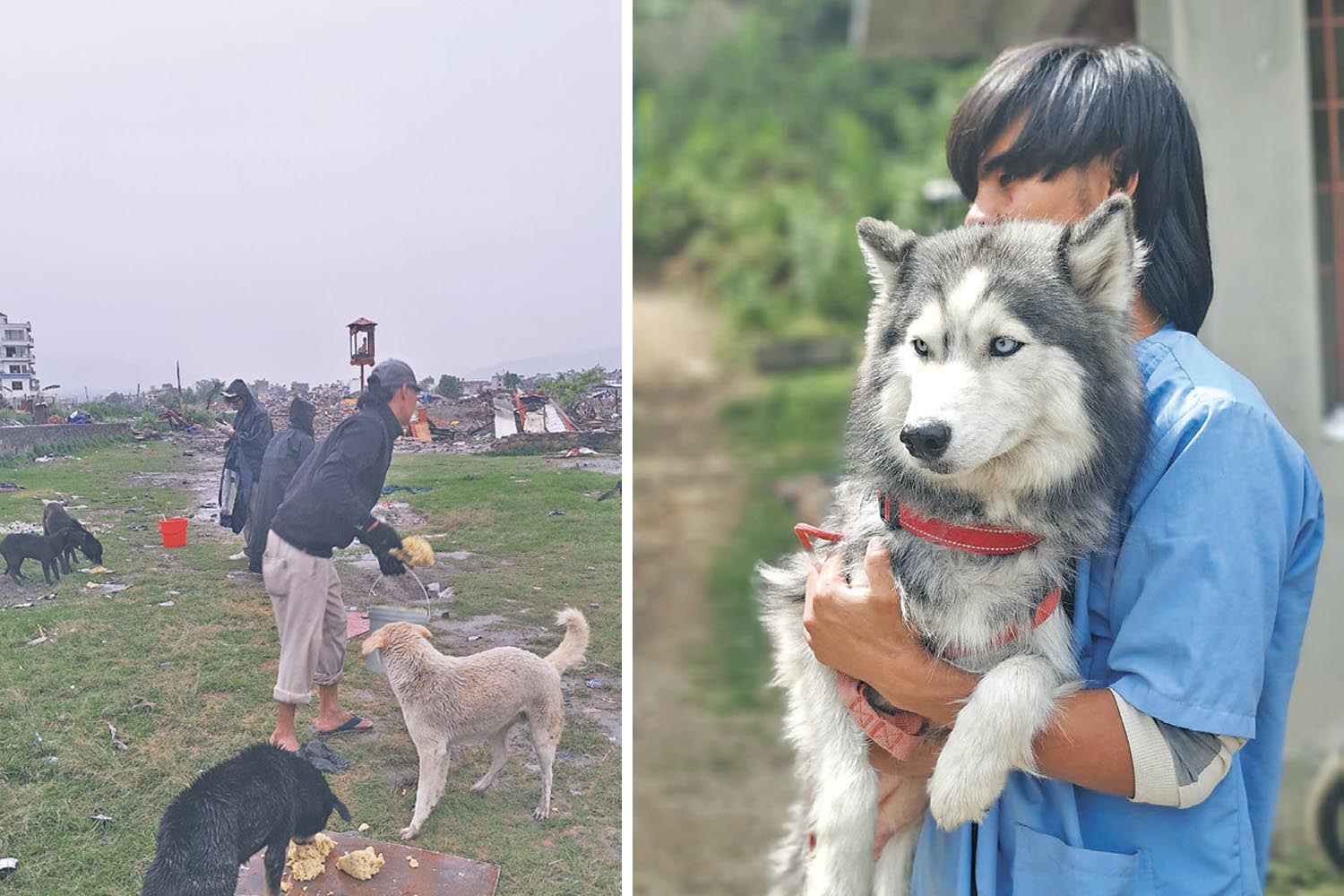
The rain had been falling on and off all afternoon over the Balkhu riverbank. What remained of the settlement—broken walls, scattered debris, patches of open ground where homes had stood days earlier—was slick and grey. Ganesh Shrestha and Rajiv Rai stepped out of Sneha's Care van and began clapping.
‘‘Fuchey, Khairey, Govinde, Seti—aaijo,’’ they called out. Come on, little ones.
From behind rubble, from under sheets of corrugated iron, from the far edge of the embankment, dogs began to appear. Some came running, jumping, visibly recognising the two men who had been showing up every day since the first bulldozers moved in. Others held back. A few stood at a distance and barked—wary of the van, which they associated with an earlier visit when the team had come to vaccinate them with injections on behalf of the Kathmandu Metropolitan City. The memory had not left them.
Ganesh, who has worked with Sneha's Care for eight years, knew which animals would come and which would not. He even knew the names given by the settlement residents who had fed and lived alongside them for years and were now gone. For the dogs that held back, trembling or watching from a distance, the two volunteers set food down separately and stepped away. ‘‘They would eat once they felt safe. Once they were sure that we'd leave,’’ he said.
Since April 15, Nepal's government has been carrying out a large-scale eviction drive across the riverbank settlements of Thapathali, Balkhu, Balaju, Manohara, Gairigaun and Shankhamul—demolishing what it calls ‘‘unmanaged settlements’’ along the Kathmandu valley's waterways. Hundreds of families have been displaced. For the people who lived there, the government made some arrangements: food, temporary hotels, the promise of relocation. The animals did not feature in the plan at all.
Two organisations — Sneha's Care and Animal Nepal — have been scrambling to fill that gap, feeding hundreds of animals daily at demolition sites, rescuing the injured and abandoned, and taking in those whose owners had no choice but to leave them behind. Both are operating without government funding, at the edge of their capacity, with no clarity on how long they can sustain the work.
Between the two organisations, dozens have been rescued and brought to shelters, but more than 350 animals remain abandoned across the demolition sites, animals these organisations can feed but cannot take in. When asked about the displaced animals, Nabin Manandhar, spokesperson for the Kathmandu Metropolitan City, was direct: there are none. For them, there is no plan, and no one in the government is making one.
Lal Bikram Prasai is one of the people they could not turn away.
Prasai did not plan to have a dog. Rocky had belonged to a neighbour who left for the United Kingdom and abandoned the animal rather than find him a home. Prasai, who had been living in the Devinagar settlement in KMC Ward 10 Baneshwar, decided he could not let such a dog end up on the street. That was roughly ten or eleven years ago. Rocky is now seventeen years old, completely blind, and has an unhealed sore on his ear that persisted even after a surgery.
On the evening of April 16, Prasai received a notice from the Kathmandu municipal office. His home would be demolished the following day. He had 24 hours. ‘‘Where were we supposed to go in 24 hours?’’ he questioned.
He and his wife—she is ill; he has a balance condition that makes walking difficult—stashed their belongings with friends and moved into a single room at his in-laws' home, where there is barely space for the two of them. They have a small grocery shop in Baneshwar and need to stay close to it. His wife cannot walk long distances. They are still looking for a room.
When Prasai brought Rocky to Animal Nepal's treatment centre, he carried the dog in his arms. Rocky was disoriented and trembling. Prasai was in tears.
‘‘It breaks my heart because I love him dearly, but I reached a point where I simply couldn't do anything more for him,’’ he said.
He has checked in on Rocky since. Taking him back is not something he can think about yet. Landlords in Kathmandu will not rent to people with dogs, that much he has already learned. An old, blind dog who bumps into walls makes it harder still.
(Left) Rajiv Rai of Sneha’s Care feeds dogs at Manohara. A caretaker from Animal Nepal is pictured with a rescued dog. Arya Chand/TKP (left) and Courtesy of Prem Roka
Prasai's situation is not unusual. Across the Valley, families displaced by the evictions have faced the same impossible choice: find a room, or keep the animal.
Neither Sneha's Care nor Animal Nepal was formally notified before the demolitions began. For the first demolition in Thapathali, both organisations heard from locals, not from any government office. A circular from the Prime Minister's Office and the Department of Livestock Services arrived only one day before the Balkhu demolition.
‘‘But a circular is not a plan,’’ said Radha Gurung, programme head at Animal Nepal.
Both organisations have been at the sites every day since, together covering eight locations across the Valley. Sneha’s Care has been feeding roughly 250 to 300 dogs every day. Animal Nepal, in addition to feeding operations supported by a network of local community feeders, has been conducting systematic rescues. The scale of what they have found is still being counted: 29 dogs, 11 cats, 2 hens, 16 chicks and 1 rabbit rescued by Animal Nepal alone, the heaviest concentration in Thapathali. Sneha’s Care has separately rescued nineteen dogs and two cats. The numbers continue to rise.
The animals are not only strays. They are pets who are named, known, loved and handed over by families who were displaced and could find no accommodation that would take them. There is also Pugu, a Japanese Spitz; Luna, a Labrador who had just given birth; and Maya, a Husky. People arrived on scooters, on foot, carrying animals in drums. One owner, who could not keep his dog, Google, but could not bear to leave without doing something either, donated Rs5,000 for the animal’s care before he walked away.
‘‘People were coming to us and begging us to take them. There were also pigs and cows. It wasn't only dogs,’’ said Sneha Shrestha, founder of Sneha's Care.
The injuries have been serious. One puppy required complex orthopaedic surgery for a fractured leg. A dog from Thapathali came in with a fractured jaw. ‘‘It's hard to say these were caused directly by bulldozers because we weren't allowed inside during the demolition, but the injuries are consistent with being hit by rubble,’’ said Gurung. Rescue decisions are made on the ground by veterinarians who triage each animal on arrival—those with minor injuries who can survive on-site receive first aid and are left; those with severe injuries or no means of survival are brought in. Some animals did not make it at all.
The Animal Nepal team has also been working to manage the bodies of those who did not survive.
Both organisations entered this crisis already stretched. Sneha's Care technical team spent the first two days simultaneously conducting field rescues and running the existing shelter, which caused delays in medication for animals already in care. They also called out for volunteers the following Friday and Saturday. The feeding operation runs on individual donations.
Animal Nepal entered with 120 dogs already in its Chobhar treatment centre and 29 more since the evictions began. All newly arrived animals are placed in isolation first; after 14 days of quarantine, those that are comfortable and confirmed free of illness can be transferred to the sanctuary in Dukuchhap. Cats, poultry and the rabbit are being cared for in the organisation’s offices and foster homes. Displaced communities sheltering at the Kirtipur facility on the Tribhuvan University campus have brought their animals as well; because the Chobhar centre is nearby, Animal Nepal has been providing spay, neuter, and other veterinary services there as well.
For most, the realistic prospect is that they will not return to their owners. ‘‘Only one owner so far has said they will try to take their dog back,’’ said Gurung. ‘‘The rest are struggling so much with rent that it's unlikely.’’
Both organisations have formally written to the Department of Livestock Services, the Ministry of Agriculture, and the Kathmandu Metropolitan City (KMC), requesting a government plan for displaced animals. ‘‘The Nepal Government has provided no support,’’ said Sneha. ‘‘Their only 'support' is that they haven't blocked us from entering the sites.’’
The question that neither organisation can answer is simple: if not the government, then who? Who takes the responsibility for the more than 350 animals still living in the rubble once these volunteers can no longer sustain the work?
What is striking, according to Gyanu Gautam, an animal rights activist and associate professor at the Kathmandu School of Law, is not just what the government failed to do, but that existing law already required it to do more.
Nepal does not yet have a comprehensive Animal Welfare Act. But the Civil Criminal Code contains a chapter dealing specifically with offences relating to animals and birds. Section 290 prohibits cruel behaviour toward animals. Gautam argued that the evictions, by destroying the shelter and food sources of animals and displacing the people who cared for them, constitute a form of indirect cruelty under that provision.
‘‘Even if the offence wasn't committed directly, the government created a situation where the animals' food, shelter and lives are threatened,’’ he said. ‘‘That can be categorised as a crime against animals. If any animals died during the bulldozer action, the law against killing animals in public places would also apply.’’
He drew on a broader constitutional argument as well. Nepal's Constitution defines the country as a welfare state—a mandate he said the government interpreted far too narrowly. ‘‘A welfare state implies the welfare of all beings within that state—not just people, but also the living and non-living environment, including rivers, forests, birds and animals,’’ he said.
He added, ‘‘The government only thought about managing the people in the slums. They failed to consider the management of the land, the animals, the other living beings. It is a constitutional mandate to ensure welfare, and we must argue that the government failed to act in that spirit.’’
The structural fix, he said, operates at two levels. Nepal's 753 municipalities already have the constitutional authority to enact animal welfare laws, but almost none have done so. At the federal level, he called for a comprehensive Animal Welfare Act and for local governments to appoint Animal Protection Officers — people who would be legally responsible for keeping records and monitoring the welfare of animals in their jurisdictions.
‘‘If we had these structures,’’ he said, ‘‘the local governments in Kathmandu, Bhaktapur and Lalitpur would have been legally responsible for providing immediate shelter and food to animals displaced by these evictions. Currently, they don't feel responsible because there is no law holding them accountable.’’
When the rain grew heavier at Balkhu, the feeding stopped—food swells in heavy rain and becomes inedible—and the team waited in the drizzle, watching the animals that had come close drift back toward the rubble. Ganesh and Rajiv have been doing this for 16 to 18 hours a day since the evictions began, calling out names no one else remembers any more.
‘‘The animals with their owners are managing,’’ Rajiv said, watching a dog disappear behind a broken wall. ‘‘The others have no idea where their people have gone.’’
Aarya Chand is a reporter at The Kathmandu Post covering social issues. Before moving to the social beat, Chand was an intern covering culture and lifestyle for the Post.




 14.5°C Kathmandu