



 21.66°C Kathmandu
Mon, Oct 19, 2026
Valley
Displaced children return to school without basics
For many children, returning to class has brought relief, but also the challenge of starting over in unfamiliar surroundings.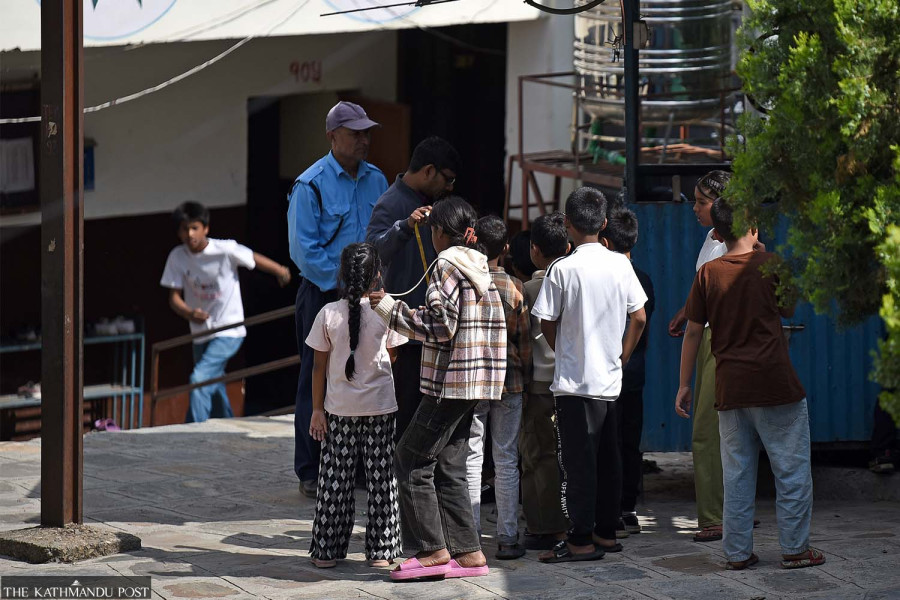
bookmark
Samarpan Shree
Published at : May 7, 2026
Updated at : May 7, 2026 18:24
Kathmandu
The classroom fell quiet when Anil Kumar Jha, principal of Jana Bikash Secondary School in Balkhu, posed a simple question to a group of newly arrived students on Wednesday afternoon.
“What do you need? Tell us, and we will try to arrange it,” he asked.
The answer came back quickly, almost in chorus.
“We don’t have uniforms, books, notebooks and pens.”
Among the voices was 12-year-old Bishwanath Gurung, one of many children displaced after the government used bulldozers to clear informal settlements in Kathmandu and Bhaktapur in recent weeks, leaving hundreds of families without homes.
The evicted families were shifted to temporary holding centres set up by the authorities. Bishwanath’s family was among those moved from the Gairigaun settlement to a centre in Kirtipur. Just days earlier, he was unsure whether he would be able to continue school at all.
“I don’t even know where we are going to live,” he had said earlier, worried about his studies at the Guhyeshwari Secondary School, where he had completed Grade 4.
On Tuesday, he and several other children finally returned to school.
For many, however, the return has been difficult. Bishnu Laxmi Gurung, a Grade 7 student, said she felt out of place without a uniform or proper school materials.
“Other students have uniforms. Coming to school would feel better if I had uniforms,” she said.
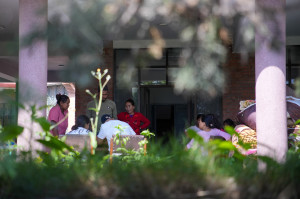
Altogether, 52 children from a holding centre at the Radha Soami Satsang Beas Ashram have started attending Jana Bikash Secondary School from Tuesday.
Namaraj Dhakal, education officer at the Kathmandu Metropolitan City, said the education department coordinated the school placement after consulting families and assessing the children’s needs. The holding centre currently houses 203 people from 66 displaced families, including children, elderly people, pregnant women and new mothers. Among them, 52 are of school-going age.
Lawita Pariyar, a Grade 6 student, said she was happy to be back in class but had arrived without basic school items.
“I used to go with a uniform and an ID card. Now I have nothing,” she said.
Lawita, Bishnu Laxmi and others were displaced from the same riverside settlement and are now trying to adjust to an unfamiliar school environment, where they have not yet built connections with classmates.
Sijan Nepali, 12, who had been studying at Guhyeshwari Secondary School before his home was torn down, said he had been uncertain about his education for weeks.
“Now I can study again, but they say this is not a permanent arrangement,” he said.
Parents, meanwhile, said the return to school has brought relief after weeks of anxiety.
Hira Hari Dusad, 58, said he had been worried his five-year-old granddaughter would miss early schooling altogether.
“Now at least she has started school,” he said.
At Jana Bikash Secondary School, Principal Jha said 58 displaced students had been listed for admission, with 41 attending classes on the first day. The students range from early childhood development to Grade 9, with the largest group in Grade 6.
“They were happy just to be in school,” Jha said. “We are now helping them adjust slowly.”
The school initially gathered the children in one classroom for orientation, asking about their previous grades before placing them in appropriate classes. Teachers were instructed to ensure the new students were not treated differently.
However, the arrangement is temporary and will last only for their one to two months of stay at the holding centres.
Jha said the school had asked the city authorities to provide uniforms and learning materials or coordinate support from social organisations.
The school itself has also been affected by the demolitions. Jha said Jana Bikash Secondary used to enrol 80 to 100 students from the Balkhu informal settlement alone, many of whom have now been forced to leave the area.
“Families cannot afford high rents elsewhere,” he said, adding that even long-time residents are struggling to find accommodation in the city.
For now, children sit in classrooms without books and uniforms, trying to resume education in the middle of displacement, uncertainty and transition.
Samarpan Shree
Samarpan Shree is an Arts and Culture Correspondent for Kantipur Media Group, covering film, theatre, music, and contemporary social issues.


Most Read from Valley
Editor's Picks





E-PAPER | October 19, 2026

×