Police in Kathmandu have compiled detailed criminal profiles of 1,097 individuals repeatedly linked to a range of offences, documenting not only their identities but also modus operandi, in what officials describe as a shift toward more proactive policing.
Senior Superintendent of Police Ramesh Thapa, chief of Kathmandu police, said the list includes individuals involved in serious offences, criminal gangs, racketeering and habitual theft. Of the total, 179 are identified as being involved in gang-related intimidation and extortion. “Details such as names and background information of some individuals are still being added,” Thapa said.
The database, prepared by the Kathmandu District Police Range, draws on records collected from police circles and units across the Capital. Officials say it is intended not only to monitor repeat offenders but also to support investigations by identifying patterns in how crimes are committed.
Police say that in the past, organised criminal groups often operated with the backing of political parties. Under the pretext of settling disputes related to contracts and financial dealings, such groups would intimidate the public and issue threats. Their influence began to weaken in the 2010s after the police launched sustained crackdowns, alongside reforms such as the digitisation of public procurement and the expansion of investigations into banking offences.
Some individuals associated with those earlier networks have since shifted into mainstream politics. A police official said that several such figures have also been included in the current list, reflecting what he described as a continuity of concern despite changes in public roles.
Among them is Chakre Milan, who contested the March 5 House of Representatives election from Gorkha-2 as a CPN-UML candidate but was defeated. Police had also arrested him on July 31, 2025, accusing him of spreading fear through videos posted on TikTok. He was later released on bail.
According to police officials, the overt displays of force that once defined organised intimidation — including openly carrying weapons — have become less common. But they say some individuals have adopted more subtle ways of exerting pressure and spreading fear. Identifying those evolving methods has been a central focus of the profiling effort.
“We have not limited the list to those involved in organised intimidation,” said Superintendent of Police Pawan Kumar Bhattarai. “We have included individuals engaged in other types of crime as well. The expectation is that if an incident occurs in the future, this database will assist in the investigation.”
Bhattarai said the profiles classify offenders based on their methods, allowing investigators to draw links between crimes and known patterns. “In certain cases, analysing how a crime was committed can point toward likely suspects,” he said. “It also helps build institutional memory.”
According to police, the database contains separate lists of individuals involved in drug trafficking, theft, robbery, gambling, fraud, arms smuggling and acting as intermediaries in public services, as well as those accused of causing disturbance to public peace.
“There are distinct records of those who steal motorcycles, scooters and other property, along with details of how they carry out such thefts,” Thapa said. “If a vehicle or other item is stolen, examining the method used could provide indications about who may be involved.”
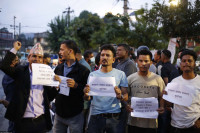
The scope of the database extends beyond conventional crime. Police have also compiled records of individuals who regularly participate in protests against government policies. This includes those detained during election-related demonstrations as well as groups that mobilise around issues linked to foreign relations.
“For example, one group consistently stages protests during high-level visits from China, while another group protests during visits from India or the United States,” a police official said. “Maintaining such records helps in planning and ensuring security.”
Kathmandu police have periodically compiled similar lists since 2013. In 2017, police identified 132 individuals as active in organised crime in the capital and categorised them into three tiers based on perceived threat levels. Fourteen were placed in category ‘A’, 32 in ‘B’ and 47 in ‘C’, while the classification of 15 others remained unclear.
Those listed in the top category at the time included figures such as Dawa Lama, Ganesh Lama, Raju Gorkhali and Deepak Manange. Some of them, including the Lama brothers and Manange, have since become active in politics.
Police officials say formal complaints related to organised intimidation remain rare, even as informal accounts of harassment are widespread. In some cases, they say, such intimidation is used to protect illegal activities, but repeated offenders often avoid legal consequences because complaints are not formally lodged.
“Names come up repeatedly in informal discussions, but without complaints, it is difficult to bring cases forward,” Bhattarai said. “So we have documented those recurring patterns as well. This is intended to support long-term crime prevention and investigation.”
Senior Superintendent of Police Uttam Subedi, who previously led Kathmandu police, said such lists have been used before and can create a degree of psychological pressure on those included. But he cautioned that profiling alone is unlikely to be effective without stronger enforcement.
“In my view, it would be more effective to directly monitor such individuals and prosecute them based on evidence,” he said. “Those involved in organised crime have adapted over time, and older approaches may not be sufficient.”
He added that individuals once associated with visible displays of intimidation — such as carrying weapons or cultivating a fearsome appearance — now often present themselves differently, suggesting the need for updated strategies.
Some serving officers also argue that if the purpose of the profiling is to control crime, the information should remain confidential. “Such measures have been used in the past to create pressure,” one officer said. “But if the goal is genuine control, the police must take decisive action grounded in strong legal cases, so that suspects are not immediately released.”
Former Deputy Inspector General of Police Hemanta Malla Thakuri expressed a similar view, warning that publicising such lists can have unintended consequences.
“It may serve as a deterrent in some cases,” he said. “But if the aim is to pursue legal action, it is more effective to proceed directly rather than create publicity. Otherwise, making names public can end up raising the profile of minor offenders.”




 21.12°C Kathmandu