East-West Highway sections still run on private land due to ownership issues
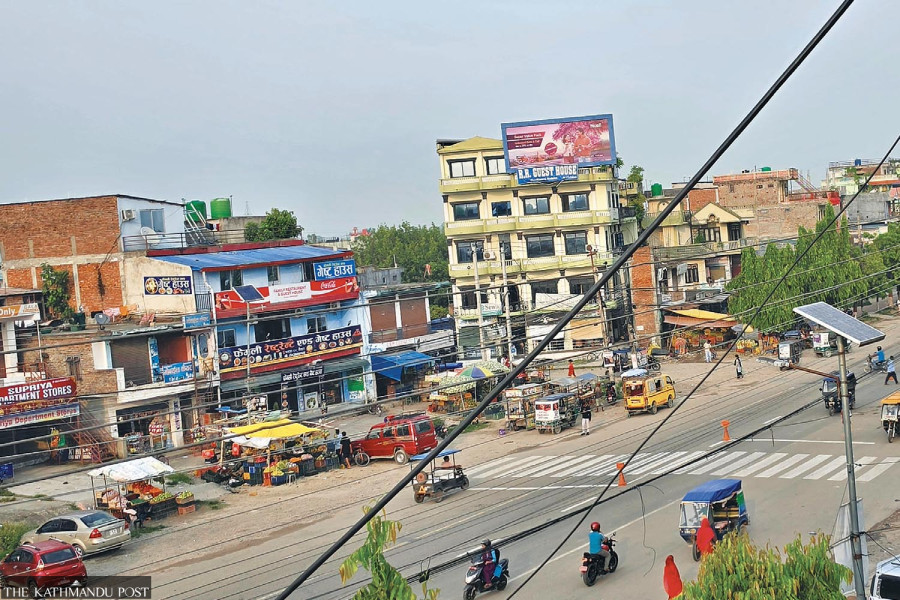
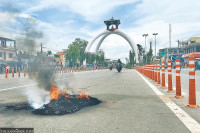
Bureaucratic delays leave parts of Nepal’s East-West lifeline still registered in private names, complicating plans for a four-lane upgrade. The East-West Highway at Chandranigahpur, Rautahat, where the land title deeds still remain under private ownership. Shiva Puri/TKP
Decades after the construction of the East-West Highway, widely seen as the country’s main economic and transport corridor, large stretches of the road remain legally registered in the names of private individuals.
Despite carrying hundreds of vehicles and thousands of passengers daily, sections of the highway, also called Mahendra Highway, passing through Dhanusha, Mahottari, Sarlahi, Rautahat and Bara in Madhesh Province have not been formally transferred to government ownership.
Officials say this mismatch between physical infrastructure and legal records reflects long-standing administrative lapses. Stakeholder agencies, including the Road Division, have written to the Department of Survey, urging that the Dhanusha–Bara stretch be prioritised for immediate correction and land acquisition.
They warn that without resolving ownership issues, the government risks legal disputes, compensation claims and disruption to upcoming expansion work.
Coordination failure behind unresolved records
Authorities originally acquired land when the highway was built decades ago, but failed to properly update land registry records or remove acquired plots from the Survey and Land Revenue systems.
A key gap, officials say, is the lack of precise coordination between the Road Division, Survey Offices and landowners. In many cases, the Road Division did not submit clear records identifying exact plots within the highway boundary.
Kranti Kumar Gupta, chief of the Chandranigahpur Survey Office, said the delay stems largely from incomplete communication from road authorities.
“We cannot delist land from an individual’s name until we receive an official letter from the Road Division. And they simply do not send the letters. This is fundamentally the road authority’s job,” Gupta said. “Even today, 30 to 40 percent of national highway land remains registered in the name of private owners. If this is not transferred to the Government of Nepal immediately, it will cause major complications.”
Survey officials said registry updates do not require landowners to be physically present and can be completed once formal requests are received from the Road Division.
However, as long as records remain unchanged, officials warn that individuals retain legal rights over land that is physically part of the highway, creating risks of sale to third parties, compensation disputes and fraudulent transactions.
The unresolved ownership issue has raised concerns over Nepal’s ongoing plan to upgrade the East-West Highway into a four-lane Asian-standard Highway corridor.
Work has already started on the Bardibas to Sarlahi–Rautahat section. Tenders have been awarded for the Bagmati–Pathlaiya stretch, while construction is underway along the Kamala–Dhalkebar corridor.
Roshan Das, chief of the Kamala–Dhalkebar–Pathlaiya Road Project in Bardibas, said attempts to improve land mapping have been restricted by procedural hurdles.
“The department did not permit the use of drones. In many places, the road technically does not exist on paper,” Das said. “We have written to the respective survey offices to delist the land, but there has been no progress so far.”
He said local residents from Sarlahi recently warned project officials of possible obstruction unless clarity is provided on land that is still recorded under private ownership and for which taxes continue to be levied.
Fraud, collateral use and encroachment risks
Survey officials say the continuation of private titles over highway land has created multiple legal and financial risks.
In some cases, individuals have used highway land as collateral to obtain bank loans. In others, buyers have reportedly been misled into purchasing land that falls within the highway right-of-way.
Officials also say unclear ownership has encouraged encroachment, with permanent and temporary structures being built along roadside areas. This has often resulted in lengthy legal disputes when authorities attempt removal.
Former Member of Parliament Dev Prasad Timalsina said the situation reflects serious administrative negligence.
“It is shocking that a national highway, having been in use for decades, is still not fully reflected in official land records,” Timalsina said. “If legal disputes arise during expansion work, a multi-billion-rupee project could be stalled. The government must coordinate with landowners and complete delisting immediately.”
Data gaps and institutional bottlenecks
Officials from both the Road Division and Survey Offices acknowledge the problem but say resolving it will require coordinated field verification and a joint task force.
The dispute is particularly severe in market areas such as Bardibas, where land values and transactions are higher.
Mahesh Kumar Singh, chief of the Bardibas Survey Office, said the delisting process is likely to trigger disputes.
“We have received a letter from the road project, but the Survey Office cannot solve this alone,” Singh said.
Neither the Survey Office nor the Road Division has complete data on how much highway land between Bardibas and Bara remains registered in private names. In Sarlahi, officials estimate that around 30 percent of highway land is yet to be corrected in official records.
Legal loopholes and long-standing practice
Under existing rules, land along highways must be subdivided and adjusted in official records after receiving formal instructions from road authorities specifying exact boundaries.
However, officials say this process has not been consistently followed for years.
In many cases, when land adjacent to the highway is sold, buyers are expected to exclude the 25-metre highway right-of-way. But to avoid future disputes, some purchasers have reportedly registered entire plots, including highway portions, in their names after paying government revenue.
As a result, generations of transactions have effectively included sections of the East-West Highway within private ownership records.
Arun Kumar Lal Karna, chief of the Road Division Office in Chandranigahpur, said the issue is widespread but manageable.
“In cases where landowners come forward, we have written to the Survey Office to amend records,” Karna said. “I don’t think it will cause too many hurdles now. The situation on the ground is different from what is shown on maps. Because this is an old highway, these issues are only surfacing now, but we will resolve them.”
Karna added that the division is working to retrieve original title documents for highway sections between the Banke forest in the east and Dhansar in the west. The records were previously stored at the regional office in Hetauda and are now being reviewed to verify ownership details.




 15.76°C Kathmandu