Tired of waiting, locals take matters into their own hands
Fed up with decades of inaction by authorities, villagers in Dhankuta have built a culvert over a stream through voluntary labour and their own funds.A concrete culvert built over the Nibuwa stream through local initiative on a rural road in Dhankuta. The culvert has ended the risky crossings that villagers previously faced. Binod Ghimire/TKP
In a display of collective resolve that speaks to the widening gap between rural needs and state delivery, the villagers in Dhankuta have completed a 22-metre-long concrete culvert over the Nibuwa stream, a narrow watercourse that turns deadly during the monsoon. The project, finished after 22 days of intensive labour donation, replaces a precarious wooden foot bridge that had long cut off several villages during heavy rains.
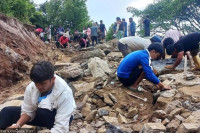
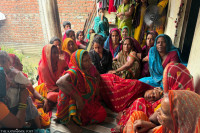
From elderly residents crushing stones to youths hauling sand, the community of Tallo Bhirgaun and Malbase villages mobilised every available resource. Those physically unable to work contributed cash to provide snacks and meals for the labourers. The new structure now connects the settlements of Tirdang Lala, Madhuganga, Ramite and Chulachuli to the district headquarters, ensuring safe passage for trade and administrative needs.
The initiative was led by 65-year-old Dron Prasad Guragain and 42-year-old Dambar Rana with the technical support of Bishnu Poddar, sub-engineer at Dhankuta Municipality. The construction of the 8-foot-wide culvert marks the end of a perilous era where crossing the stream meant risking one's life.
"We waited 25 years for the government to look our way, but the bridge never appeared on any official plan," said Rana, who is also the chairman of Madhuganga Tole Committee (local residents’ committee). "The risk was real. Seven years ago, a 60-year-old woman from Bhangtar was swept away while returning from the district headquarters. We decided we could not lose anyone else to the Nibuwa stream."
This is not the first time the community has taken infrastructure into its own hands. In 2001, local leaders including Dillishwar Darnal, Bhakta Bahadur Bhandari, Dron Prasad Guragain, Dambar Guragain and Makar Bahadur Rai led a two-year voluntary labour campaign to open the road track connecting Bihibarihat, Malbase, Nibuwakhola and Madhuganga . Despite being the primary route to the district's main market, the track remained incomplete without a permanent crossing.
While the community provided labour, the financial burden for construction materials was shouldered by Drona Prasad Guragain, a local philanthropist who is currently residing in the Kopche area. He personally funded the hume pipes, cement, iron rods, and transport costs. "I wanted to help soothe the hardships of my fellow villagers," said Drona Prasad, choosing not to disclose the exact sum spent. "My only satisfaction is seeing the villagers walk without fear,” he added.
Poddar had personally provided technical support for the project. According to him, the project was estimated to cost Rs2.1 million if executed through traditional government tenders. Instead, it was completed through the sweat of over 600 volunteers who worked in shifts.
With the culvert connecting Dhade and Malbase, motorcycles and other vehicles have started moving smoothly along the route. “Earlier, crossing the stream during the monsoon was extremely difficult. After the culvert was built, tempos no longer stop on this side, and even other vehicles have started reaching the village,” said Biwarani Rai, a local.
This year, a 7.1-kilometre stretch of road from Hile to the upper Bhirgau area is being blacktopped with support from the Asian Development Bank. In 2003, local residents led by Chandralal Tamang had spent 96 days opening the track through voluntary labour.
Yubaraj Darnal of Ganeshtar in Bhirgaun said a preliminary survey for the construction of the Bihibarehat-Malbase-Bhirgau-Ramite-Madhuganga road was also conducted in 2009 with ADB support, beginning from the upper Bhirgau area. “After work started in the upper region, those of us in the lower settlements were left waiting,” he said.
Following assurances from the ADB, Dhankuta Municipality had planned to complete a 19-kilometre ring road linking Hile, Chokrok, Bhirgaun, Madhuganga, Nibuwakhola, Malbase and Bihibarehat. However, the work failed to progress as planned, leaving residents of the lower belt facing continued hardship.
“Because of the difficult geography, the municipality’s limited investment was insufficient, so we were waiting for a larger project. But donor support did not materialise as expected under the municipality’s plans and proposals,” said Sitaram Gautam, chief of the municipality’s administration, planning and monitoring section.




 14.4°C Kathmandu