Tamakoshi V hydropower project reaches 30 percent completion
Construction has accelerated after a 10-month halt over forest land clearance, but a dispute over whether the main tunnel needs concrete lining could delay power generation until 2030. Post Photo
The construction of the 99.8-megawatt Tamakoshi V Hydropower Project in Dolakha has reached 30 percent completion, with work gathering pace after a 10-month halt caused by delays in securing permission to use government forest land.
The project, a domestically financed cascade development of the Upper Tamakoshi Hydropower Project, has resumed excavation at multiple locations after securing the necessary land-use rights.
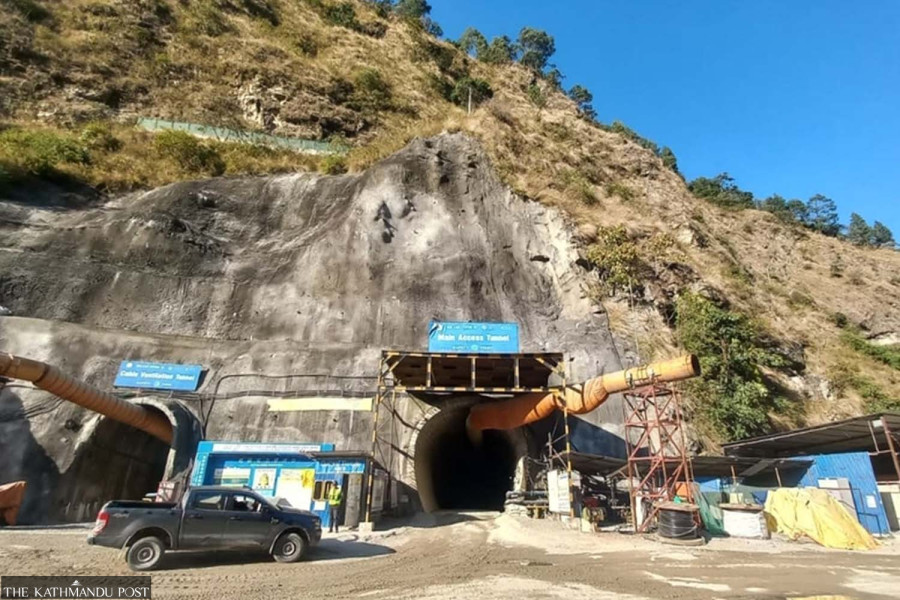
Three access tunnels have been excavated, and work on the main tunnel is under way from six locations, the project said. Of the approximately 8.1-kilometre main tunnel, 2,635 metres have been excavated so far.
Chinese contractor Sinohydro, which is responsible for the civil works, is excavating up to 14 metres of the main tunnel each day across the six working faces, said Ram Prasad Yadav, managing director of Tamakoshi V Hydropower Company.
The contractor aims to excavate up to 20 metres daily, but a shortage of explosives has affected the pace of work, Yadav said.
The project was initially scheduled for completion by mid-July 2028 under an engineering, procurement and construction (EPC) contract. However, prolonged delays in securing permission to use government forest land have pushed the construction schedule back.
Sinohydro has now stepped up work, aiming to complete its remaining construction within 15 to 18 months, Yadav said. “ There are no longer any legal hurdles to construction, and we do not expect further obstructions,” he said. “Work has picked up, and we can complete the project within the deadline if the main tunnel does not require concrete lining.”
Yadav said the rock formation along the main tunnel was sufficiently hard to make concrete lining unnecessary. However, the existing contract with Sinohydro requires the tunnel to be lined, and the project company is negotiating with the contractor to revise that provision and reduce the cost.
“The rock along the main tunnel is extremely hard, so concrete lining does not appear necessary. But the contract requires it,” Yadav said. “We are discussing with Sinohydro the possibility of removing the lining work and reducing the contract amount.”
The negotiations have not made much headway, as Sinohydro has maintained that it should receive the agreed contract payment even if the lining is omitted, he said.
If concrete lining is required, the project will not begin generating electricity until April 2030, Yadav said.
Excavation for the underground transformer cavern has been completed. Work on the spillway tunnel, ventilation tunnel and access tunnel to the underground powerhouse has also been completed. Excavation at the site of the underground powerhouse is 77 percent complete, Yadav said.
Construction is continuing round the clock, he added.
The contract for the second package, covering electromechanical equipment, has also been awarded to the Chinese company Hangzhou Jianghe Hydroelectric Science and Technology. The company has established a camp at the project site and is working on the design, Yadav said.
The project is estimated to cost Rs21.14 billion. Its financing model envisages 30 percent equity and 70 percent debt. The Employees Provident Fund has signed an agreement to provide Rs13 billion in loans. The Upper Tamakoshi project has also proposed to invest 10 percent of the total cost. The remaining equity is expected to be raised through share investments from the general public and residents of Dolakha.
Tamakoshi V will use infrastructure already built for the Upper Tamakoshi project, avoiding the need for a separate dam, desander or headworks.
As a cascade project of Upper Tamakoshi, it will directly use water discharged from the latter's tailrace, channelling it into its own headrace tunnel and underground powerhouse.
Since Upper Tamakoshi is a peaking run-of-river project with reservoir storage, Tamakoshi V will also operate as a peaking project, using the same reservoir to regulate water flows and generate electricity during periods of high demand.




 18.12°C Kathmandu