Pontoon bridge installed across Trishuli river at Furke Khola
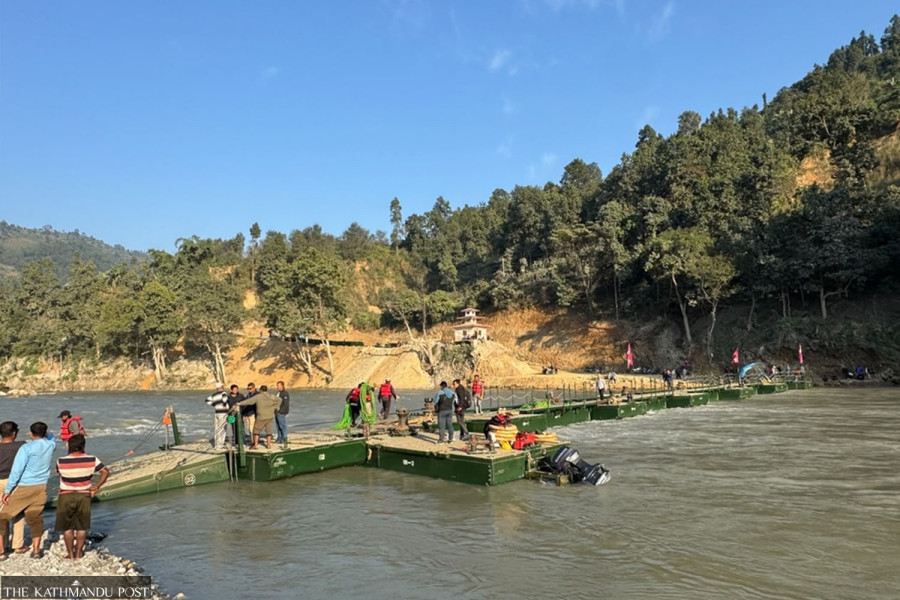
Brought from Bardiya after lying unused for nearly 13 years, the bridge is expected to open on Tuesday, restoring a vital connection severed when floods washed away the permanent crossing. The pontoon bridge brought from Bardiya is installed across the Trishuli river at Furke Khola in Dhading. Post Photo
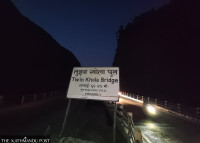
A temporary pontoon bridge transported from Bardiya has been installed across the Trishuli river at Furke Khola in Dhading, restoring a vital road connection disrupted by floods nearly three months ago.
Installation of the bridge linking Gajuri Rural Municipality-2 and Siddhalek Rural Municipality-6, near Jaladevi Temple, was completed on Sunday. It is expected to open to traffic on Tuesday, subject to technical and load-capacity tests and completion of the approach roads.
All 13 local units in Dhading joined hands to bring and install the bridge, sharing the costs. Vehicles will be driven across it on Monday to test its structural integrity and load-bearing capacity.
Yam Nath Danai, chair of Jwalamukhi Rural Municipality and coordinator of the bridge retrieval and installation initiative, said regular traffic would begin on Tuesday if the tests were successful and no further problems arose. The installation had initially been scheduled for completion within a week, but work on the approach roads and other preparations took longer than expected.
The bridge was previously used across the Geruwa river at Kothiyaghat in Bardiya, where it provided a seasonal transport link for 16 years. It was installed every year during dry season and dismantled before the monsoon to prevent damage.
The 145-metre-long structure, built using Chinese technology, was originally brought to Nepal with nearly Rs70 million in loan assistancefrom the Asian Development Bank. It consists of 33 drums. At Kothiyaghat, 31 drums were joined to form the bridge, while another was fitted with a motorboat used to connect and disconnect the structure.
After a permanent bridge was built at Kothiyaghat and inaugurated in September 2014, the pontoon bridge was left unused under the Rajapur Irrigation Management Office for nearly 13 years. Lack of maintenance during that period left some of its drums rusted and perforated.
The move to bring it to Dhading began after floods swept away the permanent bridge across the Trishuli river at Furke Khola. Representatives of all 13 local units agreed to pool resources to retrieve and install the unused structure.
The process began with a site inspection on October 27, followed by an official letter from Jwalamukhi Rural Municipality the next day and a technical assessment on October 29. On November 1, a meeting of elected representatives from all 13 local units, chaired by Dhunibesi Mayor Bal Krishna Acharya, decided to establish an inter-municipal framework and share the costs. The District Administration Office in Dhading and the National Disaster Risk Reduction and Management Authority also helped facilitate the process.
Initially, only light vehicles and those providing emergency services will be allowed to use the bridge. Other vehicles will be permitted gradually, depending on technical standards and the results of load tests, said Shashi Shekhar Wagle, a technician involved in the project.
Heavy vehicles will be subject to the bridge's load limit, with vehicles weighing up to 10 tonnes allowed to cross.
Transportation, approach road construction, painting and installation are expected to cost around Rs6 million, to be covered jointly by the 13 local units.
Bhim Prasad Dhungana, mayor of Nilkantha Municipality and chair of the Municipal Association of Nepal, said local units had been forced to take the initiative after the federal government showed little interest in providing a temporary pontoon or Bailey bridge or building a permanent replacement.
He said the joint effort had also strengthened cooperation among local governments. The temporary bridge will remain in operation until the onset of the monsoon. It will then be dismantled and moved to a safe location before being reinstalled the following winter.
The 118-metre permanent bridge across the Trishuli river at Furke Khola, built in 1999, was washed away by devastating floods on August 26. Its destruction disrupted access to the Prithvi Highway for residents of eight local units, including those in Dhadingbesi, the district headquarters, as well as communities in parts of Dhading and neighbouring Gorkha.
For nearly three months, residents have faced lengthy detours and rising transport costs. Smaller vehicles and goods carriers have been using the alternative Mastar-Parewatar road. Heavy freight vehicles have had to take much longer routes via Mugling, Aanbukhaireni, Gorkha, Arughat and Salantar, or through Sunaulabazar, Phosretar and Kalleritar to reach Galchhi.
The lack of a direct crossing has also made it difficult to transport sick and disabled people to hospitals in time. Some patients have died before reaching medical facilities because of the long, rough detour, said Besh Raj Thakuri, president of the Ambulance Drivers' Association.
Transport delays and higher travel expenses have pushed up the prices of daily essentials. Farmers have also struggled to get their produce to market. The area supplies around 33 percent of the vegetables consumed in Kathmandu, but the disruption has left many growers facing difficulties in selling their harvest.
The installation of the pontoon bridge is expected to provide much-needed relief, although residents have called on the government to ensure a permanent replacement for the washed-away crossing.




 23.12°C Kathmandu