Projects stalled, delays persist as local officials fear anti-graft investigations
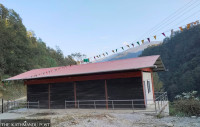
Complaints to the anti-corruption watchdog, even when they do not establish wrongdoing, are discouraging local government staff from carrying out development work, officials say. The agricultural produce collection centre built in Kathekhola Rural Municipality-2, Baglung. The building has remained unused since a complaint was filed with the anti-corruption watchdog. Prakash Baral/TKP
An agricultural produce collection centre built by Kathekhola Rural Municipality in Baglung at a cost of Rs5 million two years ago remains unused after a complaint was filed with the Commission for the Investigation of Abuse of Authority (CIAA).
The building has yet to serve the purpose for which it was constructed, as the CIAA has kept the project under investigation following a complaint.
Built alongside the Mid-Hill Highway on the boundary between wards 1 and 2, the facility could make it easier for farmers in wards 1, 2, 5 and 6 to collect and market their produce. Farmers from wards 3, 4, 7 and 8 could also use it. However, the building has remained idle for the past two years after the CIAA began investigating an anonymous complaint.
The facility would help farmers market their agricultural produce and earn a livelihood without having to leave their villages, says Khadga Thapa, ward 1 chairperson. It could facilitate the collection and transportation of fresh vegetables, oranges, ginger, milk and other fruits and produce to markets. Its location alongside the Mid-Hill Highway would also make it easier to arrange vehicles to transport goods elsewhere.
The complaint to the CIAA, however, has left the facility unused, despite its potential to ease the marketing of produce for local farmers.
Ward 1 had even listed the building as one of its flagship projects. The rural municipality does not know who filed the complaint, nor has the CIAA's Pokhara office informed it about the complainant. Instead, the complaint has effectively prevented the facility from being put to use.
The CIAA's records also list two unresolved complaints against Kathekhola Rural Municipality, including the investigation into the collection centre.
In another case, local officials and employees were compelled to visit the CIAA after a complaint alleged irregularities in the construction of a culvert worth Rs500,000 in ward 4. Vehicles have been using the culvert for the past four years. But after the CIAA sought to recover Rs500,000 each from five members of the construction committee, officials and elected representatives became reluctant to undertake further work.
Complaints over procedural lapses in development projects, payment procedures and the use of substandard construction materials prompt the CIAA to investigate, officials say.
Narayan Prasad Sapkota, chief of the CIAA's Pokhara office, said some complaints were filed solely to harass officials and were set aside after preliminary inquiries. Others take longer to resolve because they require further investigation.
“Some projects have been stalled because investigations take a long time,” he said. “Those found guilty face action, while projects are cleared if wrongdoing is not established.”
Sapkota said public funds could not be misused under any circumstances. He added that complaints were sometimes filed even when officials sought to carry out projects by taking practical considerations into account while spending public money.
According to the commission, 35 complaints were filed last fiscal year against local governments and development-related government offices in Baglung. Of these, 25 concerned local governments and 10 involved other offices.
Baglung Municipality received 18 complaints—seven in the previous fiscal year and 11 in the last fiscal year. Seven have been resolved, leaving 11 pending. Galkot Municipality received 18 complaints, eight from the previous fiscal year and 10 from the last. Of these, 15 concerned the municipality and three involved other institutions.
Sapkota said 90 percent of complaints received by the commission were filed with malicious intent to harass government employees and elected representatives. He said complaints identified as such during preliminary assessments were set aside.
CIAA data show that 37 percent of complaints concern federal government projects, 13 percent provincial government projects and 49 percent local government projects.
Corruption-related complaints in the education sector have increased since education responsibilities were devolved to local governments, with allegations including irregularities in school construction and favouritism in teacher recruitment and transfers.
Most complaints involve violations of procurement laws, irregularities in contractor selection, failure to conduct environmental impact assessments and bypassing procedures or favouring relatives in appointments. Other issues include faulty project estimates and the use of substandard construction materials.
Local government employees say they are increasingly frustrated at being treated as corrupt merely because complaints have been filed against them, even when the allegations have yet to be substantiated.
Tej Bahadur Thapa, deputy chairperson of Kathekhola Rural Municipality, said employees were reluctant to carry out projects because they feared complaints and repeated trips to the CIAA. The problems have also made it difficult to find members for user committees, he said.
He added that complaints often discourage employees from working, while publicity surrounding them further hampers development activities.
Ward chairpersons say they face unnecessary complaints even over small projects and are compelled to appear before the CIAA to give statements.
“An end should be put to the practice of user committee members being summoned to the CIAA to give statements over minor errors,” Khadga Thapa, ward 1 chairperson of Kathekhola Rural Municipality, said. “There should also be programmes to encourage those who carry out development work.”
Photo caption: The agricultural produce collection centre built in Kathekhola Rural Municipality-2, Baglung. The building has remained unused since a complaint was filed with the anti-corruption watchdog.




 21.12°C Kathmandu