Nepal’s new federal civil service bill, explained in nine points
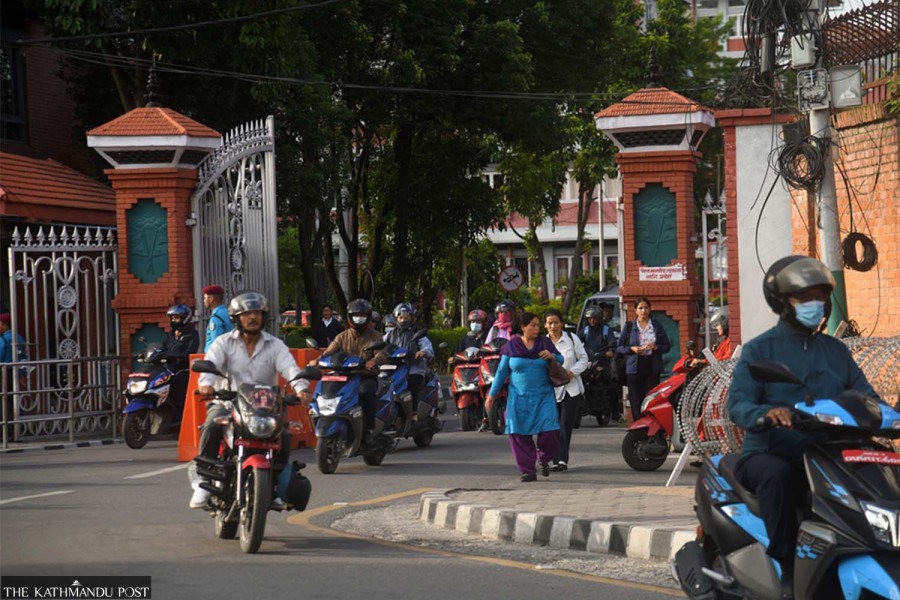
The bill would change some existing rules, retain others and introduce new provisions covering recruitment, pensions, retirement, inclusion and federal, provincial and local administration . Civil servants leave Singha Durbar in Kathmandu. Post file photo
A bill seeking to overhaul Nepal’s federal civil service was registered in Parliament on Thursday, proposing major changes to recruitment, retirement, pensions, promotions, inclusion and relations between the federal, provincial and local administrations.
The bill, which would repeal the Civil Service Act, 1993, is intended to bring the civil service in line with Nepal’s federal system. Here are nine of its key provisions.
1. Retirement age and service limits
The bill proposes raising the normal mandatory retirement age from 58 to 60. But it also includes a one-off transition provision for existing employees. When the new law comes into force, civil servants who have already reached 55 or completed 30 years of service would have to retire. Those who remain in service, as well as recruits, would retire at 60.
For the top levels of the bureaucracy, the bill sets fixed terms as well. The chief secretary, at officer level 14, would serve for two years, while secretaries, at officer level 13, would have a three-year term. Officials in these positions would leave office when either their prescribed term or retirement age is reached, whichever comes first.
2. Pension calculations capped at 30 years
The bill would cap the period of service counted for pension purposes at 30 years.
Under the existing system, all years served up to retirement are counted. So an employee retiring at 58 after 38 years in the civil service currently receives a pension calculated on the basis of all 38 years. Under the proposed system, only up to 30 years would count, regardless of how long the employee actually served. The bill says the lifetime pension would be calculated by multiplying the employee’s last salary by the number of years served, up to a maximum of 30, and dividing the result by 50.
The proposed change could encourage some civil servants with more than 30 years of service to resign before the new law takes effect.
3. Lateral entry into the civil service
The bill opens the door to lateral entry for specialised positions.
If the government cannot find suitable expertise within the civil service for a particular executive or specialist post, it could appoint an outside candidate for a fixed period after consulting the Public Service Commission.
The government would set rules on qualifications, selection, performance contracts, terms of service and benefits, also in consultation with the Commission.
4. A new rank-and-level structure
The civil service would move to a level-based structure covering employees from assistant first level, currently equivalent to the non-gazetted fifth class, up to officer level 14 in the gazetted special class.
The bill provides for 14 levels, from assistant first level to officer level 14.
The chief secretary and chief registrar would be classified as officer level 14 officials in the gazetted special class. Employees currently serving in the non-gazetted fifth class or in unclassified posts would be placed at assistant first level.
5. Age limits for recruitment remain unchanged
The bill does not propose major changes to the age limits for entering the civil service. Nepali citizens must be at least 18 to apply for non-gazetted posts and 21 for gazetted posts. The upper age limit would remain 35 for men and 40 for women.
6. Larger quotas for underrepresented groups
The share of posts reserved under the inclusive recruitment system would rise from 45 percent to 49 percent of positions filled through open competition. Half of that 49 percent would be reserved for women, with competition limited to female candidates. The remaining half would be allocated among the other designated inclusion groups.
The women’s quota itself would be divided among groups as follows: Khas-Arya 27.7 percent, Indigenous nationalities 25.7 percent, Madhesi 15.3 percent, Dalit 12.7 percent, Tharu 6.6 percent, Muslim 4 percent, people from disadvantaged areas 4 percent, and persons with disabilities 4 percent.
The other half of the inclusive quota would be divided among Indigenous nationalities at 32.5 percent, Madhesi 19 percent, Dalit 15.5 percent, economically disadvantaged Khas-Arya 10 percent, Tharu 9 percent, Muslim 5 percent, disadvantaged areas 5 percent, and persons with disabilities 4 percent.
The quota system would be reviewed every 10 years.
7. A two-year cooling-off period after retirement
Senior civil servants would face a two-year cooling-off period before taking up certain jobs after leaving government service. Officials who resign or retire from gazetted special or first-class positions would not be eligible for appointment to any constitutional, diplomatic or other government post for two years from the date their resignation is accepted or they retire.
They would also be barred during that period from working as employees or consultants on projects run by organisations other than intergovernmental bodies and international development partners.
The restriction would also apply to organisations connected to the area of work of the institution where the official served during the final year before retirement, as well as bodies that regulate that sector.
8. Provincial civil services get a legal framework
The bill also lays out provisions for provincial civil services, a long-standing issue since Nepal adopted federalism more than a decade ago. Under the proposed framework, provincial civil services would have posts up to officer level 12, equivalent to the gazetted first class.
The principal secretary of each province, however, would remain part of the federal civil service. The federal government would assign an officer at level 13 to the post.
Secretaries of provincial ministries would be provincial civil servants at officer level 12. Their service and group would be determined by the respective provincial government under provincial law.
Each province would also have a local service, with its structure, terms of service and operation governed by provincial legislation.
9. Rules on conflicts of interest
For the first time, the bill sets out specific provisions on conflicts of interest. Civil servants would be prohibited from using their office, authority or responsibilities in ways that conflict with their personal, family, professional or financial interests.




 17.81°C Kathmandu