A month in tents, Jajarkot landslide survivors face fresh misery in the rain
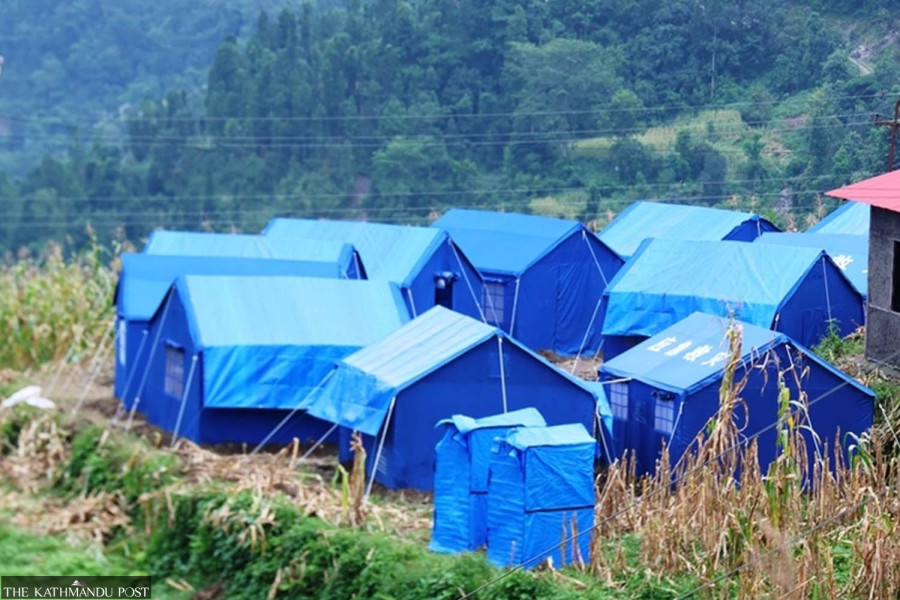
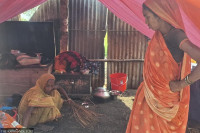
Twenty-nine families displaced by a landslide in Bheri-2 have been living under tarpaulins for a month, with continuing rain forcing some to spend nights at a nearby school. A temporary holding centre set up in a maize field for landslide-affected families in Risang, Bheri Municipality-2, Jajarkot. Post Photo
For 52-year-old Birbal Karki of Risang in Bheri Municipality-2, home has been a tarpaulin shelter for the past month. Karki has been living beside Tribhuvan Basic School with his wife Kamala, two sons and a daughter since a landslide destroyed their house. After two days of continuous rain, life under the tarpaulin has become even harder.
“A single sheet of tarpaulin cannot keep the rain out,” Karki said. “When it rains heavily, water runs underneath, and we cannot stay there. When the rain continues day and night, we have to go to the school, warm ourselves by the fire and stay awake through the night.”
His neighbour, Minaram Karki, faces the same ordeal with his family of six. They too move to the school whenever it rains at night. “Now it rains day and night. We can neither eat properly nor sleep,” Birbal said. “The children are suffering from fever and colds because of the cold.”
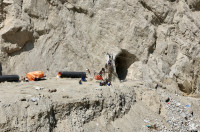
As many as 29 families displaced by the landslide that struck Risang on August 15 have been living under tarpaulins for a month. Four people were killed and 11 injured in the landslide.
For nearly two weeks after the disaster, 251 people from 70 families were sheltered at Tribhuvan Basic School. When the school itself was deemed unsafe, residents cleared a nearby maize field and put up tarpaulins for around 80 people.
Seventeen families are now staying on vacant land near the school, while another 12 have been moved to an open field higher up, according to Jajarkot Chief District Officer Nawaraj Baral.
District Disaster Management Committee records show that 23 houses were destroyed in the landslide. But not all displaced families have been able to remain in the tents. Some have returned to homes that are still considered dangerous.
Around 300 houses in ward 2 of Bheri Municipality are at risk, according to ward chair Bhim Bahadur Karki.
“Most houses had already been cracked by the earthquake, and the landslide caused further damage,” he said. “Many homes are still at risk of collapsing, but people have no choice and have been forced to return to unsafe houses.”
About 50 families are staying with relatives in safer homes, he said. But with no decision yet on where they can be permanently relocated, the displaced families remain in limbo.
For landslide victim Surendra Karki, the crisis is also threatening his crops and livestock. “We haven’t been able to harvest the maize because we have nowhere to store it,” he said. “We have had to leave our livestock with relatives. We still haven’t been able to retrieve our belongings from the landslide. We can’t go home because there’s nowhere to live, but we don’t feel safe staying here either.”
For resident Harka Bahadur Khatri, staying away from the settlement for long is also not an option. He has to return to harvest crops and care for his livestock. “We cannot leave the settlement for long. We are constantly afraid that something could come down from above or the ground could give way below,” he said. “The monsoon has not stopped yet. When it rains at night, we go to relatives’ homes, warm ourselves by the fire and stay awake.”
The crowded conditions are also taking a toll on the health of displaced residents, said Dr Sunil Pun, chief of the District Health Service Office. “There is a risk of communicable diseases because of poor sanitation,” Pun said. “Most children, women and elderly people are suffering from health problems including colds, fever, diarrhoea and headaches.”
Health workers have been deployed to the settlement, he said, adding that there is no need for panic. People with minor ailments are being treated at the camp, while those requiring more advanced care are being taken to the district hospital.
Chief District Officer Baral said the municipality was providing food to the displaced families. “Continuous rain has caused some problems,” he said. “We have mobilised health workers to provide treatment to the displaced.”
The November 3, 2023 earthquake, which measured 6.4 on the Richter scale, damaged most houses in Risang. Residents were displaced after the landslide caused further damage to homes already weakened by the earthquake.
Nearly a month and a half after the landslide, authorities have still not determined where the homeless families will be permanently resettled.




 22.62°C Kathmandu