Tunnels and bridges emerge as options to bypass treacherous Krishnabhir
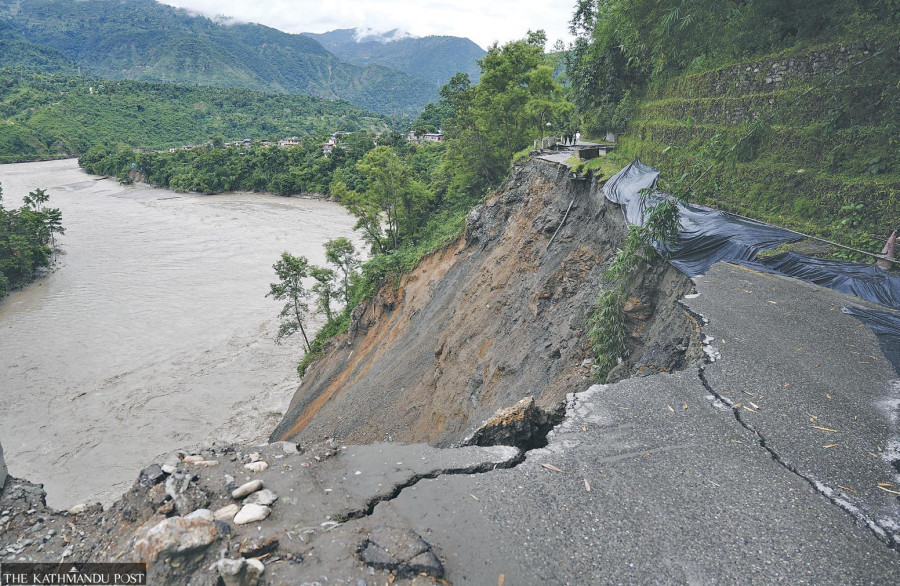
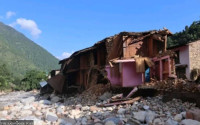
Officials will decide within a week whether vehicles can resume using the existing road. If reopening is not feasible, authorities will seek a sustainable alternative. The damaged section of Prithvi Highway at Krishnabhir in Dhading pictured last week. The Trishuli river flows below. Post Photo
The Department of Roads is considering several alternatives to the Krishnabhir section of the Prithvi Highway after the road collapsed on August 30 as rising water levels in the Trishuli River following the Bhotekoshi flood destabilised the area.
Traffic has been completely halted along about a 300-metre section of the highway at Krishnabhir, a vital road link connecting Kathmandu Valley with the rest of the country, forcing vehicles to use alternative routes that are not suitable for cargo trucks and large passenger vehicles.
The disruption has made it difficult to transport daily essentials to Kathmandu. Drivers and passengers travelling from the Valley to various districts have been facing difficulties.
With major festivals including Dashain scheduled next month, concerns are growing over whether vehicles will be able to operate through Krishnabhir in time for tens of thousands of people travelling to their home districts for the holidays.
“We will determine within a week whether vehicles can operate through Krishnabhir,” Bijaya Jaisi, director general of the Department of Roads, told Kantipur.
So what alternatives are currently being considered?
“Our first priority is to make the existing Krishnabhir section operational, and work is underway for that,” Jaisi said. “If that is not possible, we are studying the possibility of constructing two tunnels each about 500 metres long to bypass the landslide-prone section.”
Another option, according to Jaisi, is to construct two permanent bridges that would allow the highway to bypass the Krishnabhir section. The first bridge would take the road across the Trishuli River and the second, farther downstream, would bring it back to the original side of the river, reconnecting with the existing highway.
“We are studying which option—tunnels or bridges—would be cheaper,” Jaisi said. “Only after that study will we know more.”
According to Jaisi, vehicles travelling to Dhading, Gorkha, Pokhara and other districts in Gandaki Province can cross a bridge near the Hamlet Restaurant in ward 4 of Galchhi Rural Municipality along the Nagdhunga–Malekhu road section and travel along the opposite bank.
“After crossing the bridge, vehicles can travel along the opposite bank, exit at Parewatar and reach Dhadingbesi. That route is about 20 kilometres long,” he said.
Another alternative is to cross the Fishling Bridge in Chitwan and reach the Benighat Bridge in Dhading. This route is about 17.5 kilometres long.
Jaisi said around 1.5 kilometres of this route is problematic and work is underway to open a proper track.
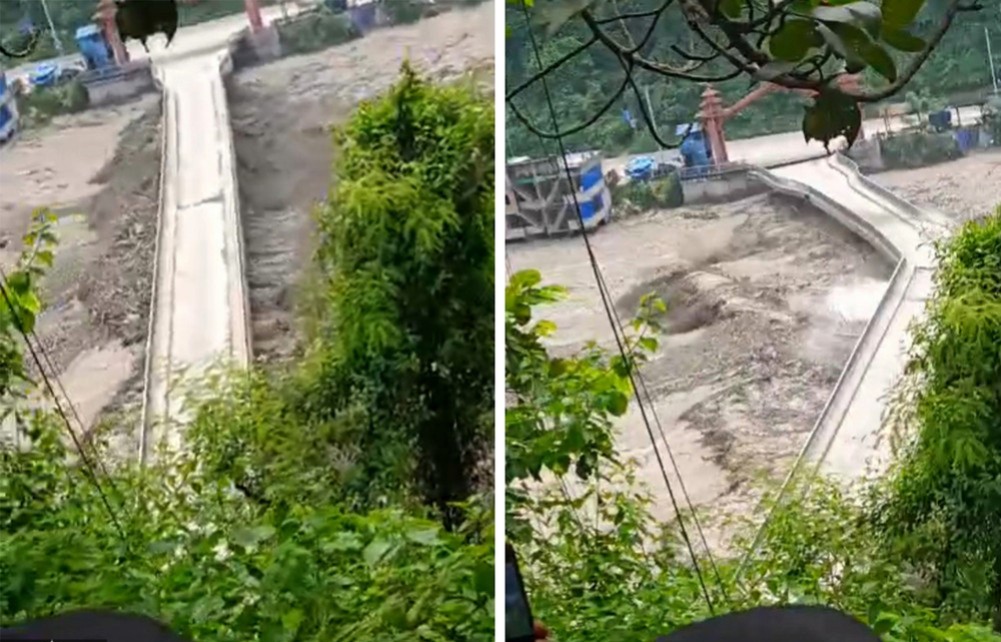
The August flood also destroyed the concrete bridge at Furke Khola, severing the direct link between Dhadingbesi, Dhading district headquarters, and the Prithvi Highway. Poshnath Adhikari/TKP
“The department has already invited bids to open the track under a fast-track process,” Jaisi said. “Of the total route, 10 kilometres have been constructed and are being operated by provincial governments, while six kilometres were built by local governments. This road is currently in use.”
The Department of Roads said the Kantirajpath, or Kanti Highway, is being used to travel to Chitwan and other districts.
“For destinations elsewhere, the Kantirajpath and BP Highway are currently operational,” Jaisi said. “If the Krishnabhir section can be restored, there will be no immediate problem. If not, we will continue improving the alternative routes.”
The Department of Roads is currently searching for a soft copy of a detailed study report prepared about a year and a half ago for constructing a parallel road on the opposite bank of the Trishuli River along the Naubise–Mugling road.
The physical copy of the report was destroyed in a fire during the Gen Z movement, and officials are now searching for its digital version.
The study had examined the Sisne–Dharke and Bishaltar–Fishling roads in Dhading as alternatives to the Nagdhunga–Mugling road.
The study was carried out under the Nepal–India Regional Trade and Transport Project with loan assistance from the World Bank. However, construction has yet to begin.
At the time, detailed studies were conducted for the 94.66-km Nagdhunga–Mugling road, the 12.4-km Sisne–Dharke section and the 15.3-km Bishaltar–Fishling section.
According to Department of Roads officials, the study was completed to the point where the projects were ready to be put out to tender. However, the government decided not to proceed with the Sisne–Dharke and Bishaltar–Fishling roads because of the high cost of land acquisition and compensation.
The government subsequently moved ahead only with upgrading the Nagdhunga–Mugling road.
The detailed study for all three sections was completed in July 2018 and the report was submitted to the Department of Roads.
According to the study, construction of the Sisne–Dharke road would cost Rs4.3 billion. About 500 ropani (25.44 hectares) of land would need to be acquired, with Rs1.75 billion estimated for land acquisition and compensation for houses and other structures.
The study also identified the need for a 180-metre tunnel along the section, with the tunnel alone estimated to cost Rs575 million.
Construction would require the felling of 1,620 trees, as well as four bridges, 29 pipe culverts and 10 box culverts.
The Bishaltar–Fishling road was estimated to cost Rs6.05 billion to construct. Around 350 ropani (17.81) of land would need to be acquired, costing an estimated Rs2.9 billion, while another Rs147 million would be required to manage houses and other structures.
The study estimated that 5,190 trees would need to be removed. The road would also require seven bridges, 23 pipe culverts and eight box culverts.
“The World Bank conducted the study, but further work did not move ahead at the time because the cost of compensation was higher than the construction cost,” a Department of Roads official said. “Now, land acquisition may not be necessary because we can improve roads already constructed by provincial and local governments.”
Although some sections are currently only one lane wide, he claimed that most of the route has two-lane roads.
Arjun Prasad Aryal, chief of the Development Assistance Implementation Division at the Department of Roads, said the department was searching for the soft copy of the World Bank-funded study after the original report was destroyed during the Gen-Z movement.
“If we find the report, we can discuss what can be done based on the study,” Aryal said.
He said the immediate priority remained reopening the Krishnabhir section.
“If there are no further problems, vehicles will operate through Krishnabhir itself,” he said. “As an alternative, constructing a road on the opposite bank would require a decision from the Cabinet.”
Currently, vehicles enter Kathmandu through the Naubise section of the Tribhuvan Highway, while traffic leaving the Valley is being diverted through the Kantirajpath.




 20.4°C Kathmandu