Dhunche has relief supplies. Getting aid to flood-hit Rasuwa villages is the problem
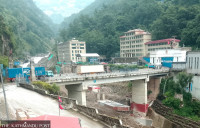
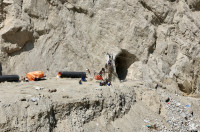
Destroyed roads have left communities in Rasuwa and Nuwakot districts reliant on helicopters, drones and temporary crossings. Relief materials to be dispatched to remote areas of Rasuwa, waiting their turn for the helicopter at Dhunche, Rasuwa. Hemanta Shrestha/TKP
Mansing Tamang, ward chairman of Uttargaya-4 in the flood-hit Rasuwa district, has been waiting in Dhunche for three days for a helicopter to take 250 sacks of rice and other relief supplies to Mailung and nearby settlements.
The road to his ward was swept away by the Bhotekoshi floods on August 26, leaving airlift as his only option for getting food to villagers.
“My turn for a chopper flight has yet to come,” Tamang told Kantipur by phone. “I have been told that food is running out in the village. We have enough supplies to send, but they are stuck here in Dhunche.”
Relief trucks are arriving from Kathmandu and Bidur, and supplies are piling up in Dhunche. Helicopters and drones are also being used to move aid. But for villages cut off by the floods, having relief supplies nearby does not mean they can get them.
The main challenge is no longer collecting relief, but getting it to villages cut off by the floods.
The Bhotekoshi floods destroyed road links across Rasuwa, leaving many communities dependent on helicopters for essential supplies. With limited airlift capacity, relief can reach only a few places at a time.
Sang Lama Tamang, ward chairman of Aamachhodingmo-1, has faced the same problem. For days, he has been taking repeated calls from villagers warning that food is running out while pressing authorities for a helicopter to deliver supplies.
“We are completely cut off because there are no roads. We have not been able to get a helicopter,” he said. “Even those who can afford food cannot find anything to buy.”
The disruption is also starting to hit local markets. Shops in villages that escaped the worst of the flooding are running out of stock because regular supplies can no longer get through. Dolma Yangjen Tamang of Syaphrubesi in Gosainkunda-5 said many shops had already closed.
“Even in places the floods did not reach, there is little left to buy,” she told Kantipur.
Urken Chiring Lama, chairman of Gosainkunda-1, shared that the same problem was being experienced in his ward as it remains completely cut off by road. After waiting for four days, he finally managed to get some relief supplies delivered by helicopter on Monday.
Relief supplies are reaching Dhunche, but getting them from there to the affected villages is the problem. “We have to wait for another helicopter,” he said.
There is plenty of relief in Dhunche, Lama told Kantipur. “As all the roads have been washed away, the Rasuwa district administration has arranged flights on a rotational basis.”
Lama travelled to Kathmandu to collect 40 solar panels and batteries. It took 12 hours to bring them by road to Dhunche. Beyond that, the road is gone.
“There is no road from Dhunche to the wards,” he said. “Our suffering will remain until a Bailey bridge is built at Syaphru. We cannot depend on helicopters to deliver relief indefinitely.”
The government says 173 flights from Rasuwa and Nuwakot have so far carried relief and essential supplies. But with roads still out of shape, airlifting alone cannot keep up with the needs of every village.
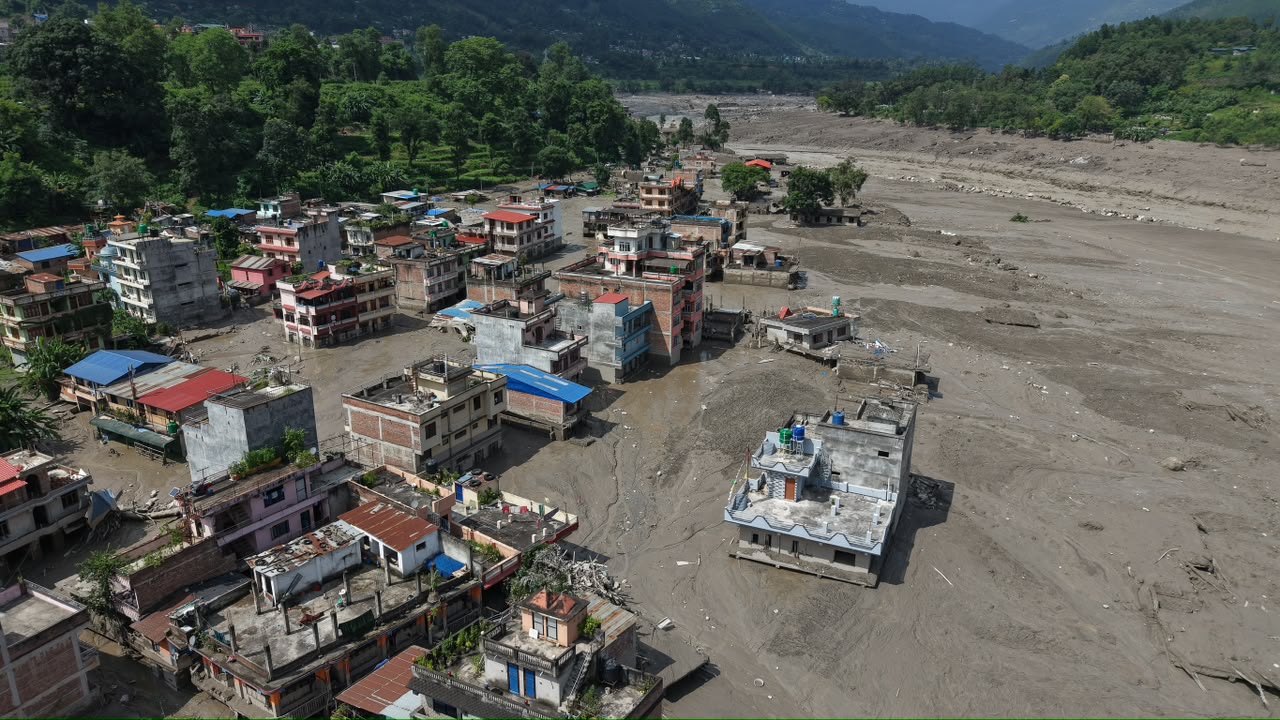
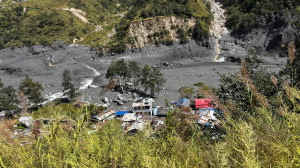
The flood devastated settlements and infrastructure along the Trishuli river. Photo: Nepal Photo Library
Helicopters can provide a lifeline in the immediate aftermath, but they cannot replace a functioning road network. As a stopgap, authorities and local officials are turning to drones.
Drones brought from China are being operated by the Nepali Army to deliver relief to some of the worst-hit areas.
Sang Lama said drones were useful for getting small consignments through, but could not supply entire villages.
“We have started using drones to carry small amounts of supplies as an alternative to helicopters. But it is not enough,” he said.
Drones can deliver medicines, small relief packages and other essentials, but they cannot handle the volume needed to keep villages supplied with food. Local officials say restoring roads, or providing higher-capacity transport, is the only sustainable solution.
They have urged the federal and provincial governments to reopen roads and urgently install Bailey bridges and temporary rope crossings to reconnect isolated communities.
Authorities have decided to install temporary rope crossings at several points to reconnect communities cut off by the floods. The planned crossings include one over the Bhotekoshi between Syabrubesi and Chilime, another over the Runga Khola linking wards 5 and 1 of Gosainkunda, and a third over the Trishuli between Pahirebesi in Uttargaya-4 and Shantibazar in Kispang-5, Nuwakot.
Government figures show that relief supplies continue to flow into Rasuwa and Nuwakot. The two districts have received 48,500 kilograms of rice and 15,600 kilograms of lentils, including 36,000 kilograms of rice and 13,000 kilograms of lentils delivered to Rasuwa.
Authorities have also sent 8,000 kilograms of fortified rice, 2,850 litres of cooking oil and 10,440 packets of biscuits, among other essential supplies. But getting those supplies from collection points to isolated villages remains the bigger challenge.
Sixty-three trucks and 38 utility vehicles carrying food and non-food supplies have been dispatched from various locations in Kathmandu. But with roads still impassable, some of the supplies can reach only designated distribution points, rather than the villages that need them.
Tuk Prasad Subedi, spokesman for the Uttargaya Rural Municipality, said Bidur had relief supplies enough for 15 to 20 days.
Villagers are struggling to buy food even when they have money, he said, because local shops have limited storage and their stocks have run out.
“Village shops do not have large warehouses,” he said. “Even people who can afford to buy food are finding little left to buy.”
Chandika Tamang, vice-chair of Aamachhodingmo Rural Municipality, said all five wards of the municipality needed food supplies. Stocks of rice and lentils are running low, along with salt, cooking oil and other daily essentials.
A total of 3,533 people displaced by the floods are staying in holding centres in Rasuwa, Nuwakot and Dhading, according to officials. Authorities are providing immediate relief to those affected. The Rasuwa district administration said it had carried out around 150 relief distributions as of Tuesday. In Nuwakot, relief was distributed at 536 locations on Tuesday, with supplies collected through 361 organisations.
Displaced people staying in holding centres and other safe locations in Nuwakot are receiving relief in coordination with local units.
Conditions, however, vary between the two districts. In Nuwakot, delivering relief to holding centres has been relatively straightforward, according to local representatives. The district has 25 holding centres housing around 2,700 people.
Rupesh Prasad Nepal, administrative and information officer at the Nuwakot District Administration Office, said essential supplies were being delivered promptly to displaced people at the centres.
The district administration said 2,274 people staying in Nuwakot’s holding centres had undergone health checks and received medicines.
Displaced people are staying at several locations, including Shree Komin Shyamey Wangphel Secondary School in Syaphrubesi; Ganesh Basic School in Uttargaya-1; Simle Basic School in Uttargaya-2; Shivalaya Basic School in Uttargaya-5; Nilkantha Secondary School in Bogatitar, Uttargaya-5; Yellow Gumba in Swayambhu, Kathmandu; Mustang Gumba in Kathmandu; and the Nepal Buddhist Dharma Sewa Sangh building in Swayambhu, Kathmandu.
In Nuwakot, displaced people are being sheltered at the Karki Manakamana Basic School and the Tribhuvan Secondary School in Kispang-4; Mahadev Secondary School and the Mahadev Campus area in Belkotgadhi-7; Indrayani Basic School in Bidur-1; the Trishuli Dam and Himalaya areas in Bidur-2; and the building used for funeral rites in Bidur-2 and Bidur-12, among other locations.
Medical teams are also providing treatment at temporary shelters. Buti Tamang, an executive member of Uttargaya Rural Municipality, said Nepali Army personnel, health workers deployed from Kathmandu and local medical staff were treating patients.
Tamang, who herself was displaced from Uttargaya and is staying in Battar, Nuwakot, said people with chronic conditions and serious illnesses had been treated and sent to Kathmandu for further care.
Ramesh Paudel, who works in the Syaphrubesi area of Gosainkunda, said treatment and medicines were being provided at temporary shelters in coordination with the district public health office.
“Seriously ill people, new mothers and pregnant women have been moved to safer areas,” he said. “We are providing basic treatment and medicines to others as needed.”
But providing temporary shelter and relief to displaced people is different from maintaining regular supplies to villages cut off by the floods.
All five wards of Uttargaya Rural Municipality in Rasuwa have been affected. The rural municipality’s building in Laharepauwa was swept away by the floods. Most other parts of Rasuwa have also been affected to varying degrees, with the exception of Syaphrubesi.
Narendra Pariyar, who was the Rasuwa chief district officer at the time of disaster, said transportation, rather than a shortage of relief supplies, was the problem.
“Helicopters are for immediate rescue operations. Now we have to build the roads,” he said.
Dharma Raj Upreti, executive chief of the National Disaster Risk Reduction and Management Authority, said relief supplies were currently sufficient but distributing them had become difficult because road connections had been severed.
“For now, there is enough relief. The main issue is how to distribute it more systematically,” he said. “Provincial and local governments need to coordinate to improve the relief supply chain.”
Anil Pokharel, a former executive chief of the authority, said helicopters and drones could provide short-term relief, but the response now needed to focus on three priorities.
First, Bailey bridges should be installed as quickly as possible to reconnect the road network. Second, rope crossings and suspension bridges should be built to restore access across rivers. Third, road tracks should be opened through safe terrain to allow vehicles to resume operations.
“Connectivity now needs to be our main priority,” Pokharel said.
The lack of connectivity is also disrupting access to basic services. The National Human Rights Commission said its monitoring teams had found shortages of drinking water, electricity and health services in affected areas, as well as inadequate rescue equipment, a lack of technical experts and security personnel involved in rescue operations, and difficulties with public movement.
The findings followed a field inspection of Rasuwa and Nuwakot by a high-level monitoring team led by commission member Lili Thapa, according to commission spokesman Tikaram Pokharel.
The commission said restoring damaged infrastructure and reconnecting affected communities was essential to ensuring access to basic services and protecting people’s rights. It urged the government to deploy technical teams to restore drinking water, electricity and health services.
The floods have damaged physical infrastructure providing basic services in Rasuwa and Nuwakot, the commission said, calling for alternative transport arrangements while the disruption of movement affects daily life.




 13.57°C Kathmandu