Power restored in much of flood-hit Rasuwa and Nuwakot, but pockets remain dark
The restoration is helping rescue and relief efforts. Solar units to reach settlements off-grid. NEA officials install transformers in Kalikasthan Rural Municipality, Rasuwa, to restore power to the area hard-hit by the August floods. Post Photo
The restoration of electricity in much of flood-hit Rasuwa and Nuwakot has provided a major boost to search, rescue and relief operations, while remote settlements remain without access to the national grid, officials said.
The flash floods along the Bhotekoshi River on August 26 swept away power pylons and damaged other hydropower infrastructure, leaving thousands of households without electricity across Rasuwa, Nuwakot and Dhading. Thirteen hydropower projects, both operational and under construction, were also damaged.
Officials at the Nepal Electricity Authority said power had been restored in more than 75 percent of the affected areas.
“Even with 300 megawatts of generation offline, we have managed to route power for internal consumption,” said Dirghayu Kumar Shrestha, acting executive director of the NEA. “In the flood-affected zones, distribution has recovered by 75 to 80 percent in Rasuwa, while Nuwakot is back to around 95 percent.”
Shrestha said engineers had used older transmission routes to restore supplies quickly. “The old 66 kV line from Chilime and Devighat used to supply Kathmandu. We stepped that line down to 11 kV to charge local feeders and restore electricity,” he said.
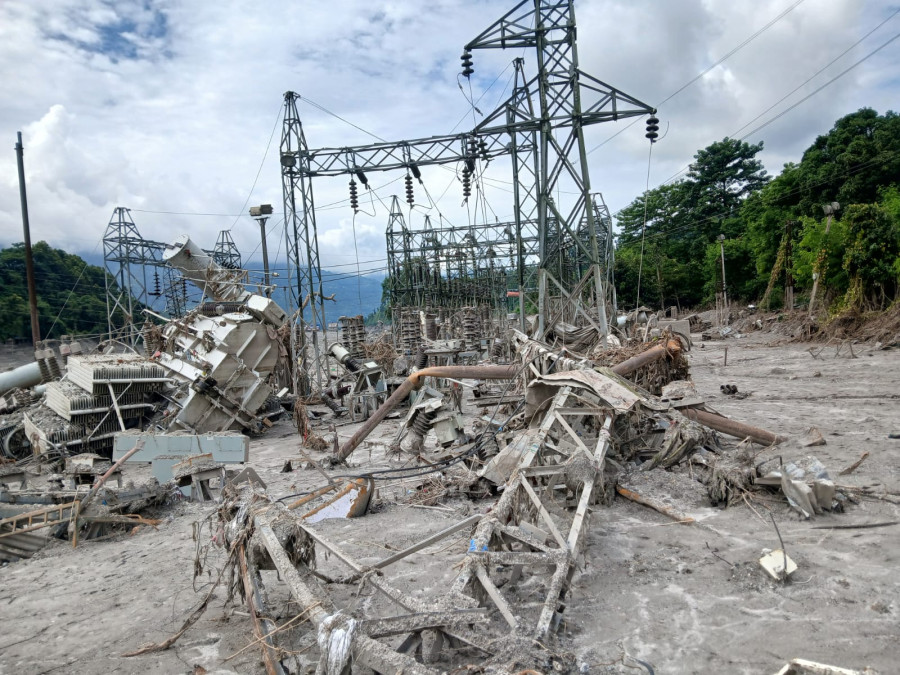
Devighat substation damaged by the flood on August 26. Photo: Courtesy of Bishnu Hari Rimal
Power returned to the market areas of Nuwakot on August 27, while Dhunche is operating at around 90 percent capacity and Dhading has regained full supply, according to the NEA.
But the restoration has yet to reach some of the worst-hit and most isolated settlements. The utility plans to send technicians by helicopter and distribute portable two-kilowatt solar units in areas where damaged roads and transmission lines continue to obstruct access.
Kaisang Nurpu Tamang, chairperson of Gosainkunda Rural Municipality, said electricity in Dhunche had significantly eased rescue and relief work, but settlements such as Syaphrubesi and Timure remained without grid power.
“We sent more than 100 solar backup units to those areas so residents can light their homes and charge their mobile phones,” said Tamang. Suresh Bhattarai, chief administrative officer of Gosainkunda, also said the return of electricity in Dhunche had substantially improved relief operations.
In Uttargaya Rural Municipality, power was restored Saturday, helping revive communications, according to spokesperson Tuk Prasad Subedi.
“All five of our wards were affected. Solar panels kept the health post running, but mains electricity returned on Saturday, allowing people to recharge their devices,” he said.
The situation remains more difficult in Amachhodingmo Rural Municipality, where only ward 1 has electricity. “Four wards remain in the dark. A small number of solar batteries have been distributed, but lighting and phone charging remain major challenges,” said vice-chairperson Chandika Tamang.
In Bidur Municipality, however, electricity has been fully restored in nearly all wards, according to deputy mayor Prabha Bogati.
Data released by the National Disaster Risk Reduction and Management Authority show that electricity has been restored to nearly all of Dhading’s 83,642 households, with around 120 families still without power. In Nuwakot, 96.7 percent of 68,679 households have electricity, while the figure for Rasuwa is 78 percent of 14,281 households.
To cover the remaining gaps, authorities have delivered 13 solar power units for institutional use and 500 for households through the Alternative Energy Promotion Centre.
NEA officials said 1,268 vulnerable households in Rasuwa had been identified for alternative solar systems and called for government support to airlift solar panels to areas where roads remain blocked.




 12.72°C Kathmandu