Nepal launches #NepalCalling campaign to counter flood-driven tourism cancellations
The peak September-November season accounts for nearly 40 percent of Nepal’s annual tourist arrivals. That makes the coming months crucial for an industry still recovering from successive shocks. Obtained by the Post
After a turbulent year that saw Nepal’s tourism industry battered first by the Gen Z protests and then by tensions in West Asia, Mandip Giri, managing director of Dom Himalaya Hotel in Thamel, Kathmandu, had finally begun to feel optimistic. Bookings for the September-November peak season had crossed 90 percent.
Then the Bhotekoshi disaster struck. The timing could not have been worse.
Within a week, about a fifth of his bookings disappeared.
“Cancellation is rising each passing day as search and rescue intensify in northern Nepal,” Giri told the Post. “Over the last seven days, 20 percent of bookings have already been cancelled, particularly online bookings.”
The problem, tourism entrepreneurs say, is not necessarily where the tourists are going. It is what they are seeing.
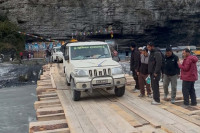
Images of washed-out roads, collapsed bridges, stranded people and bodies recovered from rivers in northern Nepal have travelled far beyond Rasuwa, creating an impression among potential visitors that the disaster has hit the entire country.
That perception is now threatening to undermine Nepal’s most important tourism season.
September to November is when the country’s post-monsoon skies clear and trekking routes begin to fill with foreign visitors. The three months account for nearly 40 percent of Nepal’s annual tourist arrivals, making the timing of the August 26 disaster particularly painful for an industry that had been hoping for a strong recovery.
Nepal received 85,444 foreign visitors in August, a 3.65 percent decline from the same month last year. The final week of the month, when the disaster struck, brought a wave of cancellations.
The government is now trying to stop that wave from becoming a wider retreat.
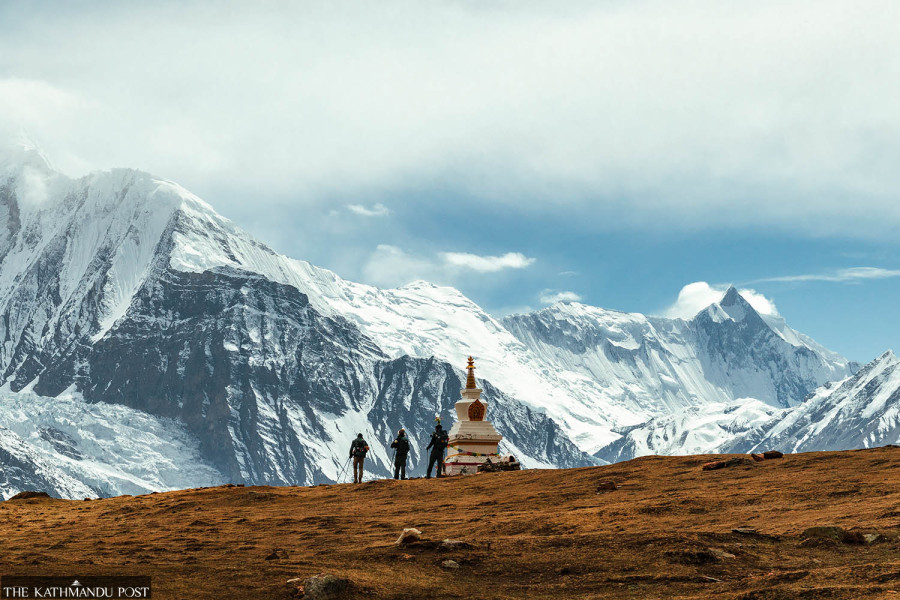
Tourism Minister Khadak Raj Paudel has taken to social media to make a simple appeal: Nepal is still open.
“Our mountain trails and trekking routes are still waiting for you,” Paudel said in a video message on Facebook, using the hashtag #NepalCalling.
“Your coming to Nepal this time does not mean only a holiday. It's a big support to the country fighting this catastrophic tragedy of flash floods.”
The message is being echoed by Nepal’s tourism industry and diplomatic missions as the government attempts to distinguish between a devastated pocket in north-central Nepal and the rest of the country.
Foreign Minister Shisir Khanal on Thursday told Kathmandu-based diplomats and development partners that the disaster was geographically localised.
Airports across the country, he said, were operating normally. Kathmandu, Pokhara, Chitwan, Lumbini, Janakpur, the Annapurna and Everest regions, and Bardiya remain open to tourists.
The message was aimed as much at foreign governments as at travellers.
Khanal urged diplomatic missions and international partners to communicate that Nepal remains open, arguing that tourism is particularly important for communities struggling with the consequences of the disaster.
But for tourism operators, simply declaring Nepal safe is unlikely to be enough.
“The message that Nepal is safe should be disseminated through Nepali embassies and missions abroad,” Binayak Shah, president of the Hotel Association Nepal, told the parliamentary International Relations and Tourism Committee on Wednesday.
The country needs to actively rebuild confidence, tourism entrepreneurs say, rather than wait for international travellers to distinguish between the affected and unaffected areas on their own.
That is particularly important because Nepal’s tourism industry has little room for another prolonged shock.
The sector has already endured the Covid collapse, the slow recovery that followed, the political unrest of September 2025 and the fallout from the US-Israeli war on Iran that began in February this year.
Giri had expected the September-November season to mark a return to normality. Instead, the flood has once again left hoteliers and tour operators grappling with uncertainty.
The economic stakes are high. Tourism contributes around 6.7 percent to Nepal’s GDP, directly and indirectly, and supports more than a million jobs.
For people working in hotels, trekking companies, airlines, restaurants and transport, a foreign traveller cancelling a trip is not simply a lost holiday. It can mean a lost room booking, a guide’s income, a porter’s wages or a restaurant’s daily revenue.
The government is therefore under pressure to manage two crises simultaneously: rescuing people from the disaster zone and preventing the disaster from becoming a national tourism crisis.
On Wednesday, the parliament’s International Relations and Tourism Committee called for an immediate strategy to restore confidence in Nepal’s tourism market alongside search-and-rescue efforts for tourists affected by the floods.
Committee chair Sumnima Udas said the government needed to go beyond repeatedly telling foreigners that Nepal was safe.
“Nepal needs to deliver positive and credible messages about Nepal’s tourism following the disaster,” she said.
Tourism Minister Paudel told the committee that the government was working on measures to maintain international confidence and increase arrivals.
But Paudel also acknowledged the unusual nature of the crisis.
“Tourism is an industry linked to emotions and based on empathy,” he said. “The tourism sector has suffered huge human and economic losses at present.”
The government, he said, was working to establish an employee welfare fund for tourism workers affected by the disaster.
The disaster has also reopened painful memories in the Langtang region, one of Nepal’s most popular trekking destinations within easy reach of Kathmandu.
Langtang had only gradually recovered from the 2015 earthquake when another disaster struck.
On April 25, 2015, the 7.8-magnitude Gorkha earthquake triggered a massive avalanche from Mt Langtang Lirung that buried Langtang village and killed an estimated 300 to 350 people. Syaphrubesi and settlements including Timure and Rasuwagadhi also suffered extensive damage.
Now, once again, Rasuwa is at the centre of a national disaster.
The difference this time is that the damage to tourism infrastructure in the district is being accompanied by a much wider perception problem.
The Trekking Agencies’ Association of Nepal has warned against travel to Langtang. The Langtang Valley trek, Gosainkunda, Helambu Circuit and Tamang Heritage Trail are currently closed or restricted.
“Except Rasuwa, the rest of Nepal is intact,” said Sagar Pandey, president of the association.
Pandey said the government needed to communicate that distinction clearly while continuing rescue and rehabilitation work in the affected areas.
The tourism industry is also asking the government to make the recovery campaign more tangible.
Bharat Jung Pandey, president of the Nepal Association of Tour and Travel Agents, suggested free visas, special hotel discounts and easier travel arrangements for international visitors until conditions return to normal.
The Nepal Tourism Board, meanwhile, is working with the tourism ministry to strengthen the #NepalCalling campaign.
Hikmat Singh Ayer, acting chief of the tourism board, told the parliamentary committee that the recovery plan could include discounts on airfares and hotels if necessary.
But the campaign is unfolding at a difficult moment for the tourism board itself.
The board remains without a permanent chief after the Balendra Shah administration dismissed its previous chief in May as part of a wider effort to depoliticise public bodies.
Lawmaker Anushka Shrestha told the parliamentary committee that crisis communication needed to be faster and more effective, particularly through infographics and digital platforms.
She also warned that vacant leadership positions in tourism-related agencies could hamper decision-making at a time when the industry needs a coordinated response.
Paudel has proposed turning Rasuwa into a “climate heritage” site in the longer term, linking the Bhotekoshi disaster to climate change and Nepal’s call for climate justice.
For the tourism industry, however, the immediate concern is much more basic.
It wants travellers to understand that a disaster in one part of the country does not mean the whole of Nepal is closed.
The message behind #NepalCalling is therefore not simply an invitation to visit.
It is an attempt to draw a line between the Nepal that has been devastated and the Nepal that is still waiting for tourists.
For hoteliers like Giri, that distinction could determine whether the coming peak season becomes the beginning of a recovery—or another season of cancellations.
Sangam Prasain is Business Editor at The Kathmandu Post, covering tourism, agriculture, mountaineering, aviation, infrastructure and other economic affairs. He joined The Kathmandu Post in October 2009.




 15.69°C Kathmandu