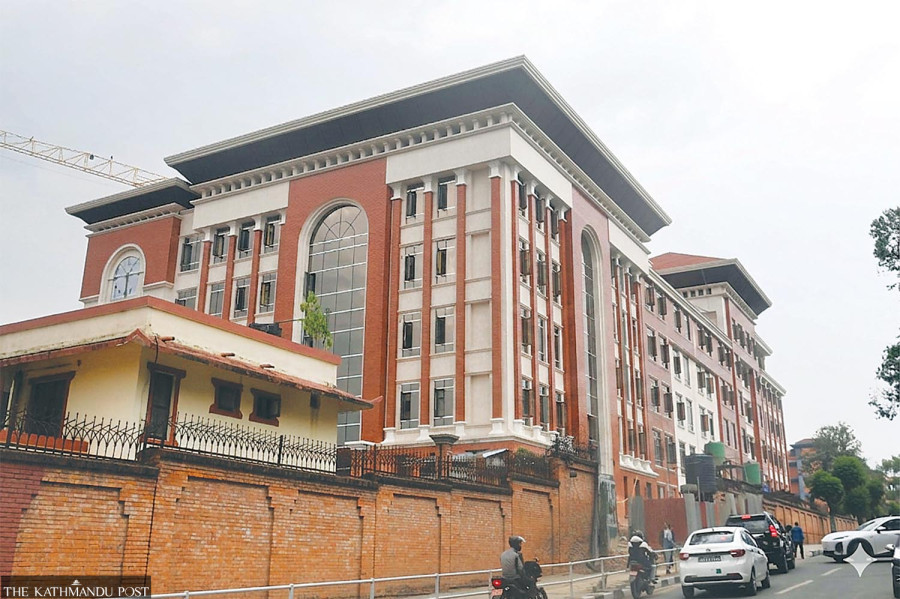
From the Property Inquiry Commission to ad policy and Nepal Airlines appointments, a string of executive actions has been suspended, overturned or subjected to judicial scrutiny within the administration's first three months. The rulings have fuelled debate over the balance of power between the executive and the judiciary. Post file photo
Within roughly 100 days of taking office, the Balendra Shah-led government has, the Supreme Court has repeatedly found its key decisions checked by the Supreme Court. The court has suspended, overturned or subjected to close judicial scrutiny a series of major executive actions ranging from the government's ambitious Property Inquiry Commission to media policy, public appointments, university governance, customs enforcement, informal settlements and criminal investigations involving senior political figures.
The latest setback came on Wednesday, when a single bench of Justice Nripadhwaj Niraula issued two interim orders concerning the Property Inquiry Commission, directing both petitioners and the government to appear for further hearings. The orders marked the third interim order granted against the commission since it was formed, highlighting growing judicial scrutiny of one of the government's flagship anti-corruption initiatives.
The commission, chaired by former Supreme Court justice Rajendra Kumar Bhandari, had asked thousands of current and former public officials to submit their property details by the end of June before launching detailed investigations. Just as that deadline expired and scrutiny was set to begin, successive court orders created uncertainty over the commission's jurisdiction and the categories of officials it could investigate.
Earlier petitions had challenged the inclusion of former judges, while another argued that the commission's revised notice still exceeded constitutional limits by requiring asset declarations from groups other than serving judges and military officers. After the first interim order, the commission clarified that investigations involving incumbent and former Supreme Court justices as well as serving and retired military officers would remain suspended until further judicial determination, while the process for other officials would continue.
The latest orders do not immediately halt the commission's broader work but extend legal uncertainty over one of the government's most visible reform measures. They also illustrate a broader pattern in which major executive decisions have faced constitutional challenges soon after implementation.
During the same period, the Supreme Court has annulled the government's policy restricting state advertising to state-owned media outlets, invalidated appointments to the Nepal Airlines Corporation board, halted implementation of a plan to remove political student organisations from colleges and universities, stopped forced eviction of informal settlers without due process and issued interim protection in several politically sensitive investigations.
The court has also examined questions surrounding the qualifications of the Attorney General and ordered the release of several detainees through habeas corpus proceedings.
The rulings have fuelled debate over the balance of power between the executive and the judiciary. Supporters say the court is performing its constitutional responsibility by protecting fundamental rights and ensuring government decisions comply with the law. Government supporters, however, argue that repeated judicial interventions have delayed key reforms and weakened the administration's ability to implement its agenda.
Government’s ‘one-window advertising policy’ struck down
One of the government's earliest legal setbacks came on July 14, when the Supreme Court struck down its decision to channel all government advertisements exclusively through state-owned media. A joint bench of Justices Sharanga Subedi and Nripadhwaj Niraula quashed the Cabinet decision through an order, ruling in favour of a petition filed on behalf of the Nepal Media Society.
The government had adopted the policy on March 31, arguing that concentrating official advertisements in public media would strengthen state institutions. Private media organisations, however, contended that the measure discriminated against independent outlets, undermined media pluralism and threatened the financial sustainability of newspapers, television stations and online platforms.
The petition argued that public advertising should be allocated fairly rather than reserved solely for state-owned media. The verdict restored private media's access to government advertising, a crucial source of revenue for many news organisations. The decision echoed longstanding concerns raised by media groups, which had warned that limiting advertisements to state outlets could weaken press freedom and reduce diversity in the country's media landscape.
On June 12, the apex court invalidated the appointment of five members to the Nepal Airlines Corporation board. The appointments had been approved by the Cabinet on the recommendation of Minister for Culture, Tourism and Civil Aviation Khadkaraj Adhikari.
A bench of Justices Tek Prasad Dhungana and Shanti Singh Thapa concluded that the government had ignored the merit list prepared by the selection committee and instead adopted what the judgment described as a ‘choose and pick’ approach. The petition had been filed by Upendra Bahadur Karki, who ranked first in the selection process but was overlooked without any stated reason.
The court said the government had failed to justify bypassing the highest-scoring candidate and found the appointments lacked transparency and fairness. The verdict reinforced the principle that public appointments should follow established procedures rather than executive discretion alone, particularly when formal selection criteria have already been applied.
Court order keeps student organisations in place
The Supreme Court has also kept in place an order suspending the government's plan to remove student organisations from universities.
The policy stemmed from the Cabinet's governance reform agenda approved on March 26 which envisioned replacing party-affiliated student organisations with independent student councils or similar representative bodies within 90 days.
Acting on that plan, the University Grants Commission convened university leaders and endorsed the removal of party structures from campuses.
The move was challenged by leaders of the CPN-UML-affiliated All Nepal National Free Students' Union and others, who argued that the decision violated constitutional rights to association and political participation. On May 11, Justice Shreekanta Paudel issued a short-term interim order preventing implementation of the ban while seeking explanations from both sides.
Although the Supreme Court later ordered authorities to produce additional records related to the decision, it has not lifted the interim order. As a result, the government's proposal to establish non-partisan student councils remains on hold, leaving the existing student organisations in place pending a final judicial determination.
Ordered issued not to arrest the Deuba couple
The Supreme Court also intervened in the government's investigation into former prime minister Sher Bahadur Deuba and his wife Arzu Rana Deuba over an alleged money laundering case. On May 25, a joint bench of Justices Mahesh Sharma Paudel and Nityananda Pandey issued an order directing authorities not to arrest the couple.
The petitioners argued that they faced possible arrest upon returning to Nepal on the basis of an arrest warrant issued by the Kathmandu District Court. The court, however, held that offences investigated by the Department of Money Laundering Investigation fall under the jurisdiction of the Special Court, rendering the district court warrant legally ineffective. It also questioned whether sufficient grounds had been presented when investigators sought the warrant and when the district court authorised it. The order temporarily halted the government's move while the constitutional and procedural questions are examined in greater detail.
Court orders dignified treatment of citizens at customs
After the government decided to strictly collect customs duties even on goods worth as little as Rs100, travellers complained of harsh treatment at border checkpoints. Acting on a petition filed by four advocates, the Supreme Court issued an order directing authorities to ensure that every individual is treated with dignity consistent with Article 16 of the Constitution, which guarantees the right to live with dignity. The court did not suspend customs collection itself but required officials to enforce the policy in a manner that respects citizens' constitutional rights.
Justices divided over verdict on abolition of civil service trade unions
The government's decision to abolish civil service trade unions through an ordinance also produced one of the judiciary's most closely watched constitutional disputes. Initially, a majority of the Constitutional Bench favoured granting interim protection after concluding that the ordinance raised serious constitutional concerns.
Following the appointment of a new chief justice, however, a new constitutional bench declined to continue that interim order, allowing the ordinance to remain effective while the substantive hearing proceeds. The contrasting rulings underscored differing judicial interpretations of the executive's ordinance-making powers.
Interim order halts forced eviction of informal settlers
The court also restrained the government from forcibly evicting informal settlers without following due process. Responding to petitions filed after demolition drives began in Kathmandu Valley, it ordered authorities on May 8 to follow due legal procedures before removing squatters and unmanaged settlers.
The bench further directed the government to ensure access to housing, education, healthcare and food for displaced families. The order effectively halted further eviction drives beyond those already completed and led the government to rely on temporary holding centres instead.
The court has also ordered the release of several detainees, including former minister Deepak Khadka, through habeas corpus proceedings, while separately seeking travel records in a petition challenging Attorney General Narayan Dutta Kandel's qualifications.
Former Supreme Court justice Top Bahadur Singh said the rulings demonstrate the judiciary's constitutional responsibility rather than interference in governance. "A strong government can sometimes become arbitrary and encroach upon fundamental rights. It is the court's duty to protect citizens' rights and remind the executive of its constitutional limits,” he said.
Senior advocate Tikaram Bhattarai echoed that view, saying the court’s orders are justified whenever executive actions appear to conflict with the constitution or the law. Three government ministers contacted for comment did not respond.




 24.79°C Kathmandu