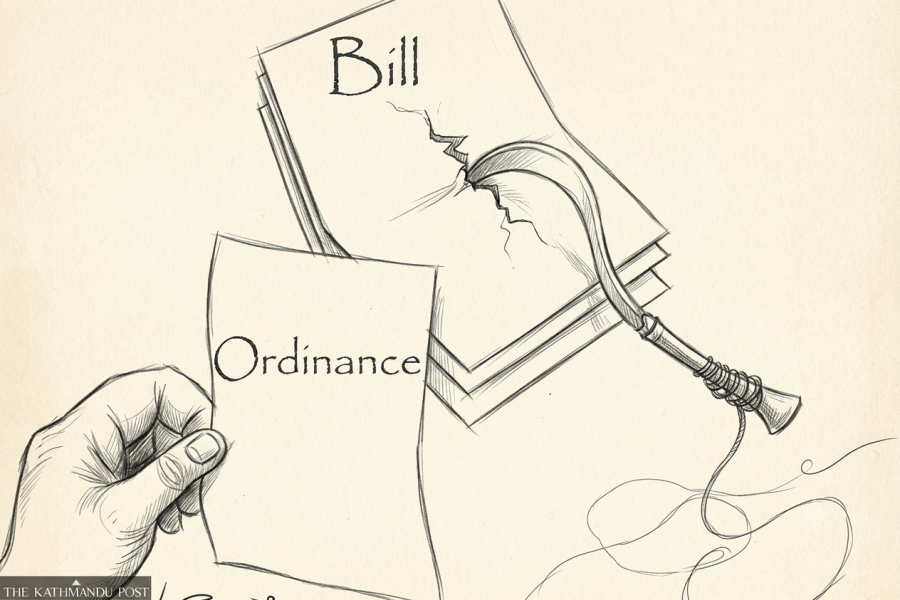
The Rastriya Swatantra Party government is set to lose half of the eight ordinances introduced in April after it became virtually impossible to secure parliamentary approval within the 60-day constitutional deadline. This shows the limits of governing through ordinances without securing support in parliament.
President Ramchandra Paudel issued the eight ordinances between April 30 and May 5 on the recommendation of the government. All were tabled in both houses of the federal parliament on May 11 for endorsement.
Under article 114 of Nepal's Constitution, an ordinance must be endorsed by both the House of Representatives and the National Assembly within 60 days of being tabled in parliament through replacement bills. Otherwise, it automatically ceases to have legal effect.
With the constitutional deadline ending on Thursday, four politically contentious ordinances have failed to enter the parliamentary approval process and are now expected to lapse automatically.
The ordinances relate to amendments to the Constitutional Council Act, special provisions concerning the removal of public office holders, amendments to laws governing universities, and amendments to several other acts.
The government has not initiated the process of introducing replacement bills for these four ordinances in either chamber after failing to build the political consensus required for their endorsement.
Although the ruling Rastriya Swatantra Party (RSP) commands a super majority in the House of Representatives, it lacks sufficient strength in the National Assembly. As a result, the government has depended on negotiations with the opposition to advance legislation requiring approval from both houses.
The decision to prioritise only four ordinances reportedly followed understandings reached with major opposition parties, allowing less controversial measures to proceed while the disputed ones were effectively placed on hold.
The four ordinances that have moved forward concern amendments to the Cooperative Act, the Public Procurement Act, the Anti-Money Laundering Act and laws governing health science academies. Their replacement bills have already been endorsed by the House of Representatives and forwarded to the upper house.
Even so, none has completed the remaining legislative process.
National Assembly lawmaker Prem Dangal of the CPN-UML said the legislation management committee on Wednesday endorsed replacement bills relating to anti-money laundering and health science academies with recommendations for amendments.
However, replacement bills for the Public Procurement Ordinance and the Cooperative Ordinance remain under committee discussion after lawmakers registered numerous amendment proposals.
The committee called another meeting on Thursday morning to seek consensus on the outstanding proposals.
Kamala Panta, leader of the Nepali Congress parliamentary party in the National Assembly, expressed confidence that all four bills would clear the committee with agreed amendments.
"All four ordinances will be endorsed unanimously by the committee on Thursday through give-and-take," said Panta. "The government has agreed to accept some amendments. Once that happens, both the committee and the government will make compromises to complete the process."
Dangal, however, said there was still no certainty that the remaining two bills would be endorsed. "It depends on how many of the committee's proposed amendments the government is prepared to accept and how many it rejects," he said.
Even if the committee approves all four replacement bills, parliament must still complete deliberations and voting in the National Assembly before they are sent to the President for authentication, leaving lawmakers racing against the constitutional clock.
A fresh dispute has also emerged over how the 60-day deadline should be calculated.
The Federal Parliament Secretariat argues that the count begins on the day after the ordinances were tabled, giving lawmakers until Friday to complete the process.
Parliament General Secretary Padam Prasad Pandey said legal interpretation, procedural laws and court precedents support counting from the following day.
"The counting starts the day after the ordinances are tabled," said Pandey. "Based on the act relating to interpretation of laws, the civil procedure code and several court decisions, the deadline falls on Friday. The Secretariat has determined the deadline accordingly."
Constitutional lawyers disagree.
Senior advocate Chandrakanta Gyawali argued that article 114 clearly requires counting from the day both houses first meet after an ordinance is issued.
"The federal parliament convened on May 11, so the count begins from that day," said Gyawali. "If the ordinances are not approved within 60 days from then, they automatically become ineffective. That is both the letter and the spirit of the constitution."
The disagreement comes against the backdrop of growing criticism over successive governments' frequent reliance on ordinances instead of the regular legislative process.
Theopposition parties have repeatedly accused governments of bypassing parliamentary scrutiny by introducing politically sensitive measures through ordinances, while constitutional experts have warned that the practice should remain an exceptional tool reserved for urgent circumstances.




 13.73°C Kathmandu