Nepal’s LGBTQI+ rights gains remain out of reach for many
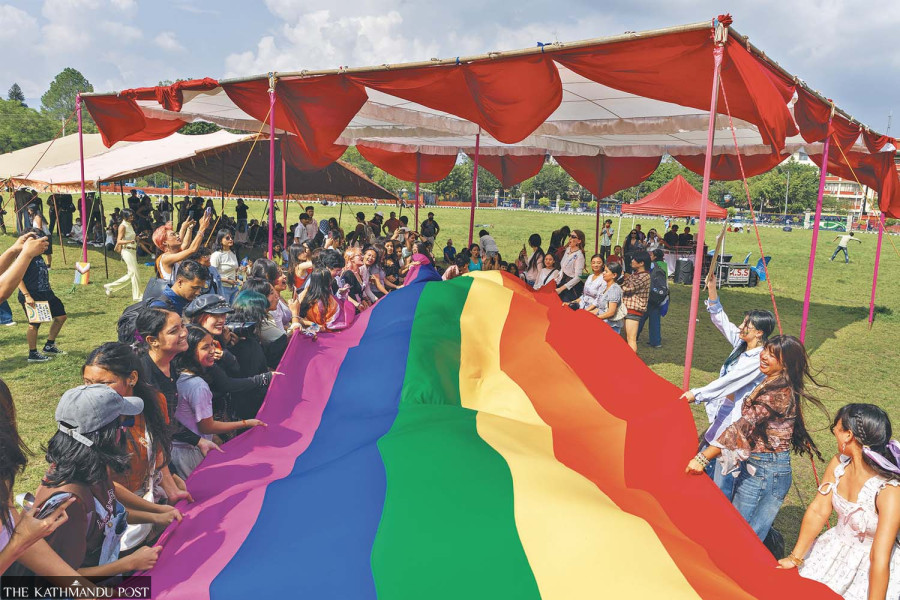
Despite landmark court rulings and constitutional guarantees, members of the community state they still encounter discrimination when seeking documents, education, healthcare, and jobs. People gather at Tundikhel, Kathmandu to celebrate Pride Month on Saturday. Noah Epps/TKP
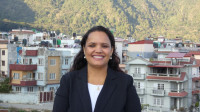
As transgender mountaineer Nilam Paudel stood atop Mount Everest, she fought back tears.
“I was crying on Everest,” Paudel recalled at a Pride Month celebration and national dialogue event in Kathmandu on Monday. “I was thinking about my community, those who I had lost to suicide.”
Yet before making history as the first trans woman to summit Everest, Paudel encountered countless obstacles at home, she said. While applying for trekking and climbing permits from the Department of Tourism, officials repeatedly demanded additional documents and initially refused her applications because she was transgender.
Her experience reflects what LGBTQI+ activists say is a persistent contradiction in Nepal. While the country is often hailed as one of South Asia’s most progressive nations on sexual and gender minority rights, many members of the community continue to face barriers in accessing basic government services, legal recognition, education, and employment.
This disconnect was the focus of a new policy brief released by the Blue Diamond Society during Monday’s Pride Month event, which brought together activists, lawmakers, artists, provincial representatives, and community leaders to discuss the status of LGBTQI+ rights across Nepal.
The report argues that despite constitutional guarantees and a series of landmark Supreme Court rulings recognising gender identity and protecting the rights of sexual and gender minorities, implementation remains inconsistent and often discriminatory. For many transgender, intersex, and non-binary Nepalis, obtaining citizenship documents that accurately reflect their gender identity remains one of the biggest challenges they face.
“The constitution exists, but implementation has not occurred,” said Samon GC, one of the presenters of the policy brief.
“We talked with representatives from all seven provinces,” he said. “There are still many loopholes in obtaining educational certificates, passports, and other documents. Things that might take two or three hours for a cisgender person can take two or three years for us.”
For decades, Nepal has been viewed as a regional pioneer on LGBTQI+ rights. The Supreme Court’s landmark 2007 ruling in the Sunil Babu Pant case directed the government to recognise sexual and gender minorities and establish legal protections. Subsequent court decisions further affirmed the right to self-identification and legal recognition of gender identity.
Article 12 of the Constitution of Nepal guarantees the right to obtain citizenship certificates reflecting an individual’s self-identified gender. Courts have repeatedly interpreted constitutional protections to include the rights of transgender, intersex, and non-binary individuals to live with dignity and have their identities legally recognised.
However, according to the policy brief and activists, those rights often remain inaccessible in practice.
The report documents cases in which local governments and District Administration Offices have refused to issue citizenship certificates based on self-identification, instead demanding medical examinations, proof of surgery, or psychiatric evaluations, despite court rulings stating such requirements are unnecessary.
The policy brief also highlights the continued use of “Sarjamin Muchulka,” a public inquiry process requiring individuals to gather local witnesses to verify their gender identity, which activists describe as invasive and humiliating.
“Citizenship is not only a document,” the report argues. Without legal recognition, individuals can be excluded from formal employment, education, healthcare, banking services, and legal protections.
Manisha Dhakal, executive director of the Blue Diamond Society, said Nepal’s achievements should not obscure the work that remains.
“Nepal is very progressive in South Asia,” she said. “But there is still work to be done and actions that need to be taken to address the legal and structural gaps that still exist.”
Dhakal pointed to the legacy of the Pant decision as a milestone in the movement for LGBTQI+ rights while emphasising that progress has stalled in some areas.
“We have made great achievements, but we are not there yet,” Dhakal said.
The policy brief argues that the consequences of inconsistent implementation extend far beyond citizenship offices. Educational institutions often refuse to update academic records after citizenship documents are amended, creating bureaucratic deadlocks that can prevent students from receiving transcripts, sitting for examinations, or continuing their studies.
The report cites cases in which transgender and intersex students were barred from examinations or accused of identity fraud because their appearance did not match information contained in official records.
Employment presents similar challenges.
Speaking at Monday’s event, activists said discrepancies between an individual’s gender identity and official documents frequently result in exclusion from formal employment opportunities, forcing many into informal work where labour protections are limited. Financial institutions have also been accused of suspending accounts or creating obstacles during identity verification procedures when documents do not align with an individual’s appearance.
The event also highlighted concerns that conditions outside Kathmandu are often far more difficult than national-level legal developments suggest.
Sanjay Sharma, programme director of Blue Diamond Society, said that discussions about progress frequently focus on urban centres while overlooking realities elsewhere.
“We can always talk about Kathmandu,” Sharma told the Post. “But what is the ground reality in the provinces?”
Representatives from all seven provinces presented reports on local conditions, achievements, and challenges facing LGBTQI+ communities. Several presentations cited limited funding, insufficient staffing, weak implementation mechanisms, and lack of public awareness as major barriers to advancing inclusion and equality.
In Madhesh Province, presenters highlighted budget shortages, administrative delays, and coordination problems between provincial, local and federal governments. Representatives from Bagmati Province identified citizenship, education, healthcare access, discrimination, and underrepresentation in policymaking as continuing concerns.
At the same time, speakers celebrated growing visibility and representation for LGBTQI+ Nepalis.
The event featured a panel discussion including Paudel, transgender lawmaker Bhumika Shrestha, actor Pushpa Lama, and Miss Universe Nepal 2025 first runner-up Aarohi Basnet.
The speakers reflected on personal milestones that would have been nearly unimaginable for previous generations.
Pushpa Lama discussed her experience appearing in “Elephants in the Fog,” a Nepali film that recently received a standing ovation at the Cannes Film Festival.
“At Cannes, nobody looked at gender or race,” she said. “Everyone sat together. People were sharing stories.”
Basnet spoke about pursuing her childhood dream of competing in Miss Universe Nepal despite discrimination and social pressures.
“I did not win by myself, I won with this community,” she said. “I created history with this community.”




 14.57°C Kathmandu