Tuin Khola landslide threat persists as monsoon nears
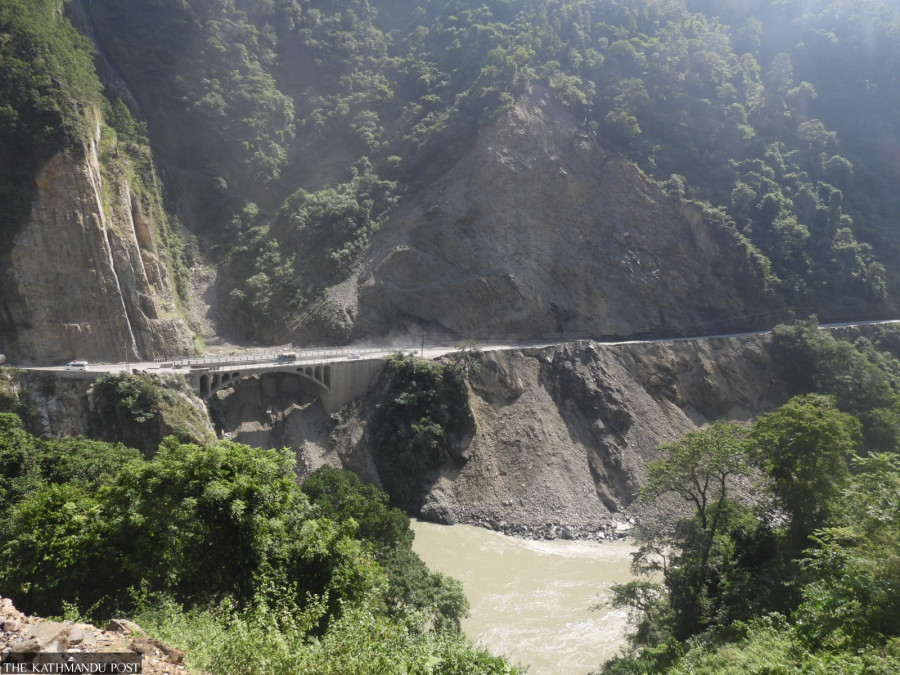
Delayed mitigation efforts continue to endanger traffic along the Narayanghat-Mugling road. Prolonged closures also disrupt travel and supplies to Kathmandu. A file photo of the landslide-hit Tuin Khola section along the Narayanghat-Mugling road.
The Tuin Khola section near Mugling has once again become a major landslide risk ahead of the monsoon, threatening traffic on the busy Narayanghat-Mugling road.
The landslide-prone area has repeatedly disrupted movement on the highway over the past two to three years, leaving vehicles and travellers stranded for hours during the rainy season. A massive landslide near Tuin Khola on September 23, 2025, had paralysed traffic on the road.
Despite repeated disruptions, authorities have yet to implement a sustainable solution. Efforts to control the landslide generally slow once the monsoon ends and resume only after fresh incidents occur.
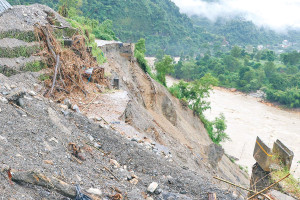
This year, too, mitigation efforts began only after new landslides had already started affecting traffic. On May 3, a dry landslide reduced traffic to one-way movement near Tuin Khola. Another landslide on May 7 again forced a one-way operation for some time and led to an accident.
A falling rock struck the fuel tank of a moving car, causing it to catch fire. Deputy Superintendent of Police Rabindra Khanal, spokesperson for the Chitwan District Police Office, said the fire was immediately extinguished and no casualties were reported.
The following morning, another landslide completely blocked the road in both directions, prompting the Division Road Office in Bharatpur to issue a tender notice for landslide control works.
The tenders cover mitigation works at Tuin Khola and nearby Namsi Khola. Krishna Acharya, information officer at the Division Road Office, said tenders had initially been called for works on the Mugling side of Namsi Khola and at Tuin Khola.
Separate tenders for the Bharatpur side of Namsi Khola and Kalikhola would also be issued soon, he said. A total budget of Rs430 million has been allocated for works at the four sites.
At Tuin Khola, rocks and debris fall from slopes rising up to 105 metres above the road. Even small rocks can cause serious accidents if they hit moving vehicles below. Large landslides have repeatedly blocked the highway for hours.
Although the tender notice has been issued, Acharya said the contractor selection and agreement process would likely continue until around June 29.
“By then, the monsoon will already be in full swing,” Acharya said. “It is difficult to say whether work can continue during heavy rain. If rainfall remains below average after the contract is awarded, some work may still be possible.”
The planned mitigation measures include rock anchoring and rock netting.
Engineer Arjun Ghimire said unstable rock masses would first be cleared before steel rods four to five metres deep are installed into stronger rock layers to stabilise the slope and prevent collapse.
Special mesh netting would then be installed to stop smaller rocks from falling onto the road.
Ghimire said three types of mesh would be used, including standard rock nets, high-strength nets and three-dimensional mesh systems that support vegetation growth.
“We plant vegetation through the mesh so that, over time, the roots help stabilise the slope naturally,” he said.
The Narayanghat-Mugling road is one of Nepal’s busiest highways, carrying more than 12,000 vehicles daily. It is the main route linking Kathmandu and Pokhara with the eastern and western regions of the country.
Continuous landslides at Tuin Khola have stripped much of the hillside bare. The landslide stretches around 165 metres, with debris falling from heights of up to 105 metres above the road, making the area highly dangerous during the monsoon.
According to Ghimire, a major landslide occurred at Tuin Khola two years ago during the rainy season, blocking the road for hours. Last year alone, the road remained obstructed for a total of 184 hours due to repeated landslides.
The largest incidents occurred on September 19 and 23, 2025. The September 19 landslide blocked the road for 46 continuous hours, while the September 23 landslide shut the highway for 58 hours.
The highway, used by passenger buses, private vehicles and cargo trucks, is considered a lifeline for Kathmandu. Prolonged closures not only strand travellers but also disrupt supplies to the capital.




 21.05°C Kathmandu
1.jpg)