Temporary shelter away from Capital disrupts jobs, schooling and daily life for displaced families
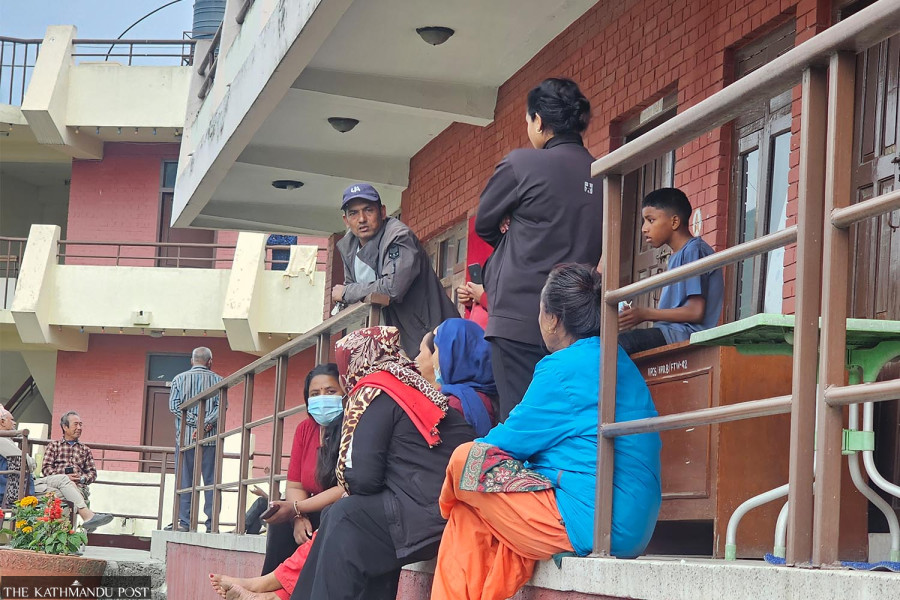
Around 100 squatter families from Kathmandu have been housed at a Nepal Red Cross facility in Budol, Kavrepalanchok. Squatter families housed at the Nepal Red Cross Society facility at Budol in Banepa, Kavrepalanchok, are pictured on Sunday. Jyoti Shrestha/TKP
Until a few weeks ago, Dalli BK spent her days cleaning homes, offices and organisations across Kathmandu. Mornings and evenings were filled with work both outside and inside her small hut in the Manohara squatter settlement, where she lived with her two sons.
Now, 38-year-old Dalli spends most of her time inside a temporary shelter at Nepal Red Cross Society training centre in Budol in ward 6 of Banepa Municipality. Since being displaced from Kathmandu, she has lost not only her home but also her livelihood.
On April 25, bulldozers demolished the settlement where Dalli had lived for years. She says the demolition shattered the fragile stability she had built after moving to Kathmandu from Humla around 15 years ago with her husband in search of work.
“If my husband were still alive, I would at least feel there was someone beside me. Now I have to manage everything alone. My sons are still young,” she lamented. “Somehow I can survive, but I worry about their studies and future. I have no work and no money.”
Dalli’s husband died in 2015, leaving her to raise their sons, now aged 13 and 11. The family built a small hut in Manohara riverbank a few years after arriving in Kathmandu. She says life was difficult but manageable until the eviction.
After receiving notice to vacate the settlement, Dalli searched for rented rooms around Manohara, Lokanthali, Koteshwar and Bhaktapur. But she says landlords refused to rent rooms once they learned she came from the squatter settlement. “They immediately treated us differently after hearing we were from the squatter settlement in Manohara. Some even said they would not rent to a single woman. One room cost between Rs8,000 and Rs10,000. After that, I stopped searching,” she shared her ordeal.
Long journeys to keep jobs alive
Nima Lama, another displaced resident, now spends three to four hours travelling between Banepa and Kathmandu to keep his job as a security guard in Dhobighat, Lalitpur. Before the Thapathali settlement was removed, he could reach work within half an hour. Since authorities shifted displaced families first to Balaju and later to Banepa, commuting has become exhausting and expensive.
“Father leaves early in the morning and returns only at night. When we lived in Thapathali, going to work was easy for him,” said his daughter Anisha Tamang. “Now the journey itself has become a burden. We do not know where they will send us from here. Being shifted from one place to another has made life extremely difficult for those who have to travel for work,” she added. The family says the uncertainty has made it difficult to plan work, schooling or daily expenses.
Januka Pokharel, who was also displaced from Manohara, said she had to quit her job at a cafe in Kathmandu after being relocated to Budol. Her husband works at a Balaju-based factory but struggles to travel regularly from Banepa. According to her, her husband sometimes stays with friends and relatives near his workplace because daily travel has become impractical.
“Earlier, I sold goods on pavements,” said Januka. “After the Kathmandu Metropolitan City banned roadside vending, I worked at a cafe for two years. Our combined income supported the family and our daughter’s education. After being displaced, I could no longer travel daily from Banepa while caring for my child, so I had no alternative but to quit the job.”
For Gita Pariyar, displacement ended the tailoring work she carried out from her home in Thapathali. She said the sewing machine that supported the family’s income was lost after the demolition. “I used to stitch clothes from home and run the household from that income. Now there is no home, no sewing machine and no earnings,” she lamented.
Gita’s son recently appeared in grade 12 examinations, but she says she has not even been able to visit him. Her husband is ill and unable to move around, leaving her solely responsible for the family. According to her, she had tried to arrange housing before the eviction and even paid an advance for a rented room in Balkot. But the landlord later returned the money upon learning they were squatters. “We paid Rs10,000 in advance. The next day, they told us we were squatters and refused to rent the room,” she shared her ordeal.
Ayusha Tamang, who relied on daily wage labour, said displacement has left her family without any income. She now struggles to feed her two-year-old daughter. “If we work, we eat. If we don’t work, we go hungry,” she said. “My child cries from hunger sometimes. I borrow money just to buy food.”
Originally from Sunsari, Ayusha and her husband had built a small hut in Thapathali through years of labour work. She says the government removed them without ensuring proper alternatives. “We carried loads and sweated to build that small shelter,” she said. “Now we have nothing. We feel as though we are not treated like human beings.”
Roshani Pariyar, another displaced squatter from Thapathali, said she lost both employment and education opportunities after the eviction. She worked at a clothing store in Lazimpat and earned around Rs12,000 a month. But she lost the job after being displaced and could not sit her grade 12 examinations because she injured her hand during the demolition. “I still do not know where we will live. I worry about how my younger brothers will continue their studies,” she said.
Around 100 displaced people from Kathmandu’s squatter settlements are currently staying at the Budol holding centre under the coordination of the Ministry of Urban Development. The displaced include infants as young as two weeks and elderly people aged around 90 years. At least 28 children are living at the centre.
Men working as daily wage labourers continue travelling to Kathmandu each morning, while most women and children remain inside the temporary camp. Food arrangements have been made through a nearby hotel.
The evictions come amid continued drives by Kathmandu authorities to clear riverbanks and public land occupied by informal settlements. Many squatter families displaced from river corridors have repeatedly called for rehabilitation arrangements before demolition, arguing that sudden evictions destroy livelihoods, interrupt children’s schooling and push already vulnerable families deeper into poverty.
Khagendra Bista, sociologist at the High Powered Committee for Integrated Development of Bagmati Civilisation under the Ministry of Urban Development, said the Banepa shelter is only temporary. “This arrangement is not for long-term settlement. Screening and verification of genuine landless families are underway. Once the process is completed, the government will manage rehabilitation for eligible families,” said Bista.
According to Bista, authorities aim to complete the screening process within 10 to 15 days. Families failing to meet government criteria, however, may have to return on their own.




 14.79°C Kathmandu