Nagdhunga–Sisnekhola tunnel road near completion, opening hinges on operation deal
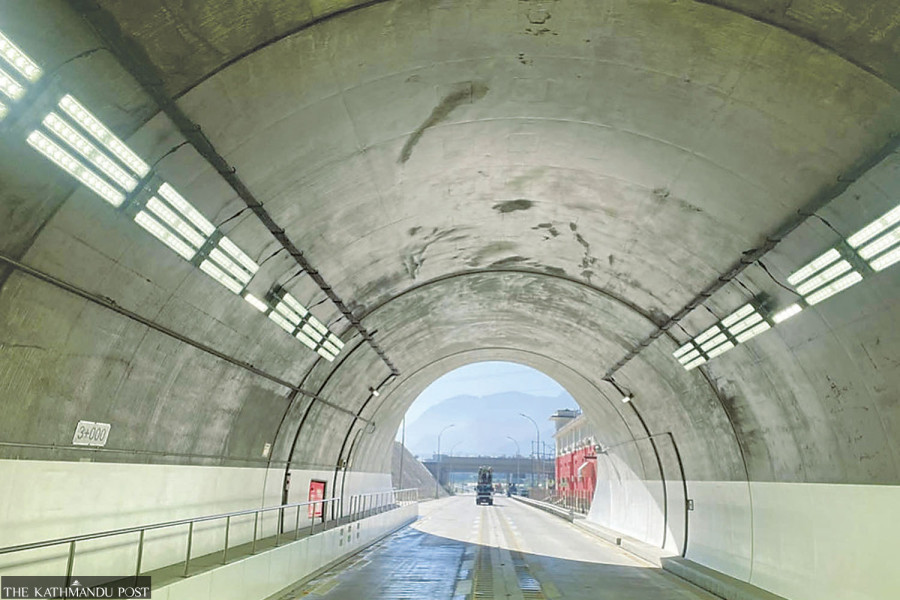
With 98 percent of work done, authorities expect full operations within three months as staffing, safety systems and toll infrastructure are finalised. Construction of tunnel began on October 21, 2019, with a completion target of 42 months. Post file photo
The Nagdhunga–Sisnekhola tunnel road project is 98 percent complete, but it has yet to open as authorities move to finalise a service provider agreement critical to its operation.
Project director Saujanya Nepal said the contract with the selected operator is expected to be signed within this week. “The company is preparing the required documentation. Once the agreement is concluded, it will be mobilised immediately,” he said.
The operation contract has been awarded to the Yusin–ART JV, a joint venture between a Chinese and a Nepali firm, although the agreement is still in its final stage.
Nepal said the tunnel will not be opened to traffic until all operational systems are fully in place, stressing passenger safety as the primary concern. According to him, the tunnel is expected to come into operation within three months of the agreement being signed.
That timeline is largely driven by the need to recruit and train around 150 personnel who will run the facility. “The tunnel will operate round the clock. Staff must be thoroughly trained before deployment, particularly in such a controlled and high-risk environment,” he said.
The training programme will involve officials from the Department of Roads, project staff, consultants and technical teams from the construction company. Selected personnel will also undergo practical orientation within the tunnel, including the full stretch from Kathmandu through to the Dhading exit.
A trial run is likely by mid-May, while full-scale operations are expected by mid-July, placing the opening in the middle of the monsoon season.
Authorities said slope stabilisation works on the Dhading side and construction of toll plazas are now in their final phase.
Once operational, the selected service provider will be responsible for managing the tunnel for five years. Its mandate includes maintenance, traffic control, emergency response, toll collection and oversight of the 2.8-kilometre access roads linking both sides of the tunnel. All toll revenue collected must be deposited daily into the Road Board Nepal account.
Toll structure finalised
The government has already set toll rates through a gazette notification.
Cars and vans will be charged Rs65 when entering Kathmandu and Rs60 when exiting. The project estimates around 859 such vehicles will enter the Valley daily, while 646 will exit.
Mini-buses, trucks and tippers will pay Rs115 to enter and Rs80 to exit, with an estimated daily flow of 540 entering and 406 exiting.
Buses and trucks will be charged Rs260 for entry and Rs200 for exit. Daily traffic is projected at 794 entering and 597 exiting.
Heavy vehicles, including large trucks and lorries, will pay Rs600 to enter and Rs250 to exit, with an estimated 596 entering and 448 exiting each day.
Access restrictions defined
Under the Tunnel Operation Directive, pedestrians, two-wheelers, three-wheelers and other non-motorised vehicles will be barred from using the tunnel.
Vehicles carrying highly flammable or explosive materials, including fuel and gas, will also be prohibited. Such vehicles will instead use the existing Nagdhunga–Sisnekhola road.
Road Board Nepal said toll collection will be fully digital. Executive Director Ganesh Bahadur KC said a Chinese firm will be engaged to handle toll operations due to limited in-house capacity, with oversight retained by the board.
“This is entirely new technology for Nepal, and there is a shortage of experienced personnel,” he said. He added that more advanced and efficient tolling systems will be introduced within six months to a year of operation.
Construction of the tunnel began on October 21, 2019, with an original completion target of 42 months. The deadline has since been extended multiple times and now runs until May 14, 2026.
The main tunnel stretches 2,688 metres, while the emergency tunnel runs 2,557 metres. The project is being executed by Japan’s Hazama Ando Corporation, financed through a concessional loan of Rs16 billion from Japan and Rs6 billion from the Government of Nepal. A proposal for an additional loan of around Rs5.5 billion is currently under consideration at the Ministry of Finance.




 16.62°C Kathmandu