Seven bodies from September 9 fire remain unidentified as DNA profiling stalls
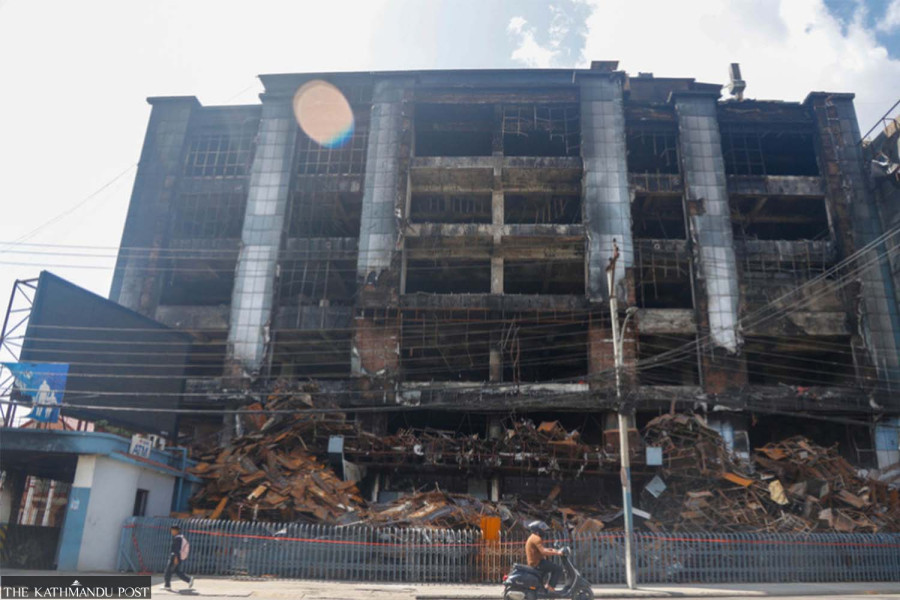
Authorities struggle to extract samples from severely burnt remains, delaying identification of the deceased. The bodies were found in a burnt state inside the store, but officials said their condition has made even sample collection for DNA testing extremely difficult. Post file photo
The identification of seven bodies recovered from the Chuchepati-based Bhatbhateni Supermarket fire during the September 9 protests has stalled as authorities have been unable to conduct DNA profiling due to the severely damaged condition of the remains.
The bodies were found in a burnt state inside the store, but officials said their condition has made even sample collection for DNA testing extremely difficult.
Senior Superintendent of Police Ramesh Thapa, chief of the District Police Range, Kathmandu, said efforts are ongoing to trace the families of those reported missing during the protest period.
“We are reviewing missing persons reports from that time to identify possible links,” Thapa said. “Around seven to eight cases that may be related to this incident are being examined separately.”
Police had collected the remains shortly after the incident and sent them to the forensic department at Tribhuvan University Teaching Hospital. However, doctors said post-mortem examinations were not possible due to the condition of the bodies.
According to a forensic doctor, the remains were brought in separate bags and were almost entirely reduced to ash. Only small bone fragments were recovered.
“The remains were almost fully burnt, so we suggested DNA-based identification if possible,” the doctor said. “Some fragments have been stored, but there was very little usable material.”
Police said employees and others who entered the supermarket on September 9 had alerted authorities after seeing the remains, prompting a response from the Gaushala police team.
“What remained was mostly ash that only indicated the presence of bodies,” a Kathmandu police officer said, adding that only small bone fragments were found at the site.
Superintendent of Police Pawan Bhattarai said samples had been sent to the Central Forensic Science Laboratory for DNA analysis, but officials concluded that no viable samples could be prepared.
“We are now exploring other options after being informed that testing may not be possible here,” Bhattarai said. “We have also heard that facilities in Europe, including Vienna, may have the capability, but that is still at a preliminary discussion stage.”
Nepal has two main forensic facilities, the Nepal Police forensic lab and the National Forensic Science Laboratory in Khumaltar. In this case, samples were sent only to the police lab.
Jeevan Prasad Rijal, former executive director of the National Forensic Science Laboratory, said samples should also be tested at both facilities.
“In such cases, samples should be tested in both government labs,” he said. “Even in high-heat burn cases, DNA can sometimes be extracted from bones or teeth.”
He recalled a previous case in Shivapuri where only charred bone fragments were recovered, yet DNA extraction was attempted and later sent abroad when local testing was insufficient.
“These cases are rare, but some countries do have advanced technology,” he said. “If necessary, joint discussions between experts from both laboratories could help find a solution.”
The September 8 protest turned violent after police used force to control demonstrators, resulting in 21 deaths in Kathmandu and Koshi provinces that day alone. A curfew was imposed in the afternoon after protesters breached security barriers and reached the federal parliament.
The following day, September 9, protests escalated further, leading to the resignation of then Prime Minister KP Sharma Oli. Subsequent unrest saw vandalism, looting and arson targeting major state institutions, including Singha Durbar, the Supreme Court and commercial structures such as Bhatbhateni outlets.
A high-level commission led by Gauri Bahadur Karki reported that 76 people died during the September 8 and 9 events, with 42 killed by police gunfire. It said three police personnel died in attacks by protesters, while others were killed during looting incidents.
The report stated that 2,522 people were injured and damages exceeded Rs85 billion. At the Bhatbhateni Tangal branch alone, 2,192 SIM cards were reportedly active during the incident period.
The commission recommended legal action against former prime minister Oli, then home minister Ramesh Lekhak and other officials for the September 8 violence. However, it said further investigation was needed for the September 9 events, citing limited mandate and time constraints.
It added that a detailed investigation involving experts and analysis of available evidence, including video footage and victim statements, was necessary. The government has since announced plans to form a committee to investigate the September 9 incident, but progress has been slow.




 26.12°C Kathmandu