To Karnali people, unreliable passenger flights are sickening
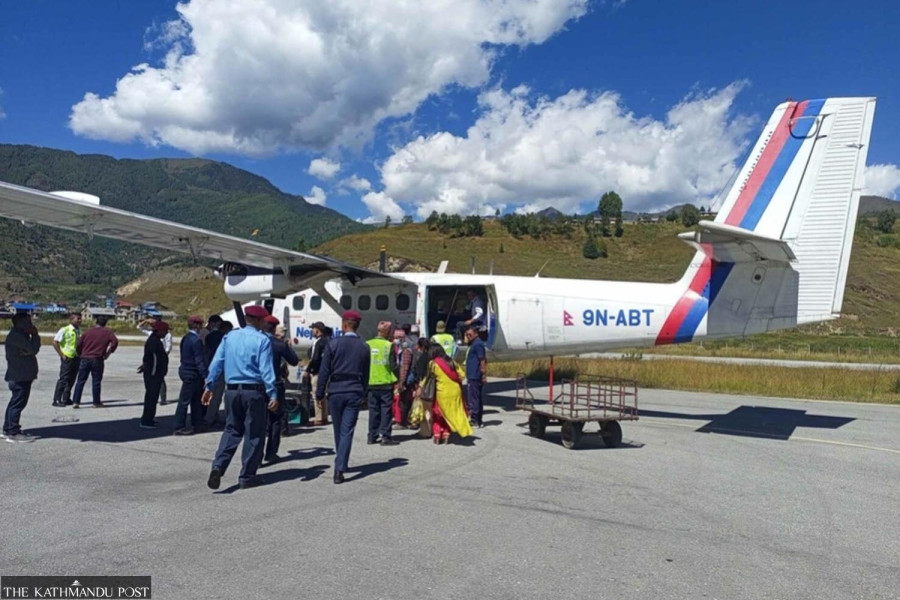
In a geography where good roads are non-existent, even patients needing urgent flight are forced to return from airports.A Nepal Airlines plane pictured shortly after landing at Jumla Airport in this recent photo. DB Budha/TKP
On April 8, 71-year-old Kal Bahadur Adhikari of Hima Rural Municipality-6 in Jumla was admitted to the Karnali Academy of Health Sciences Teaching Hospital after his diabetes worsened. Doctors later referred him to Nepalgunj for prostate surgery because his condition could not be managed locally.
His relatives waited the entire day for a scheduled flight from Jumla, but the aircraft never arrived. As his health deteriorated, the family decided to transport him to Nepalgunj in an ambulance arranged by Hima Rural Municipality. The ambulance crashed in Khadachakra Municipality-2 of Kalikot district before reaching its destination. Adhikari’s son Bhim Bahadur, 32, and ambulance driver Shakti Bahadur Shahi, 26, died in the accident. Adhikari himself was injured. “If the plane had arrived that day, my treatment would have been easier. Instead, I lost my son,” said Adhikari.
Many patients in Karnali continue to face similar hardships because of irregular flights.
Every week, airlines release flight schedules for the remote Karnali region. Passengers buy tickets with hopes of reaching hospitals, schools, government offices or family events on time. Yet for many residents, a ticket is no guarantee that an aircraft will actually arrive.
Passengers often spend hours waiting at airports in districts such as Jumla, Dolpa, Humla and Mugu, only to be told that flights have been cancelled because of bad weather or technical problems. For residents of Karnali, where roads remain dangerous and unreliable, repeated flight disruptions have become a part of daily hardship.
The consequences are often severe. Critically ill patients miss referrals, travellers are stranded for days and families are forced to risk dangerous road journeys through mountain highways prone to landslides and accidents.
Sabee Kami, 21, of Chandannath Municipality-8 in Jumla was admitted to the Karnali Academy teaching hospital this week after developing heart, chest and lung complications. Doctors advised her family to take her to Nepalgunj with oxygen support on a flight.
But the scheduled Wednesday service did not operate. “The doctors here had already referred her, but the flight was cancelled. We had to return to the hospital again,” said Binod Kami, the patient’s brother.
Durga Rawat of Tila Rural Municipality-8 in Jumla said she had planned to travel to Nepalgunj after her chronic gastritis worsened. She said treatment at the Karnali Academy had failed to improve her condition.
“I cannot undertake a painful road journey. We reached the airport because Nepal Airlines had announced a Wednesday flight, but for two days the service was cancelled citing bad weather.”
According to passengers, many travellers had already completed security checks and entered the airport terminal before airline staff announced that flights would not operate. Rawat was forced to cancel the ticket.
Local people find the services of both the Nepal Airlines and private flight operators frustrating.
Private airlines are accused of shifting aircraft to eastern Nepal during the tourist season, where operators can earn more by transporting trekkers and tourists. Residents say Karnali is often left with limited services during peak travel periods.
Nepal Airlines, meanwhile, has been criticised for repeatedly cancelling flights citing technical problems and weather conditions. According to its timetable, Nepal Airlines is supposed to operate flights to Jumla from Nepalgunj on Sundays, Tuesdays and Wednesdays, and from Surkhet on Tuesdays.
Chandralal Neupane, a local, said only one scheduled flight operated in the past week. “When flights are cancelled, patients either have to pay expensive fares for private airlines or risk dangerous road travel,” said Neupane. People prefer flights as the 232-kilometre Karnali Highway is narrow and damaged at places in the rainy season.
“Even light rain causes vehicles to stop or leaves them stuck in mud,” said Neupane. “If one vehicle breaks down, traffic can remain blocked for hours. The blacktopped road built five years ago has already peeled away, so even winter travel becomes dusty and difficult.”
Umakant Adhikari, the Nepal Airlines station chief in Jumla, said weather conditions were largely responsible for flight disruptions. “We call passengers to the airport after confirming the schedule. But if the aircraft cannot arrive, we have no choice but to send them back,” he said. Two seats per flight are reserved for patients and government employees.
Jumla is served by Nepal Airlines, Tara Air, Summit Air and Sita Air, although residents say private airlines frequently cancel flights citing low passenger numbers.
Dr Kamal Thani, director of the teaching hospital at the Karnali Academy of Health Sciences, said irregular flights have forced many referred patients to remain admitted longer than necessary.
“Sometimes we refer patients to Nepalgunj, but flights are cancelled repeatedly. The patients then have to stay in the hospital again while their families struggle with extra expenses,” he said.
Residents of Mugu and Humla, where road access remains poor, depend heavily on air travel. Guru Tamang of Mugum Karmarong Rural Municipality said passengers often wait several days without getting tickets.
“Either you need connections with airline staff or support from political leaders,” Tamang said. “First, planes do not arrive regularly. Even if they do, ordinary people often fail to get tickets.”
He alleged that tourists travelling to Rara Lake frequently purchase return tickets in advance, reducing seat availability for locals.
Raj Bahadur Rokaya of Simkot in Humla pointed to another problem. Fuel occupies the space of two or three passengers, and seats are also reserved for government staff. “You may have to spend a week searching for a single ticket,” he said.
Humla was connected to the national road network only last year. But the rough road from Simkot to Surkhet still takes nearly two days to travel. Ram Bahadur Bhandari, president of the local Chamber of Commerce and Industry, said the newly opened road remains difficult and unreliable. “Travelling on the rough track is exhausting and risky,” he said.
One aircraft, many destinations
Nepal Airlines currently operates only two Twin Otter aircraft. One aircraft serves eastern districts from Kathmandu, while the second is based in Nepalgunj for Karnali operations.
According to airline staff, the Nepalgunj-based aircraft is brought from Kathmandu on Sunday mornings and returned to the capital on Friday evenings. The aircraft had remained grounded for a long period before returning to service after repairs.
Yamaraj Singh, the Nepal Airlines chief in Nepalgunj, said the ageing plane continues to face technical issues. “The aircraft has a very demanding schedule. In six days, it is expected to operate nearly 40 flights. Technical problems and bad weather often affect operations,” he said. Nepal Airlines recently returned to Chaurjahari Airport in West Rukum after years of suspension.
Travel agent Amar Raj Pun said the airline has overloaded a single aircraft with too many destinations. “The schedule is unrealistic,” Pun said. “Pilot flight hours, weather conditions and technical problems lead to three or four cancellations almost every day. Passengers suffer because of poor planning.”
Airline staff occupy passenger seats
Small aircraft operating in Karnali usually have 19 passenger seats excluding crew members.
However, Nepal Airlines flights based in Nepalgunj also carry one engineer and one technical staff member on board. One of them is stationed in Nepalgunj and the other in Surkhet. Because additional fuel must also be carried, airlines often limit passenger numbers to around 15.
Pradip Aryal, chief of the Civil Aviation Office in Jumla, said the technical staff travel continuously because local airports lack permanent positions for engineers. “One employee handles refuelling, while the engineer travels to prevent technical complications,” said Aryal.
He argued that the absence of proper staff management reduces passenger seats and causes financial losses.
Yamaraj Singh of Nepal Airlines said technical inspections before every flight are mandatory.
“We need another employee to handle fuel and technical checks. We have repeatedly requested staff management support from the central office, but the issue has not been addressed,” he said. According to him, carrying travelling staff on flights costs the airline up to Rs130,000 each month in lost revenue.
Nepal Airlines provides up to 50 percent fare discounts for senior citizens, children, students and people with disabilities. Because private airlines charge higher fares, many residents wait for Nepal Airlines tickets despite repeated delays.
“Two discounted seats are provided on each flight, but once the quota is filled, passengers must wait for another aircraft. We have faced ticket shortages for years,” said local resident Kamal Budha.
Weather blamed for flight cancellations
Strong winds regularly affect Humla, Dolpa, Mugu and Jumla, especially after midday. Flights are also disrupted by fog and haze in Nepalgunj and Surkhet.
“Sometimes the weather is clear in one place but unfavourable in another. The aircraft is old and technical problems appear from time to time,” said Singh.
Civil society leader Purichandra Devkota said private airlines adjust schedules immediately after cancellations, while Nepal Airlines changes schedules only on annual, half-yearly or quarterly bases.
“If a private airline cancels today’s flight, another is often scheduled for the next day. But if Nepal Airlines cancels a flight, passengers may have to wait until the next scheduled date,” said Devkota.
He said the cancellation system affects both passengers and the airline’s revenue.
According to him, a Nepal Airlines ticket from Nepalgunj to Jumla costs Rs6,493, while private carriers charge around Rs8,881 or even more for chartered services.
Air tickets hard to get
Although Nepal Airlines has increased flights to Juphal Airport in Dolpa, residents say getting tickets remains extremely difficult.
Durga Prasad Devkota of Tripurasundari Rural Municipality-1 said that passengers once had to wait nearly a month for Nepal Airlines tickets. “Compared to two years ago, flights are more regular now, but the ticket syndicate persists,” he said.
Some passengers now use online booking systems, while others rely on phone reservations. But many residents still have to visit airline offices repeatedly. “Airline staff prioritise people they know and those with influence. Ordinary passengers always struggle to get tickets,” said local leader Bishnu Lal Budha.
Nepal Airlines currently operates flights to Dolpa from Nepalgunj on Tuesdays, Thursdays and Fridays. Kali Bahadur KC, an employee at the airline’s Juphal office, said flights are now operating according to schedule.
Residents recall several tragedies linked to flight shortages in the past. In July 2016, 65-year-old Singh Bahadur Shahi died at Juphal Airport after waiting eight days for a flight to Nepalgunj for medical treatment. In 2018, a Canadian tourist died at the airport after failing to receive timely helicopter rescue during severe altitude sickness.




 24.91°C Kathmandu