Vermicompost gains ground as farmers seek alternative to chemical fertilisers
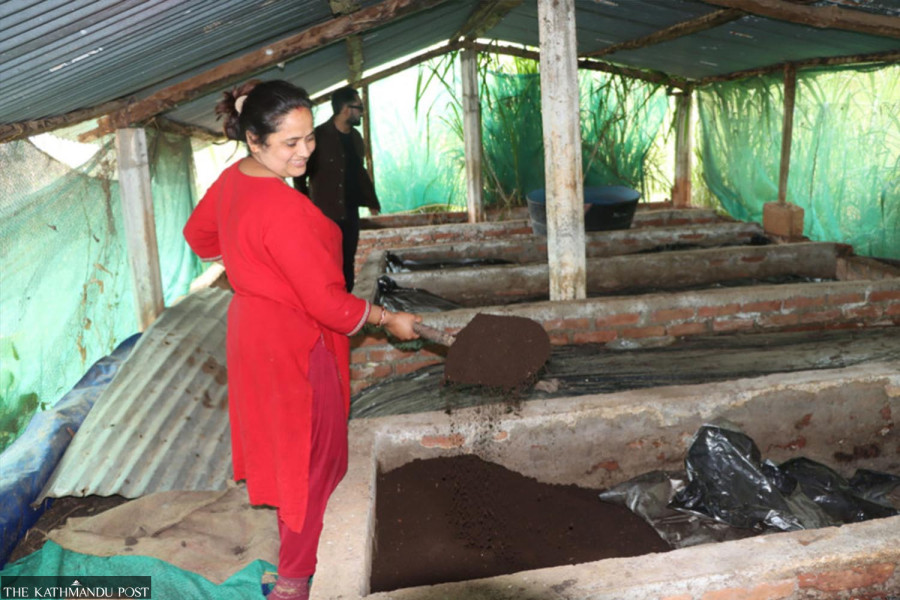
Farmers in Palpa say worm-based manure has improved crop yields and reduced plant diseases, while local producers are expanding output to meet rising demand. Madhav Aryal/TKP
Dilu Magar of Devisthan in ward 4 of Rampur Municipality has been using vermicompost produced from earthworms for the past six years.
Initially, he used the manure for seedling production, but in recent years, he has applied it to vegetable farming as well.
“After using vermicompost, both seedling and vegetable production increased,” Magar said. “Tomato plants that previously yielded four to five kilograms are now producing up to seven or eight kilograms after applying the manure.”
He said fungal infections and plant diseases have also declined.
Dil Bahadur Thapa of Kajipauwa in ward 7 of Tansen Municipality said vermicompost had proven especially effective for raising seedlings. He has been using the manure for the past three to four years.
“ I found it more useful for germinating seedlings, rather than vegetable production itself,” he said. “The seedlings grow healthier and suffer fewer diseases even after being transplanted elsewhere.”
He said processed vermicompost was more effective than applying raw cattle manure directly to the soil, as it supports better plant growth.
According to farmers, Kutu Agriculture Farm in Dharampani of ward 5 of Tansen Municipality has started commercial vermicompost production.
Agro-vets in Tansen distribute the farm’s products, while some farmers travel directly to the farm to buy the manure. Farmers from Rampur and Ribdikot are among regular buyers.
Agriculture expert Sagar Karki said vermicompost helps increase beneficial microorganisms in the soil. According to him, the manure contains all 16 essential nutrients required by plants, which has increased its popularity among farmers.
He said excessive use of chemical fertilisers in recent years has weakened soil productivity.
Bhagwati Paudel Ghimire, operator of the farm, said she began producing vermicompost commercially to restore soil fertility.
Ghimire has built more than 15 pits for earthworm cultivation, while manure is also produced separately outside the pits. She said she started the business six years ago after bringing 20 kilograms of earthworms from Kapilvastu at Rs1,500 per kilogram.
With support from her husband, Subin, she now raises earthworms and produces manure commercially.
“At present, we are packaging the manure and sending it to market,” Ghimire said. “Later, I plan to produce granulated fertiliser as well.”
What began as a small investment has now become a profitable business. From an initial stock of 20 kilograms of earthworms, the farm now has around 300 kilograms. The farm produces nearly 30 quintals of vermicompost every month.
Some farmers and organisations visit the farm directly to purchase both worms and manure. Ghimire said the manure is produced mainly from cattle dung collected from livestock raised at home.
According to her, a single pit can produce up to 150 kilograms of vermicompost in a month. Fallen leaves, cattle dung, jute sacks, discarded paper and rotten vegetables can all be used to produce the manure, although the farm currently relies mainly on cattle dung.
She said earthworms require no specialised feed or intensive care. The farm is also now capable of selling up to 50 kilograms of earthworms every month.
Agriculture expert Karki said vermicompost is around three times more fertile than chemical fertiliser or untreated cattle manure applied directly to fields.
He said the manure can be used in paddy, maize, vegetable farms and household gardens, while also increasing soil microorganisms that improve production and productivity.
In previous years, the Agriculture Knowledge Centre allocated more than Rs500,000 annually to promote vermicompost production. However, officials said no budget has been allocated for the programme this year.
Karki explained that vermicompost is a mixture of decomposed compost and earthworm castings produced after worms consume organic materials.
“There is no shortage of market demand for this manure,” he said. “Farmers who use it once tend to look for the same manure again.”
According to him, earthworms digest only a small portion of the food they consume, while the remaining material is expelled as nutrient-rich granular compost.
Karki said earthworm farming is easier on plastered concrete floors with slight slopes and drainage pipes installed at the lower end. Covering the pits with straw, thatch or plastic to protect them from direct sunlight and rain is considered ideal.
“The structure should be designed so excessive heat does not enter from the roof or direct sunlight,” he said.
He also advised farmers to use cattle dung that has been left to cool for 15 to 20 days before placing worms into the pits. A layer of grass or straw should first be placed at the bottom, followed by a layer of cooled dung.
“This does not require a lot of labour,” Karki said. “Farmers can even produce the vermicompost they need themselves.”




 22.94°C Kathmandu