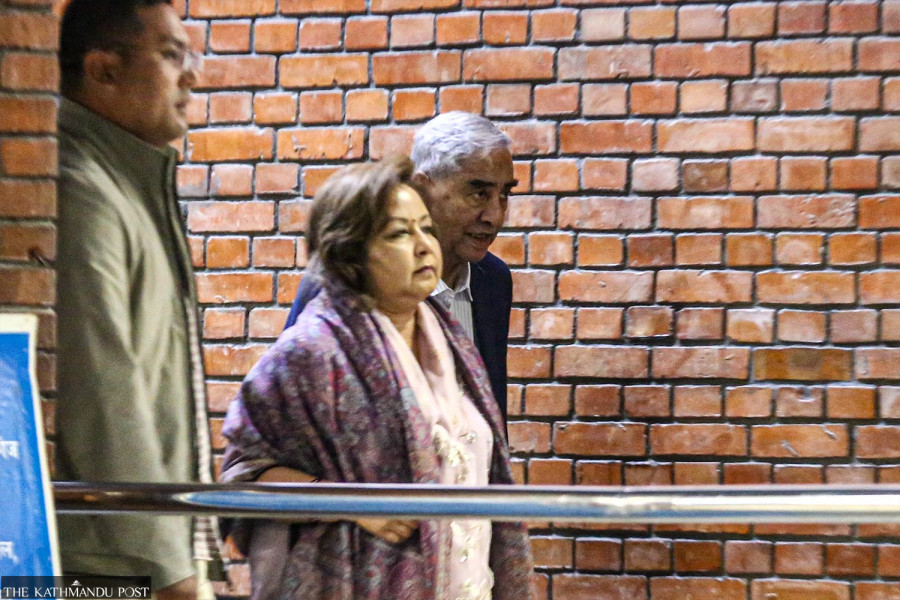
Nepal has renewed its efforts to secure an Interpol red notice against former prime minister Sher Bahadur Deuba and his wife, former foreign minister Arzu Rana Deuba, by sending additional evidence and legal documents to the organisation’s headquarters following queries raised by the international police body.
Senior police officials confirmed that the National Central Bureau (NCB) in Kathmandu recently forwarded a detailed response to the General Secretariat of the International Criminal Police Organisation (Interpol), which had earlier declined to issue a red notice under the existing circumstances and sought further clarification regarding the case.
The request is linked to an ongoing money laundering investigation being conducted by the Department of Money Laundering Investigation (DMLI). According to high-level security officials, Interpol had questioned whether the case involved offences beyond money laundering and had also sought specific legal and procedural documents, including court orders.
In response, Nepali authorities have now submitted additional information, including details related to an investigation into burnt foreign currency notes recovered from the Deuba residence, along with supporting legal documents and records connected to the case.
“After the DMLI requested assistance in issuing a red notice, the police forwarded the relevant documents to Interpol,” a senior police officer familiar with the process told Kantipur. “However, around a week ago, Interpol sought further clarification regarding the nature of the offence and supporting legal procedures. The queries were then sent back to the department for additional details.”
According to police officials, the initial request sent by the department lacked several procedural requirements necessary for Interpol to consider issuing a notice, including an arrest warrant approved by a court.
“This investigation did not originate through the police system, so there may initially have been some misunderstanding regarding the required procedures,” the officer said. “At first, only a request letter seeking a red notice was submitted. Later, when further details were requested, it became clear that an arrest warrant had not yet been issued. Investigating officers subsequently approached the court.”
Following the request from the department, the Kathmandu District Court issued arrest warrants against the Deuba couple on April 7.
The government replaced Gajendra Thakur, then chief of the DMLI, reportedly dissatisfied over the pace and handling of the investigation involving the Deuba family and several other high-profile cases. Nirmal Dhakal has since taken over the department.
Security officials said preparations are also underway to expand the investigation into other potential offences beyond money laundering.
While authorities believe the Deuba couple are currently in Hong Kong, neither the government nor the family has publicly confirmed their whereabouts.
The couple reportedly left Nepal after a series of political and security developments following the Gen Z protests held on September 8, 2025. During unrest on September 9, 2025, the Deuba couple were assaulted at their residence in Budhanilkantha. At the time, the Nepali Army rescued them and transported them to Shree Birendra Hospital in Chhauni for treatment.
After participating in a central committee meeting of Nepali Congress on October 14, 2025, the couple travelled to Singapore on October 27 for further medical treatment. They later returned briefly to Nepal before leaving again for Singapore and eventually travelling onward to Hong Kong.
The money laundering investigation was launched while they were abroad.
The department has also investigated Arzu Rana Deuba’s brother, Bhushan Rana, in connection with the same case. While he was overseas, investigators from the department, assisted by the Central Investigation Bureau (CIB), raided his residence in Jawalakhel on September 28, 2025, seizing electronic devices and several documents for examination.
Beyond the Deuba family, the DMLI has initiated investigations into several other political leaders, including former prime ministers KP Sharma Oli and Pushpa Kamal Dahal, as well as former minister Deepak Khadka.
Khadka was arrested on March 29 during the course of the investigation but was later released after the Supreme Court heard a habeas corpus petition challenging his detention.
According to Interpol’s official guidelines, a red notice is not an international arrest warrant. Rather, it is a request to law enforcement agencies worldwide to locate and provisionally detain an individual pending extradition, surrender, or other legal proceedings.
The extent to which a red notice is acted upon depends on the domestic laws and legal priorities of each member country. Once issued, the notice is circulated among Interpol’s 196 member nations.
Interpol states that red notices are generally issued in cases involving serious offences such as murder, rape, organised crime, or major financial fraud.
“If a person is wanted for prosecution, it means they have not been convicted and are innocent until proven guilty by a court of law,” Interpol states on its official website.
To request a notice, national authorities are required to provide detailed information, including the suspect’s identity, passport details, photographs, fingerprints, descriptions of alleged offences, court orders, and possible locations.
Each request is reviewed by Interpol’s Notices and Diffusions Task Force, a specialised unit composed of lawyers and operational experts responsible for ensuring that requests comply with the organisation’s constitution and operational rules.
“The Task Force considers all available information, including details provided by requesting countries, other member states and open-source information,” Interpol says on its website. The organisation further notes that any request found to violate its constitution or internal rules can be rejected or cancelled.
One of the key provisions relevant to the current case is article 3 of Interpol’s constitution, which strictly prohibits the organisation from engaging in activities of a political, military, religious or racial character.
Because of this provision, Interpol annually rejects or withdraws hundreds of requests that are considered politically motivated or inconsistent with its legal framework. Citing violations of this provision, the Interpol General Secretariat refused to issue red notices against 365 individuals in 2025; 194 in 2024; 179 in 2023; 229 in 2022; 370 in 2021; and 600 in 2020.
Hemanta Malla Thakuri, a former chief of the Central Investigation Bureau who previously worked with Interpol-related matters, said it is common for the organisation to seek clarification when dealing with politically sensitive or legally complex cases.
“In many cases, Interpol asks follow-up questions if the initial details are not sufficiently clear,” Malla told Kantipur. “That is a normal part of the review process.”
Moreover, he added that even if Interpol eventually issues a red notice and the Deuba couple is detained abroad, bringing them back to Nepal could still prove difficult.
“They may argue that there are concerns regarding their safety and whether they can receive a fair trial in Nepal,” he said.
Malla noted that videos showing the attack on the couple’s residence during last September’s unrest remain widely circulated on social media platforms.
“Because of those circumstances, even if a red notice is issued, extradition may still become challenging,” he said.




 15.26°C Kathmandu