Taplenjung Chauri farmers demand resumption of trade with Tibet
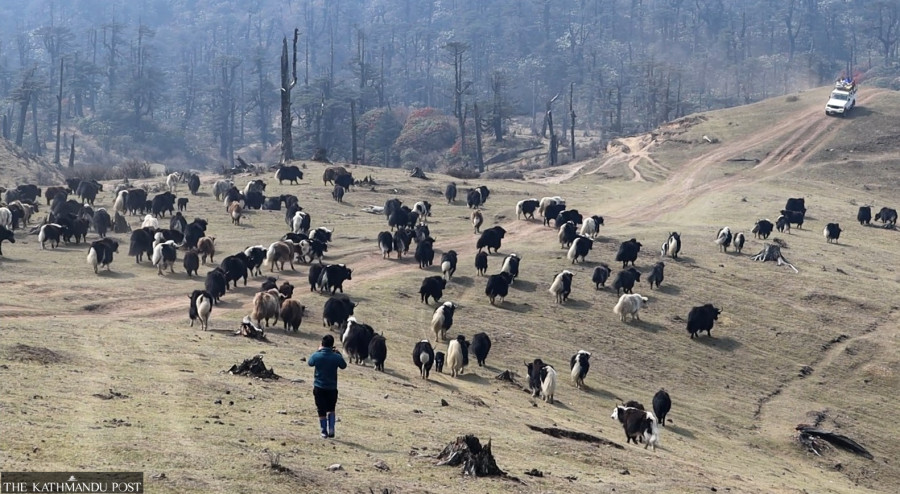
Livestock exports remain stalled since the Covid pandemic five years ago. Over 180 herders in Taplejung are left with thousands of unsold animals and shrinking incomes. Laxmi Gautam/TKP
Livestock farmers in Taplejung’s northern highlands say the continued closure of cross-border livestock trade with Tibet has left them unable to sell their animals, making them indifferent towards the promotion events such as a Chauri-Yak Festival. Chauris, the hybrid of yak and cows, are the source of livelihood for the people living in the highlands of Taplejung.
Chheten Sherpa Lama, the ward 7 chair of Phaktanglung Rural Municipality, Olangchung Gola, was recently advised at a municipal meeting to organise such a festival. He consulted livestock farmers in his ward and neighbouring areas.
The farmers, however, said they did not want a festival and instead requested him to take the initiative to reopen trade with China. They said resuming exports and imports was far more important than organising fairs, and suggested that funds allocated for the festival be redirected towards the programmes aimed at restoring trade.
Gyanje Sherpa, ward 5 chair of Mikwakhola Rural Municipality, said he faces similar pressure. Under Chauri promotion schemes, calves and young yaks have been brought from other districts and distributed for breed improvement. However, the farmers have shown little interest in these programmes as their primary demand remains the reopening of trade with China.
“The large number of Chauris makes our pastures look like a fairground all the time,”said Nupu Sherpa of Tokpe Gola. “But we have not been able to sell them.”
Nupu said the traditional cycle of raising calves, selling them as they age, and using the income for household expenses has been disrupted. Farmers say this situation arose because China has not resumed buying Nepali chauris and yaks since the Covid pandemic.
In 2020, Nupu sold 20 yaks at a market in Dinggye County of Tibet, earning between Rs 90,000 and Rs 110,000 per animal. He led a caravan through the Omdola pass in Thudam, Sankhuwasabha, and returned with around Rs5 million along with five companions. Since then, exports to China have come to a standstill.
At the time, one Chinese yuan was worth Rs16; it has now risen to Rs19. Nupu said he currently has 95 animals ready for market, with an estimated value of at least Rs10 million if trade resumes.
Yak-chauris typically live for 15 to 20 years and are ready for sale at around 12 years of age. Beyond that, they begin to lose weight. They were once widely used as pack animals, but with road expansion and increased use of mules, demand for such labour has declined. More than 180 farmers now face similar difficulties.
These livestock farmers are affiliated with the Yak-Chauri Farmers’ Federation, whose data show that families rear between 10 and 300 animals. Chheten Sherpa Lama said some households graze up to 300 to 400 animals. “People talk about holding festivals here and there, but our pastures are already filled with chauris and yaks,” he said.
In Nepal, chauri milk is processed into chhurpi (hard cheese) and ghee, but farmers say these products alone cannot sustain their livelihoods. Nupu Sherpa of Olangchung Gola said that for generations, farmers have relied on selling mature animals while raising young calves. Livestock owners from border areas such as Lelep, Olangchung Gola, Yangma, Tokpe Gola, Papung, and Sanwa have repeatedly raised the issue with their local government representatives.
A group of farmers had earlier urged the then chief district officer, Netra Prasad Sharma, to take up the matter during bilateral border meetings. During a meeting between officials of Taplejung and Dinggye County of Tibet on December 14, 2024, a delegation led by Sharma raised the issue.
Sharma said the Chinese side responded that the matter would have to be addressed at a higher level. “Regarding livestock, a decision must come from the central government, we will request our higher authorities,” he recalled. He said the issue was included in his report to the Ministry of Home Affairs. No border meetings have been held since.
Pemba Phuti Sherpa of Papung said she also demanded the candidates during the March 5 elections to address the problem of chauri sales.
After losing their primary market during the pandemic, farmers had hoped that the reopening of the border on May 24, 2024 would restore normal trade. However, they say they remain in distress as China has not resumed livestock imports.
Ward chair Chheten, who also serves as an interpreter between the Taplejung administration and officials of Dinggye County, said there has been no clear communication from the Chinese side. “Earlier, they cited lumpy skin disease [in Nepal], now, some say it is due to foot-and-mouth disease. But no clear information has been received,” he said.
Residents of the district’s highlands have long practised yak and chauri herding as a traditional occupation. According to the District Livestock Service Office, Taplejung, there are over 12,000 yaks and chauris in the district, mostly raised in grazing lands between 3,000 and 5,000 metres.
Yak-Chauri farming is centred in the highlands of Sirijangha, Phaktanglung, Mikwakhola, and Meringden rural municipalities, as well as Phungling Municipality. Farmers also face threats from wild animals such as tigers, bears and wolves, which prey on livestock, but losses from lumpy skin disease have been higher. Data from the District Livestock Service Office show that lumpy skin disease affected or caused losses to more than 3,000 animals in 2024 and 2025. Officials say the disease has since been brought under control, with no losses reported this year.




 14.81°C Kathmandu