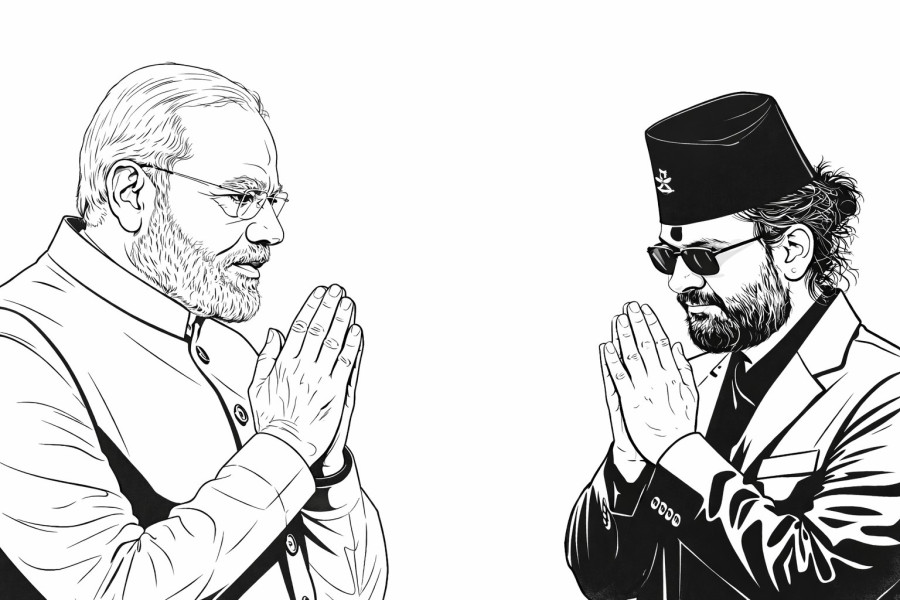
Indian Prime Minister Narendra Modi has invited Prime Minister Balendra Shah to visit India, with both sides aiming to ensure tangible outcomes from the trip, Foreign Minister Shisir Khanal said.
Speaking to the Post from Mauritius, Khanal said Modi extended the invitation in his congratulatory message as soon as Shah assumed office on March 27.
Khanal, who is in the island nation to attend the ninth Indian Ocean Conference (IOC) organised by India’s External Affairs Ministry, the government of Mauritius, and the India Foundation, said preparations are underway to ensure the visit is outcome-oriented.
“The prime minister has accepted the invitation, but the visit will take place only after the two sides complete homework at the technical and political levels so that it delivers concrete results,” Khanal said.
Officials familiar with the development said there is a clear intent to avoid a routine high-level visit, noting that both Kathmandu and New Delhi are working out tangible deliverables.
The officials, who are not allowed to speak to the media, said both sides want some kind of departure from the symbolic outcomes of previous prime ministerial visits.
On the sidelines of the IOC on Friday, Khanal and India's External Affairs Minister S Jaishankar agreed to organise high-level visits only after prioritising projects and programmes in line with Nepal’s own priorities.
“We have agreed to activate all bilateral mechanisms, focusing on priorities set by the two countries and exploring new avenues of cooperation before convening high-level visits and meetings, including at the prime minister and foreign minister levels,” Khanal had told the Post on Thursday.
Once the technical and political leadership in Kathmandu develops a concrete roadmap and sets clear priorities, it will be shared with the Indian side for further negotiations and consideration.
Khanal and Jaishankar also agreed to review the rationale for ongoing projects and programmes and explore new areas of cooperation, and Nepal will formally request that India send its foreign secretary for further talks.
After Kathmandu completes internal preparations, it will inform the Indian side on the next round of discussions, after which the Indian foreign secretary is expected to visit Nepal.
India and Nepal have almost three dozen mechanisms, ranging from the district to the foreign minister level, covering security, water resources, irrigation, border management, boundary issues, trade, commerce, and agriculture, among other areas. Some of these mechanisms meet regularly, while others have not convened for years.
Similarly, dozens of projects and programmes are currently being implemented in Nepal with Indian economic and technical assistance, and they are at different stages of completion. While some projects have made good progress, others have failed to meet expectations. Nepal and India have a number of mechanisms, as well as many projects and programmes, which the present government thinks should be streamlined while also exploring new avenues.
In an interview with Indian news channel WOIN, Khanal said that Prime Minister Shah has accepted the invitation. Khanal described the invitation as a positive step following new government formation in Kathmandu. “As soon as elections were held, PM Modi spoke to our leaders,” he said.
Modi telephoned Shah soon after the election results were out. Modi had called both Rastriya Swatantra Party leader Rabi Lamichhane and congratulated him on his party’s landslide victory in the March 5 polls.
After Shah was sworn in as prime minister on April 27, Modi congratulated him and stated that Shah’s appointment reflected the Nepali people’s trust in his leadership. “I look forward to working closely with you to take India-Nepal friendship and cooperation to even greater heights for the mutual benefit of our two peoples,” Modi wrote on multiple social media platforms.
Khanal, in his interview with WOIN, emphasised continuity in Nepal's foreign policy while aligning it firmly with national interests. “New doesn’t mean discontinuity. Our fundamental values remain the same. In terms of relationships with neighbours and partners, they will be linked to national interest,” he said.
The minister highlighted practical steps ahead. Nepal and India maintain around 40 different bilateral mechanisms, and the new government in Kathmandu is conducting an internal review to set clear priorities. “We are trying to set up priorities,” Khanal said.
Khanal raises issues of global concern
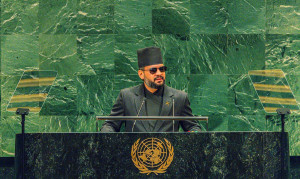
In his address at the IOC on Saturday, Khanal raised Nepal’s environmental concerns particularly the melting of snow, referring the phenomenon to rising sea levels.
The Hindu Kush Himalaya region serves as the primary source of fresh water for billions of people. The glaciers and snowfields of Nepal feed the great river systems that ultimately discharge into the Indian Ocean. Therefore, the health of the mountains and the health of the ocean are inseparable.
“Nepal may be a landlocked nation, but our bonds with the Indian Ocean are ancient, organic, and inseparable. Long before the age of modern diplomacy, Nepali traders, pilgrims, and scholars travelled along routes connecting the high Himalayas to the shores of this great ocean,” the foreign minister said.
Highlighting Nepal’s initiatives, Khanal stated that the establishment of Sagarmatha Sambaad, a flagship global dialogue platform, was instituted to discuss the future of humanity in light of climate change.
On the conflict in the Middle East, Khanal noted that millions of Nepali citizens live and work in the region. “Their safety remains our foremost concern. We have already lost one life, and others have been injured,” the minister said.
Anil Giri is a Chief Sub Editor covering diplomacy, international relations and national politics for The Kathmandu Post. Giri has been working as a journalist for more than two decades, contributing to numerous national and international media outlets.




 15.2°C Kathmandu