Electric vehicles meant to boost Lumbini tourism lie idle
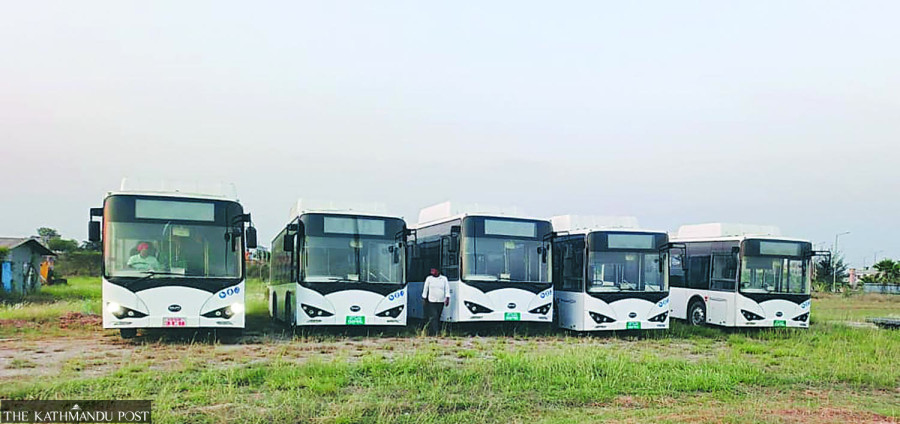
Political wrangling, staffing issues, and unclear operational rules blamed for grounding. Despite an investment of about Rs130 million, coupled with government’s waiver of Rs35 million in customs duties, the vehicles have spent more time exposed to the elements than on the road. Manoj Paudel/TKP
Five years after they were imported to transform tourism in the Buddhist circuit, the fate of the electric buses gifted to the Lumbini Development Trust (LDT) remains in limbo. Following a brief two-day operation triggered by a directive from the Prime Minister’s Office, five state-of-the-art electric buses have once again been grounded, currently sitting idle on premises of the Civil Aviation Authority of Nepal (CAAN) premises at Gautam Buddha International Airport in Bhairahawa.
The buses, which were operated for less than 48 hours (on April 1 and 2), were handed back to the aviation authority on April 3 by the trust, ending a short-lived attempt to provide transport services between Belahiya, Lumbini, and Tilaurakot.
The fleet—five buses and 14 electric vans—was acquired through a grant from the Asian Development Bank (ADB) under the Clean Energy Project in 2020. Despite a total investment of approximately Rs130 million—coupled with the government’s waiver of Rs35 million in customs duties—the vehicles have spent more time exposed to the elements than on the road.
The latest saga began a month ago when a secretary-level decision by the Ministry of Culture, Tourism, and Civil Aviation initiated a process to transfer the buses to Kathmandu. Local residents protested the move.
"We will not allow these buses to be taken to Kathmandu or elsewhere," said Arjun Kurmi, a local resident and civic leader who, along with Shakil Ahmed Khan, submitted a memorandum to the Lumbini trust on March 30. "We are prepared to stage sit-ins and hunger strikes. These resources were sent for the development of Lumbini, not to serve the capital's bureaucracy."
Following the local outcry and a verbal directive from the Prime Minister’s Office on the same day, the transfer was halted, and the Lumbini trust was ordered to operate them locally. However, the lack of a clear operational framework led to the buses being grounded again after only two days.
Deepak Shrestha, member-secretary of the LDT, admitted that the institution is caught between conflicting directives. "Initially, the ministry pressured us twice to hand over the buses to CAAN in Kathmandu. Then the Prime Minister’s Office intervened to keep them here. Currently, we have handed them to the CAAN office in Bhairahawa to comply with the ministry’s latest instructions, and the PMO has not raised further objections,” said Shrestha.
The grounding of the fleet highlights a chronic failure in management and a lack of legal preparation. Since their arrival, the vehicles have been bogged down by "number plate politics." Initially fitted with white government plates, the law prohibited them from carrying fare-paying tourists. It took a writ petition at the Butwal Bench of the Tulsipur High Court and a subsequent court order in April last year to finally convert them to the green plates required for tourist transport.
However, the change in plates has not solved the underlying issues. "We face a severe shortage of technical manpower," said Rajan Basnet, information officer at the trust. "The Lumbini trust does not have the budget to hire drivers and conductors (helps) for a large fleet, and our financial health is so fragile we are struggling to even pay existing staff. Furthermore, legal hurdles prevent us from easily leasing the operation to the private sector."
While the buses remain grounded, the 14 electric vans are reportedly being used by trust officials for personal purposes.Local stakeholders claim the green-plated vehicles, intended for visitors, are frequently seen transporting families of staff on personal trips.
Lila Mani Paudel, the president of the Lumbini Hotel Association, criticised the LDT’s apathy. "The failure to operate these vehicles shows the trust is simply not tourism-friendly. These buses were meant to link the airport to the holy sites and revitalise a sector crushed by the 2015 earthquake. Instead, they are being ruined by negligence,” said Paudel.
The physical condition of the fleet is rapidly deteriorating. During a brief period of "populist" operation by politicians during the 2022 elections, several vehicles were damaged. Currently, three of the five buses are non-functional due to cracked windshields, dented bodies, and drained batteries. Two of the 14 vans are also out of operation following accidents.“The situation is further exacerbated by a chronic shortage of spare parts and the absence of good repair facilities in the Butwal-Bhairahawa corridor,” said Surendra Yadav, a driver of the Lumbini trust.
The persistent dysfunction, as Kurmi claimed, is due to escalating partisan interference within the trust. "The vice-chairman, member-secretary, treasurer, and project manager each represent four different political parties. They are perpetually at odds, and as a result, development projects in Lumbini are constantly stalled,” claimed Kurmi, warning stern protests if attempts are made to take the vehicles to Kathmandu.
Echoing this sentiment, Bhikkhu Maitri Mahasthavir remarked that the crisis stems from a culture of nepotism, where "one's own people" are prioritised over competent, capable leaders. "The failure to operate these vans and buses is the direct consequence of political appointments," he said.
This is not the first time the trust’s vehicle management has come under fire. Earlier reports highlighted that the "Dhamma Yatra" shuttle service, launched briefly by the trust, collapsed because it relied on "voluntary fares" which failed to cover even basic electricity costs for charging.
The technical specifications of the buses make their abandonment even more tragic. The 19-seater buses (with a total capacity of 35 including standing passengers) are fully air-conditioned, disability-friendly and comfortable seats. They feature automated doors and can travel 400 kilometres on a single charge. A sophisticated charging station, also funded by the ADB, sits ready near Gate No 2 of Lumbini, yet remains largely unused.
The internal rift within the trust was palpable as board members voiced their frustration. "The vehicles are registered under the trust's name, and we are the ones paying the annual insurance premiums," said Bishwaraj Paudel, a board member of the trust. "Why should we hand over assets meant for Lumbini to the ministry?” According to him, these electric vehicles must run to connect Lumbini with Tilaurakot, Ramgram and Devdaha."
Lumbini trust has frequently deflected criticism by claiming the buses were sent to Bhairahawa for repairs, a move many see as a calculated attempt to preempt local protests. Binod Singh Rawat, information officer at Gautam Buddha International Airport, confirmed the buses are now under CAAN’s jurisdiction but noted he had no clear instructions on their intended use. "We received them as per the ministry's directive, but the purpose remains unclear," said Rawat.




 15.26°C Kathmandu