A Chinese company has been awarded the contract to operate the Nagdhunga–Sisnekhola tunnel, despite initial reservations from the Japanese side.
Seven out of 10 bidders cleared the technical evaluation stage, and a joint venture between China’s Yusin and Nepal’s ART was selected through the financial evaluation. The final shortlist comprised six Chinese firms and an Indian company, all partnered with Nepali firms.
Saujanya Nepal, director of the Nagdhunga-Sisnekhola Tunnel Construction Project, said a notice has been issued announcing the firm that passed the financial evaluation, and a letter of intent was issued on Monday.
“This means the bidder that cleared the financial assessment is in the final stage of selection,” he said, adding that a seven-day period has been provided to lodge complaints.
A formal public notice will be issued after eight days, followed by a 15-day period to invite the selected firm to sign the contract. According to the project office, the selected company quoted Rs1.10 billion. As per procurement rules, the contract is awarded to the lowest bidder.
“If the company comes forward within the stipulated time, the agreement can be signed and mobilisation will begin,” Nepal said. “The operator will first prepare the workforce, after which the construction company will hand over the project.”
As the tender was international, foreign companies were required to form joint ventures with Nepali firms. Officials say the provision is intended to help transfer technical expertise to Nepali personnel for future tunnel operations.
The selected company will operate and manage the tunnel for five years.
Operations and staffing
Around 150 personnel will be deployed for tunnel operations, with about two months allocated for training. The service provider will be responsible for recruiting and training staff, who will also take part in a trial phase to test operational readiness.
“The duration of the trial run will be determined by the operating company,” Nepal said. “The tunnel must come into full operation within three months of the agreement.” Preparations are under way to begin trial operations by early May, he added.
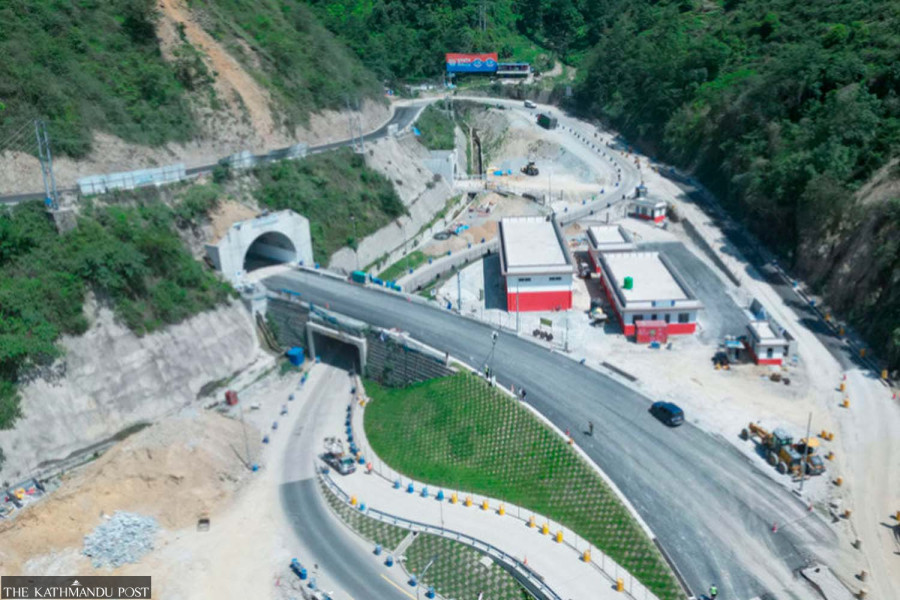
The operator will oversee maintenance, traffic management, emergency response, toll collection and overall supervision of the tunnel, along with the 2.8-kilometre approach roads linking Kathmandu and Dhading. The tunnel will be operated round the clock throughout the year.
While the government will bear operational costs, the operator must deposit daily toll collections into the accounts of the Road Board Nepal account.
Funding and progress
The project is being financed through a concessional loan of Rs16 billion from Japan and Rs6 billion from the government.
An additional loan of around Rs5.5 billion is under consideration at the Ministry of Finance. “The loan has not yet been approved,” Nepal said. “It is required to cover payments to contractors and consultants as the initial budget was insufficient.”
Tank Prasad Pandey, spokesperson for the Ministry of Finance, said the proposal submitted by the Ministry of Physical Infrastructure and Transport is under review.
Construction of the tunnel is about 98 percent complete, with slope stabilisation work ongoing on the Dhading side. Officials say this will be completed before operations begin.
The project deadline is April 25, and most works are expected to be finished by then.
Toll rates and restrictions
The government has fixed toll charges for vehicles using the tunnel, with cars and vans required to pay Rs65 when entering Kathmandu and Rs60 when exiting. Minibuses, trucks and tippers will be charged Rs115 for entry and Rs80 for exit, while buses and large trucks will pay Rs260 when entering and Rs200 when exiting. Heavy vehicles will be charged Rs600 for entry and Rs250 for exit.
According to the Nagdhunga–Sisnekhola Tunnel Transport Operation Guidelines 2025, pedestrians, two-wheelers, three-wheelers and non-motorised vehicles will not be allowed inside the tunnel.
Vehicles carrying highly inflammable materials such as petrol, diesel, gas and explosives are also prohibited.
Construction of the tunnel began on October 21, 2019, with an initial deadline of 42 months, but the project saw multiple extensions. The main tunnel is 2,688 metres long, while the emergency tunnel measures 2,557 metres.
Japan’s Hazama Ando Corporation is the contractor for the project. Although construction is nearing completion, delays in selecting an operator have pushed back the tunnel’s opening.




 13.68°C Kathmandu