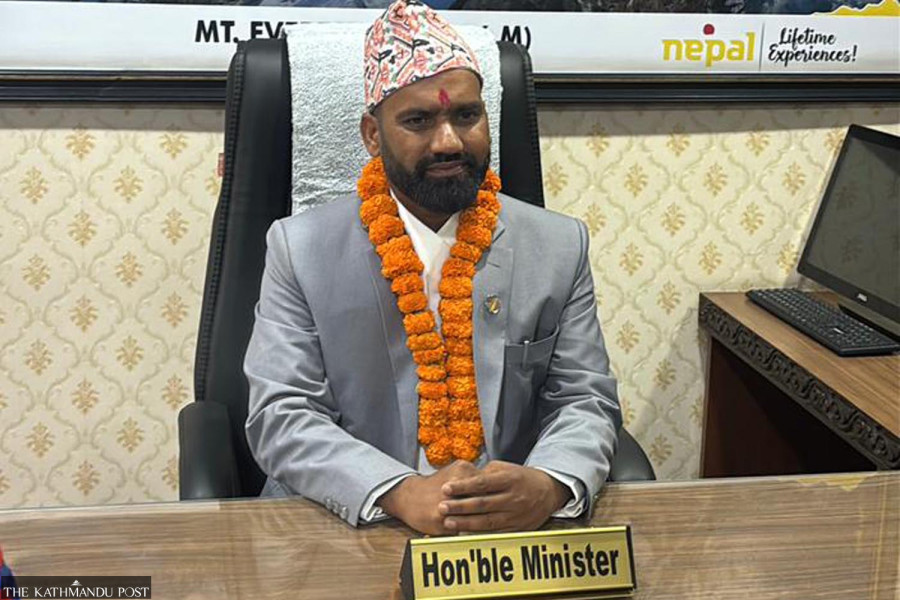
Ganesh Paudel, a central committee member of the Rastriya Swatantra Party, has stepped into a ministerial role tasked with tackling the sector’s numerous persistent challenges. Khadakaraj Paudel, tourism minister Post Photo
Khadkaraj Paudel—known by his literary name Ganesh Paudel—has been appointed Minister for Culture, Tourism and Civil Aviation in the Balendra Shah–led government. Paudel, who has made his mark in literature, education and social activism, now shoulders the responsibility of a ministry tasked with addressing long-standing problems in Nepal’s tourism and aviation sectors.
A permanent resident of Majheripatan in ward 14 of Pokhara metropolis, Paudel holds a bachelor’s degree in English literature and an MBA from Pokhara University, and has more than 15 years of teaching experience. Through the Random Readers Society, he has actively promoted a reading culture, and through experimental works such as Paitala (sole), he has introduced new trends in contemporary literature.
A proponent of an alternative political ideology summarised by the phrase “Win by ideas, endure through character,” Paudel is also the initiator of the Ateri (stubborn) campaign. Currently serving as a central committee member of the Rastriya Swatantra Party, he faces formidable challenges as he takes charge of the ministry.
Nepal’s tourism sector—long regarded as the backbone of the national economy—continues to suffer from structural weaknesses, poor management and policy ambiguity. The aviation sector in particular remains under international scrutiny. Since 2013, the European Union has banned Nepali airlines from its skies, a restriction that still stands and reflects continued concerns about Nepal’s aviation safety standards.
Nepal Airlines Corporation carries a debt of around Rs52 billion. Weak management, political interference and the absence of a clear commercial strategy have hampered the national flag carrier’s performance. Despite having air service agreements with 42 countries, Nepal has not been able to expand flights to many destinations due to a limited fleet, weak market strategies, and stiff international competition.
Infrastructure challenges persist. The Pokhara and Bhairahawa international airports—built with billions of rupees—have yet to operate at full capacity. Meanwhile, growing pressure at Tribhuvan International Airport has made management increasingly complicated, and the implementation of the airport’s master plan continues to face delays.
The aviation sector is in dire need of reform. The Civil Aviation Authority of Nepal currently performs as both regulator and service-provider, and this raises questions about transparency and efficiency.
Other tourism-related sectors are also plagued by problems. The share dispute at the Hyatt Regency, encroachment on property in the Pashupati area, delays in the Lumbini development project, and the inactivity of the Janakpur Development Committee all point to weak governance in the sector.
In mountain tourism, waste management issues, unregulated practices, and controversies over liaison officer appointments have raised concerns about potential damage to Nepal’s international image. The practice of charging foreign travellers airfares in US dollars for domestic flights, and the failure to act on reports of ticket collusion during the Covid pandemic, further reflect policy inconsistencies.
Against this backdrop, Paudel’s appointment presents both an opportunity and a challenge. Expectations are high that if he can turn his alternative ideas and reform-oriented vision into action—through structural reforms, greater transparency and the rebuilding of international credibility—Nepal’s tourism sector can be made more sustainable and competitive.
Suraj Kunwar is a senior correspondent with over two decades experience covering Aviation, Tourism and Mountaineering. He received the IFJ Tolerance Award in 2005.




 14.81°C Kathmandu