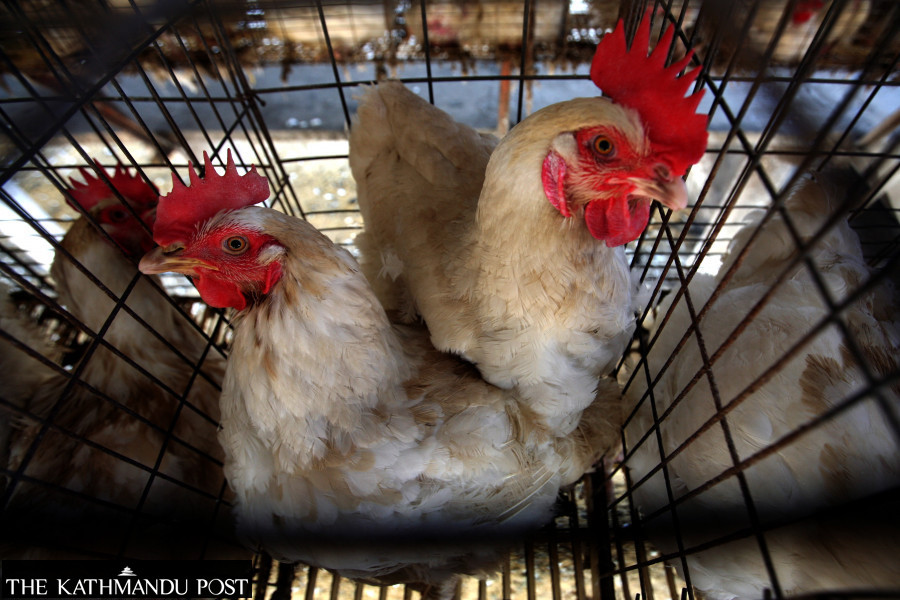
Over 100,000 domestic fowls—layers, broilers, indigenous chickens, and ducks—have been culled in Jhapa, Morang, and Sunsari districts following confirmation of avian influenza viruses A(H9N2) and A(H5N1).
Although unusual bird deaths had started some three weeks ago during the parliamentary elections, the outbreaks were confirmed only a few days ago.
“When poultry farmers reported sudden deaths, veterinary officials were deployed on election duty,” Dr Ajaya Shah, senior livestock development officer at Veterinary Hospital and Livestock Service Expert Centre, Morang, told the Post over the phone from the district. “The outbreak of avian flu was known only after the Central Veterinary Laboratory confirmed the infection.”
Veterinary officials in Morang said they have already culled over 33,000 fowls, including layers, broilers, indigenous chickens, ducks, and pigeons, and destroyed over 58,000 eggs, along with thousands of kilograms of poultry feed and manure from the disease-hit farms.
They said several rapid response teams comprising veterinary officials have been mobilised to destroy birds and disinfect affected farms. So far, outbreaks have been reported in Sundarharaincha, Urlabari, and Katahari, and Biratnagar in the district.
Likewise, neighbouring Sunsari district has reported outbreaks in 11 poultry farms.
“We have already killed over 15,000 chickens from eight poultry farms,” said Dr Manoj Kumar Mahato, senior livestock development officer at Veterinary Hospital and Livestock Service Expert Centre, Sunsari. “Three more farms have been sealed following the outbreak, and it is estimated that there are around 7,000 chickens in those farms.”
He said that all chickens in some poultry farms had died of infection before the rapid response team reached the sites.
Veterinary officials in Jhapa reported bird flu outbreaks at several poultry firms and the culling of over 20,000 chickens, along with the disposal of thousands of eggs and feed stored on farms.
“We are still sanitising disease-hit poultry farms. Outbreaks have been reported from several locations and districts,” said Dev Kumar Darlami, a senior veterinary official in Koshi province.
Unlike previous outbreaks, the current surge is largely driven by A(H9N2), a subtype of the influenza virus, whereas past outbreaks were mostly caused by A(H5N1). Experts say A(H9N2) inflicts heavy economic losses on the poultry industry by wiping out large numbers of chickens.
Vet officials say that A(H5n1) virus has also been detected in some poultry farms. H5N1 is a highly lethal bird flu strain. The virus was first detected in birds in Nepal in 2009, and since then, the country has experienced disease outbreaks almost every year.
Nepal witnessed a massive bird flu outbreak in 2022 when it spread in 15 districts. Over 600,000 fowls were culled at the time. Many farmers abandoned poultry farming due to the lack of compensation and continue to struggle for reimbursement.
Nepal had previously reported a human death from the virus in 2019. A 21-year-old man from Kavrepalanchok district, who worked as a truck driver transporting poultry, died of a respiratory infection while undergoing treatment. The World Health Organisation (WHO) Collaborating Centre for Influenza in Japan confirmed an infection of A(H5N1) in him after his death.
The first A(H5N1) infection was reported in 1997 in Hong Kong and the virus has since spread to Asia, Africa, the Middle East and Europe and other parts of the world, causing millions of poultry infections.
Although rare, the World Health Organisation has reported 954 confirmed human cases of bird flu between 2003 and 12 December 2024, including 460 deaths, resulting in a case fatality rate of around 50 percent. According to the UN body, almost all cases of H5N1 infection have been linked to close contact with infected live or dead fowls or contaminated environments.
Like A(H5N1), A(H9N2) virus can be transmitted by airborne droplets, dust, feed, or water.
Experts warn that there is also a risk of the infected poultry reaching the market, as farmers may sell their fowls to minimise losses. They have urged the authorities to consult the affected farmers and provide compensation at the earliest.




 22.11°C Kathmandu