



 22.73°C Kathmandu

Thu, Oct 22, 2026
National
They left to build a future. Now they wait to come home in death
Ongoing war and irregular flights have hampered repatriation of 22 Nepali bodies. Embassies say bodies will be sent home after flights resume.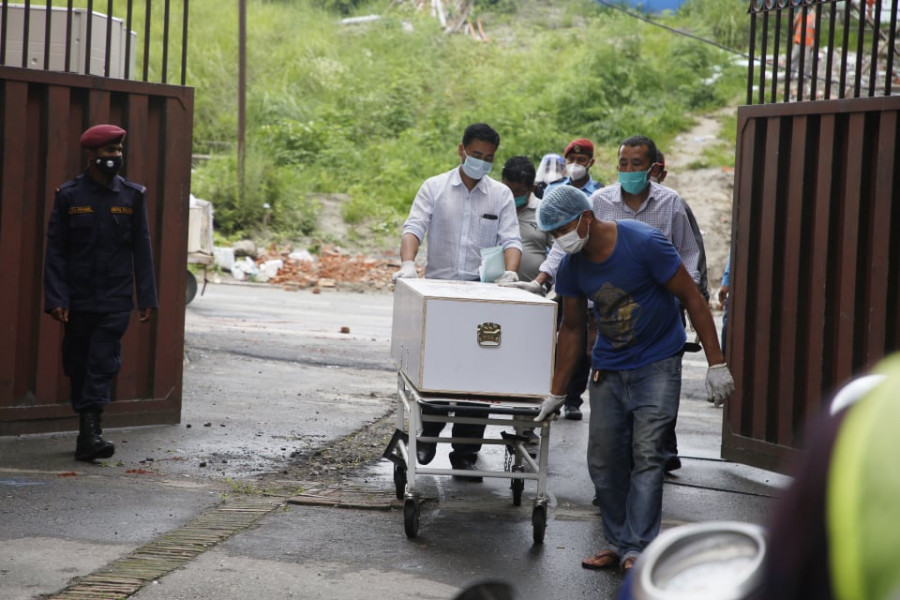
bookmark
Hom Karki & Binay Aazad
Published at : March 20, 2026
Updated at : March 20, 2026 20:03
Kathmandu/siraha
Escalating tensions in the Gulf region, triggered by the ongoing standoff involving the US-Israeli coalition and Iran, have disrupted the repatriation of the bodies of Nepali migrant workers who died in the region. These deaths were not related to the ongoing conflict, according to officials.
A total of 22 bodies remain stranded—eight in the United Arab Emirates and seven each in Kuwait and Saudi Arabia—despite the Nepali embassies in those countries already granting permission for their repatriation.
One such case is that of Ramesh Kumar Mochi of Shivanagar in ward 1 of Sukhipur Municipality in Siraha, who died in Kuwait on March 5. His last contact with his family back home was on the night of March 4, just a day before the recently concluded parliamentary elections in Nepal.
In the phone conversation with his wife, Pramila Kumari Ram, he shared a plan to return home in April or May to see his 18-month-old son, Aryan. He also inquired about Nepal’s political situation and asked his family to vote for “good people and youths” in the elections. “The country will change after this election,” he said.
However, he died in the early hours of March 5 before he could return.
Ramesh, 35, spent 16 years in foreign employment. At 17, he went to Kuwait for the first time to work, where he stayed for eight years. He later worked two years each in Malaysia, Qatar and Saudi Arabia. Most recently, he had been working in Kuwait for the last 22 months.
“We had gone to vote at a polling centre at a community school in neighbouring Mohanpur village with my in-laws in the morning, and returned home at 2pm after voting. I was doing dishes when a relative, Rahul, arrived in the courtyard with the news of my husband’s death,” Pramila said. “As soon as I heard it, I felt like collapsing. It didn’t feel real. Somehow, I gathered myself and spoke to Rahul’s maternal uncle using his phone.”
Rahul’s maternal uncle, Ram Kumar Ram, worked with Ramesh. According to him, Ramesh had been taking medication for high blood pressure. “At around 2am, he woke up to go to the toilet. While trying to take his medicine, he collapsed,” Ram Kumar said over the phone. “An ambulance arrived about half an hour later. He was declared dead on arrival.”
Pramila, 31, has spent the past two weeks in grief. Ramesh’s 55-year-old father, Ram Narayan, has been in regular contact with the company and the Nepali embassy, urging them to bring the body home. “There have been no flights. They say they will send the body once flights resume. I have sought help from the ward chair and informed the municipality,” he said. “I have also approached influential people here. Everyone says they are trying.”
Since February 28, the US and Israel have carried out joint attacks on Iran. In return, Iran has been launching strikes targeting US military bases in the Gulf countries, including Kuwait, Bahrain, Saudi Arabia, Qatar and Oman. As a result, airports in Kuwait and other countries remain closed.
The disruption has left grieving Nepali families waiting for weeks to receive the bodies of their loved ones. With airports intermittently closed and flights cancelled amid the escalating conflict, Nepali missions say they are unable to repatriate the bodies despite completing all required procedures, prolonging the anguish of families back home.
According to the Nepali embassy in Kuwait, despite the completion of required documentation, the bodies of seven Nepali workers, including Ramesh, remain stuck. The bodies include those of Khushiram Chaudhary of Dang, Samjhana Gole of Sindhupalchok, Kopila Dhami of Udayapur, Basanta Rai of Khotang and Yamuna Sunar and Krishna Ramja Budha of Salyan. “Lack of flights from Kuwait to Nepal has created the problem. We are preparing to send the bodies as soon as flights resume,” said Nepali ambassador to Kuwait, Ghanashyam Lamsal.
The embassy has already issued a ‘No Objection Certificate’ (NOC) to the employers for repatriation. Such an approval is granted only after the deceased’s salary and benefits have been settled and all documents, including police and medical reports, have been completed. Once the NOC is issued, the responsibility for repatriating the body lies entirely with the employer, which arranges the transport.
Jazeera Airways operates direct flights from Kuwait to Nepal. Iran has attacked Kuwait International Airport twice. For Nepali workers in urgent need, arrangements have been made to travel by road to Saudi Arabia, with the embassy facilitating Saudi visas. Nepali workers who reached Riyadh and Dammam by road are flying to Nepal. However, due to legal complications, bodies cannot be transported from Kuwait to Saudi Arabia by land, officials said.
Labour counsellor at the Nepali embassy in Riyadh, Kabiraj Upreti, said bodies of Nepali workers who died in Saudi Arabia could also not be sent home due to irregular flights. Despite the completion of the necessary documentation, the bodies of six Nepali workers—Laxmi Narayan Thapa of Gulmi, Ram Jatan Thakur of Dhanusha, Binod KC and Pawan Prasad Sharma of Kathmandu, Dulari Prasad Chaudhary of Rupandehi, and Jeevan Shrepali and Binod Prasad Shah—remain stranded in Saudi Arabia.
“Even under normal circumstances, it takes at least two weeks to send a body after completing all procedures. Currently, it is taking about a month. Flight disruptions have made it more difficult,” Upreti said.
Employers in Saudi Arabia usually send bodies via cargo on flights operated by Air Arabia, IndiGo, and Air India. At present, ticket prices have surged, and cargo costs have increased even more. Transporting a body costs around 25,000 riyals (approximately Rs900,000), while a passenger ticket costs around 4,000 riyals (approximately Rs144,000).
According to Hari Odari, the consul general of Nepal in Dubai, eight Nepali bodies remain stuck in the UAE. Iran has attacked Dubai airport thrice—on February 28, March 7 and 16, leading to the frequent delays, suspensions and cancellations of flights.
Due to heavy passenger demand on limited flights, airlines are not prioritising cargo. “If Nepal Airlines was ready to carry the bodies, all could be repatriated. Special flights are very expensive,” Odari said. “At present, the responsibility lies entirely with the employers. Neither the families nor the government of Nepal have to bear the cost.”
Five bodies stranded in Qatar were repatriated on March 16, according to the Nepali embassy. Qatar Airways brought all the bodies in a single day. The bodies include those of Sunil Kapar of Dhanusha, Niraj Kafle of Bara, Surya BK of Lamjung, Bhakta Bahadur Khawas of Jhapa, and Lok Bahadur Thapa of Gorkha.
Kumar Rai, acting ambassador to Qatar, said they are coordinating with employers and airlines. “Some bodies remain at Hamad Hospital, where documentation is still pending. Efforts will be made to send them as soon as the process is complete,” he said.
For Ram Narayan, waiting for his son’s body has been agonising. “My son Ramesh was the main support of our family. He went abroad to take on that responsibility. Now that he is gone, I don’t know how we will manage the household or raise the grandchildren,” he said.
“We don’t know when flights will resume or when his body will arrive. Each day is becoming harder to bear.”
Hom Karki
Hom Karki is a reporter with two decades experience covering migrant workers issues and the Nepali diaspora. He was previously based in the Gulf for Kantipur Daily.
Binay Aazad
Binay Aazad is Siraha correspondent for Kantipur Publications.

Most Read from National

Flood sweeps away houses, bridges in Gorkha

What to know about the US trial over Mamta Kafle’s disappearance

Torrent of black mud and rocks engulfs settlements along Budhigandaki

From blankets to handmade dolls, two foreign women bring comfort to flood survivors

Budhi Gandaki flood washes away three bridges in Gorkha
Editor's Picks




E-PAPER | October 22, 2026

×