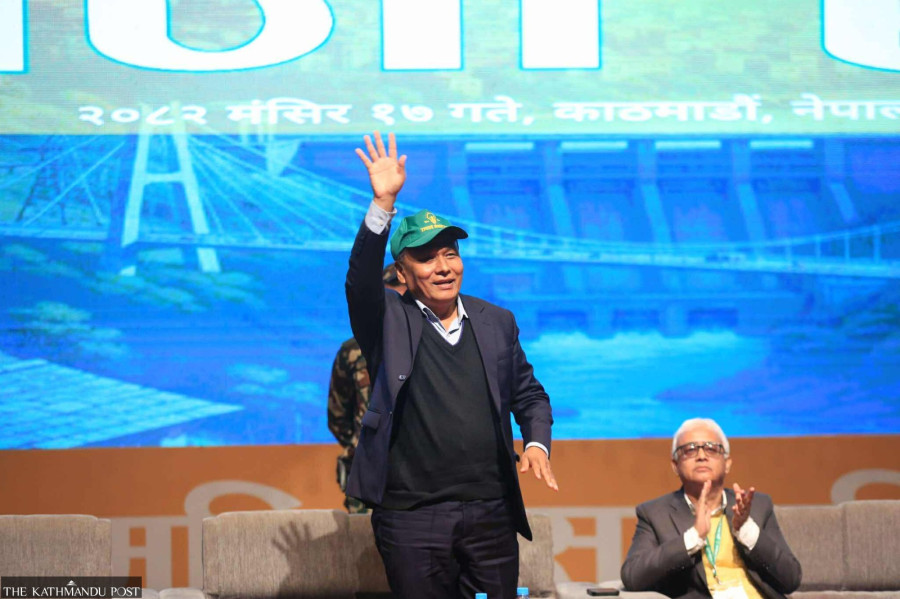
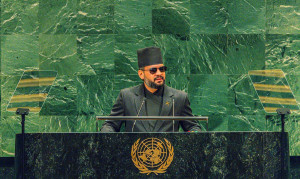
Kulman Ghising, who leads three ministries in the interim government, unveiled his own party, Ujyalo Nepal, on Wednesday.
Ghising is known for ending 18-hour-long power cuts in Nepal while he led the Nepal Electricity Authority as its managing director. He was unceremoniously removed as NEA’s MD by the KP Sharma Oli-led government in March.
The party was established on behalf of Ghising but due to his ministerial responsibilities in the current non-partisan government, he just attended the ceremony as the chief guest. According to the party’s leaders, former energy secretary Anup Kumar Upadhyay will head the party as long as Ghising remains in the government.
“I came here as the chief guest,” Ghising said while launching the party, whose election symbol is an “electric bulb”, possibly a reference to his credit for ending prolonged load-shedding in Nepal. Ghising is the party’s patron—at least for now.
Upadhyay, former education minister Sumana Shrestha, civil society member Dr Sundar Mani Dixit and actress Rima Bishwakarma were among the noted personalities present at the opening ceremony.
The party also unveiled its manifesto, which expresses commitment to the country’s overall transformation by addressing the expectations of the new generation, promotion of good governance and improved political culture.
The party accepts the Constitution of Nepal as a dynamic document but believes some provisions need amendment.
The Ujyalo Nepal manifesto says it is impossible to have a strong and stable government in the present political and constitutional setup. Therefore, the party calls for electoral reforms to ensure proportional inclusive representation. The party supports federalism and says Nepal has to give continuity to the exercise of federalism but make it practical, result oriented and effective.
The party has also pledged to start a new era of good governance stating that the country has been mired in political instability and corruption since 2010.
Nepal’s democratic values, citizens’ independence, impartial administration, capable service delivery, social justice, free press, transparency and accountability will be the fundamental principles of the party that believes in the governance system of “New Nepal” based on truth, justice and equality.
The manifesto has proposed revisiting local and federal structures on the basis of population, geography, identity, capability and economic possibilities.
“Through a broader national consensus, we have to address issues linked to federalism and review the numbers of ministries based on various recommendations made in the past.”
In its manifesto, the party has proposed that ministers may be appointed from outside parliament, except for foreign, home, law, and defence ministers, who it said must be parliamentarians.
In provinces, the party has proposed electing chief ministers through direct vote while the cabinet size should not exceed five.
The party has proposed replacing provincial assemblies with provincial councils where the chairs and deputy chairs of local units will serve as members. The provincial council should be authorised to pass laws, and at the central level, the prime minister should lead the government at least for half of its tenure.
A member of parliament appointed under the proportional representation should be limited to just one term. The party says that local elections should be held on a non-party basis.
The manifesto also calls for restructuring the Judicial Council to ensure that there is no political-party interference in the judiciary.
“Our failure to elect the right leadership is the main reason behind the current situation of the country,” said Ghising speaking at the event. “In the past 75 years, we have changed several systems, but failed to develop our country. This shows that correct leadership is the demand of the time.”
“We have seen many political changes in these 75 years. Our leaders have appeared successful in bringing political change. But they have failed to achieve an economic revolution,” he said. “Those who can make big political speeches have repeatedly failed to lead development. No one has practiced results-oriented politics.”
Anil Giri is a Chief Sub Editor covering diplomacy, international relations and national politics for The Kathmandu Post. Giri has been working as a journalist for more than two decades, contributing to numerous national and international media outlets.




 28.33°C Kathmandu