



 17.57°C Kathmandu
Sun, Oct 18, 2026
Money
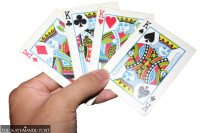
Nepal imports 2 million packs of playing cards in two months
The country imported cards worth Rs51.8 million in the first two months of the current fiscal year, generating Rs31.1 million in customs revenue.
bookmark
Seema Tamang
Published at : October 18, 2026
Updated at : October 18, 2026 21:33
Kathmandu
Demand for playing cards tends to rise in Nepal during the festive season, particularly around Dashain and Tihar. The country imports cards from several countries to meet the seasonal demand. While cards are commonly used for entertainment, gambling can lead to substantial financial losses, with millions of rupees changing hands. Imports also account for a considerable outflow of money from Nepal.
In the first two months of the current fiscal year, Nepal imported playing cards worth Rs51.8 million, according to the Department of Customs. The country brought in 1,992,265 packs of cards during the period, generating Rs31.1 million in customs revenue.
During the same period last fiscal year, Nepal imported cards worth Rs90.09 million, generating Rs54.6 million in revenue.
Nepal imports playing cards from countries including China, India and the United States. In the first two months of the current fiscal year, corresponding to mid-July to mid-September, China accounted for the largest share, supplying cards worth Rs46.78 million. Imports from India were valued at Rs5.055 million, according to customs data.
In the fiscal year 2025-26, Nepal imported playing cards worth Rs420.09 million. China alone accounted for Rs387.245 million of the total, followed by India at Rs32.251 million. Imports from the United States were worth Rs436,000, while those from Japan and South Korea stood at Rs41,000 and Rs12,000, respectively. Nepal also imported cards worth Rs8,000 from Kuwait, Rs4,000 from the United Kingdom and Rs2,000 from the United Arab Emirates. Other suppliers included Australia, Canada, Taiwan, the Philippines and Saudi Arabia.
In fiscal year 2024-25, imports totalled Rs313.7 million. China supplied cards worth Rs292.149 million and India Rs21.362 million. Imports from the United States were valued at Rs214,000, those from the United Kingdom at Rs6,000 and those from Ireland at Rs2,000. Nepal also sourced cards from Hong Kong and Italy, among other countries.
In fiscal year 2023-24, Nepal imported playing cards worth Rs321.887 million. China accounted for Rs282.346 million, India Rs26.871 million, the United States Rs9.522 million and Spain Rs2.859 million, according to the department.
Imports stood at Rs212.794 million in fiscal year 2022-23, with China supplying cards worth Rs187.6 million, India Rs21.595 million and Brazil Rs3.579 million.
The department's records show that Nepal imported playing cards worth Rs215.445 million in fiscal year 2021-22, Rs286.264 million in 2020-21 and Rs235.453 million in 2019-20.
Police arrests over gambling rise during festivals
Arrests for gambling are common during Nepal's festive season, with the number of people detained on suspicion of playing gambling games tending to rise as major festivals approach. The government prohibits gambling under the law.
Section 125 of the National Penal (Code) Act, 2017, prohibits gambling and organising gambling activities. However, the law exempts games conducted with government approval and lotteries organised with the authorisation of the competent authority.
On October 17 alone, Nepal Police arrested 20 people in separate incidents across the country for allegedly gambling.
A team deployed by the Koshi Province Police Office in Biratnagar and the Pakali Area Police Office arrested five people in Itahari Sub-Metropolitan City in Sunsari district. Police seized Rs371,010 in cash and three packs of playing cards from them.
In another incident, a team from the Anarmani Area Police Office arrested six people at Omchok in Ward 5 of Arjundhara Municipality, Jhapa district. Police recovered Rs122,680 in cash and two packs of playing cards.
In Chitwan district, nine people were arrested while allegedly gambling in Bagaincha Tole, Ward 10 of Ratnanagar Municipality. Police from the Ratnanagar Tandi Area Police Office seized Rs110,255 in cash and one pack of playing cards.
Police said further investigations into the incidents were under way.
Police step up surveillance to curb gambling
Abhi Narayan Kafle, spokesperson for Nepal Police, said people sometimes lose substantial amounts of their assets while gambling in the name of festive entertainment.
During festivals, police step up security deployments, gather intelligence and use CCTV cameras and drones, alongside regular surveillance, to curb gambling, he said.
Those organising gambling sessions often place large bets, shift venues to evade detection and offer various excuses when arrested. Police, however, bring those involved within the ambit of the law, Kafle said.
Playing cards at home or among friends and family for entertainment, without betting money or other stakes, does not constitute gambling, he said.
“Importing or possessing playing cards is not illegal in itself. But action is taken when gambling is organised commercially or in an organised manner, with large sums of money at stake and millions of rupees won or lost,” Kafle said.
What penalties does gambling carry?
Under the National Penal (Code) Act, gambling refers to a game or process in which a person stakes money or other movable or immovable property, or a potential reward, with the possibility of gaining or losing it depending on chance.
The law also treats betting on the outcome of another person's gambling as gambling, even if the bettor does not participate directly in the game. Similarly, placing a side bet or chhyankhe on another person's win or loss, with the possibility of gaining or losing money or other property, falls within the legal definition.
A person convicted of gambling or organising gambling for the first time can face up to three months in prison or a fine of up to Rs30,000, according to the act.
A second offence can attract up to one year in prison and a fine of up to Rs50,000.
Those caught gambling again after serving the sentence for a second offence can face an additional three months in prison and a fine of up to Rs10,000 for each subsequent offence.
The law also provides for the confiscation of equipment used for gambling and all movable and immovable property found at the gambling venue.
However, games conducted with government approval and lotteries authorised by the competent authority are exempt from the definition of gambling under the act.
Seema Tamang
Seema covers business and economy for Kantipur Publications.


Most Read from Money
Nepal travel agents threaten to stop selling Thailand trips over visa rules
Explained: Why does an hour long flight to Dhangadhi cost more than a flight to New Delhi?
Malaysia rejects Nepal’s demand to open recruitment to all manpower agencies

No school, but a graduation cap for women dairy farmers
Nepal arrests four medical service providers as Malaysia recruitment row deepens
Editor's Picks
Dashain is in the air
Buying a goat for Dashain? Look for the green mark
Explained: Why does an hour long flight to Dhangadhi cost more than a flight to New Delhi?
Bhotekoshi flood wasn’t a freak event. It’s the Himalaya doing what it does

How Tenzing Sherpa became Nepal’s breakout star at the Asian Games
E-PAPER | October 18, 2026

×