Q&A: Nepal’s economy is on firmer footing, IMF committed to continued engagement
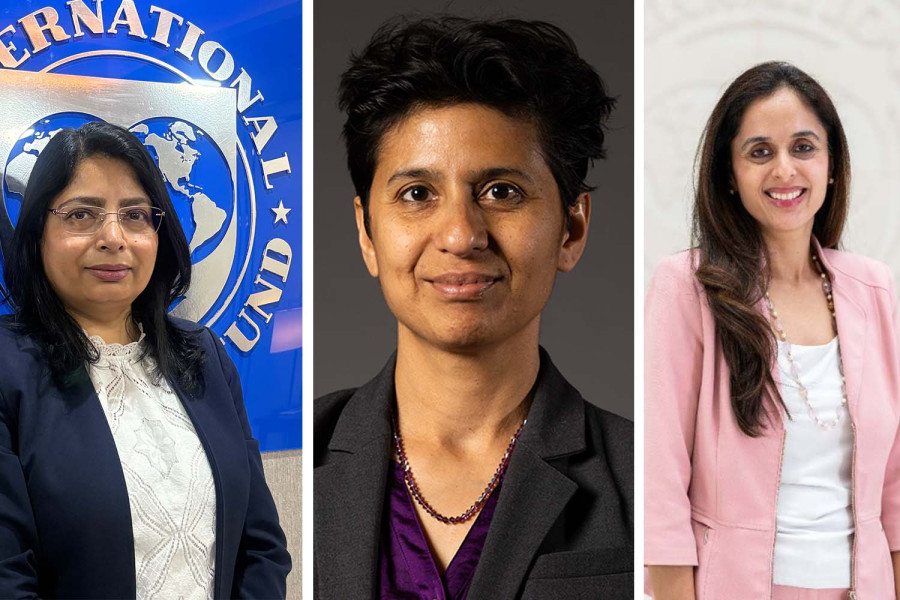
IMF officials discuss the gains from the Extended Credit Facility, the risks posed by the Middle East conflict, banking sector reforms, the FATF grey list and the Fund’s future engagement with Nepal. From left, Sarwat Jahan, Rupa Duttagupta and Sonali Jain-Chandra
In the wake of the Covid-19 pandemic, Nepal sought an Extended Credit Facility (ECF) from the International Monetary Fund as the country's current account slipped into deep deficit and foreign exchange reserves fell sharply.
The seven-review programme has provided Nepal with a total amount of $384.1 million in financing.
The facility was tied to a series of reform commitments, including measures to strengthen macroeconomic stability, rebuild foreign exchange reserves, safeguard financial sector stability, assess loan quality in the banking system and adopt risk-based financial supervision.
Since the programme began, Nepal's external sector has recovered markedly, with foreign exchange reserves reaching a comfortable level.
Against this backdrop, Kantipur spoke with Sarwat Jahan, IMF mission chief for Nepal and deputy division chief, and Sonali Jain-Chandra and Rupa Duttagupta, deputy directors of the IMF's Asia and Pacific Department, about Nepal's economic outlook.
Nepal recently completed its Extended Credit Facility arrangement with the IMF. What did the programme accomplish in Nepal?
Rupa Duttagupta
Approved in early 2022 amid acute post-pandemic stress, the IMF-supported programme aimed to safeguard macro-financial stability, rebuild economic buffers, and protect the vulnerable population. The strong commitment of the Nepali people to implement economic reforms during the past four years, despite the many changes in government, has yielded tangible results and is testament to strong domestic ownership of the programme’s reform priorities. Key macroeconomic indicators have strengthened. Specifically, international reserves have been rebuilt with over 12 months of import cover; fiscal balances have also strengthened keeping public debt sustainable; and inflation had been on a downward trend until the recent war in the Middle East. Still growth fell short of expectations in part because the economy was hit by successive shocks—including an earthquake in November 2023, one of its worst floods in September 2024, social unrest in September 2025 and more recently the global energy price shock triggered by the war in the Middle East—which prevented the nascent recovery from gaining strong traction and weighed on job creation.
The structural reforms implemented under the programme have also strengthened institutions and improved policymaking. Key advances include the modernisation of monetary operations, improvements in financial sector oversight, the completion of a bank loan portfolio review, enhancements to the fiscal framework and transparency, and stronger public investment management. Governance and accountability have also been reinforced through upgrades to the anti-money laundering framework, legal reforms, enhanced external auditing of the Nepal Rastra Bank, steps to strengthen the central bank act, and improved accountability of public enterprises.
The global economy has broadly been on track recently, but ongoing conflicts in the Middle East are projected to cause serious disruptions. The IMF has already indicated that the impact on developing countries will be twice that on developed nations. What factors would cause greater impact on developing countries like Nepal? Please answer with Nepal as the central focus.
Sonali Jain-Chandra
The oil price shock comes at a precarious juncture for Nepal, when the nascent economic recovery needs to find a stronger footing. While strong external buffers accumulated during the programme would help to absorb the shock, a prolonged war would materially weaken the growth outlook, push inflation above the Nepal Rastra Bank’s (NRB) target, and could result in a permanent loss in the level of output. There are several transmission channels. Nepal is fully dependent on imported petroleum products sourced from India, which itself relies heavily on oil supplies from the Middle East. Higher fuel prices will persistently raise import costs, worsen the trade balance, and feed into domestic prices. Additional spillovers operate through remittances—accounting for about one quarter of GDP, with roughly 40 percent originating from Middle Eastern labour markets. Tourism activity may also soften, reflecting disruptions to air travel through key Gulf transit hubs. Finally, reduced supply of fertiliser (Nepal imports about half of its fertiliser from three Gulf countries: Qatar, Bahrain, and Saudi Arabia) and higher energy costs would weigh on agriculture, a sector that contributes about one-quarter of GDP and employs over half of the total workforce.
Nepal has recently been placed on the Financial Action Task Force (FATF) Grey List. Behind this lie weaknesses such as the informal economy, corruption, and issues with the rule of law. Do you think these issues will improve and that Nepal can exit the Grey List? What is your view?
Sarwat Jahan
Anti-Money Laundering and Countering the Financing of Terrorism (AML/CFT) and governance are closely linked. Governance weaknesses, including gaps in the rule of law, can undermine the effectiveness of AML/CFT frameworks and weaken the integrity of institutions and the broader economy. IMF staff have supported Nepal’s AML/CFT reforms in close coordination with key partners, including the Financial Action Task Force (FATF) and the Asia/Pacific Group on Money Laundering. A key milestone was Nepal’s amendment of its AML/CFT law to align with international standards, supported by IMF technical assistance and conditionality under the IMF-supported programme. Nepal has also agreed on an Action Plan with FATF to address remaining AML/CFT deficiencies, which the IMF staff continue to actively support through recent technical assistance and training to around 180 government and private-sector participants. IMF staff also remain closely engaged on other priority reforms, including the development of effective, risk-based supervision of financial institutions. Ultimately, countries exit the FATF listing process once they have effectively completed the agreed Action Plan. The IMF’s objective is to help the Nepali authorities implement the required AML/CFT reforms swiftly and effectively, enabling Nepal to exit the grey list at the earliest opportunity.
On the IMF's recommendation, Nepal Rastra Bank has already conducted supervision of the 10 systemically important commercial banks (D-SIBs - Domestic Systemically Important Banks) through independent auditors. Did the quality of the banks' loans turn out to be as the IMF suspected?
Sarwat Jahan
The recently completed Loan Portfolio Review (LPR) of the ten largest Class A banks was an important supervisory step that will enable the NRB to better understand asset quality conditions in the banking sector. The IMF had recommended conducting the LPR for an in-depth analysis of the banking sector, but did not have a preconceived notion of what the analysis would find. The LPR shed light on the extent to which banks will need to reclassify loans and make additional loan loss provisions As a result, the NRB should move toward a more robust risk-based supervisory approach that emphasises accurate assessment of loan portfolios, stronger bank governance, and greater balance sheet resilience through higher capital buffers. These steps are crucial to reverse the asset quality weaknesses in the system, and address high NPL levels and weak bank capitalisation.
Another important priority is for NRB to provide instructions to the banks to improve the shortcomings in credit practices that are identified in the qualitative section of the report. i.e., ensure better credit underwriting standards, borrower adherence to loan terms and conditions including repayment schedules, and prompt action to address payment arrears. Extending the application of the LPR diagnostic approach to the remaining portfolios of the ten largest banks as well as to the full portfolios of the remaining ten commercial banks will be a key next step. Additionally, requiring banks to adopt better provisioning and auditing practices will further strengthen the financial sector. It is also important to improve the scope of its supervisory on-site examinations and off-site analysis by incorporating the shortcomings identified in the LPR exercise and expanding its analytical approach to the broader banking sector loan portfolio in order to better capture asset quality.
More than Rs1.5 trillion is currently sitting idle in Nepal's banks and financial institutions - meaning there is excess liquidity. What are the reasons behind the inability to manage liquidity effectively? What could be the solutions to this problem?
Sarwat Jahan
The rise in excess liquidity in Nepal’s banking system has been driven primarily by large foreign exchange inflows. Remittances, in particular, have increased sharply, rising by about 50 percent over the past three years. At the same time, weak private sector credit growth has lowered banks’ credit-to-deposit ratio, keeping excess liquidity elevated. Nepal Rastra Bank (NRB) has taken steps to absorb this liquidity, including by expanding open market operations (OMOs) at longer maturities through deposit collection auctions and NRB bond issuance. However, foreign exchange inflows have continued to outpace the scale of OMOs. NRB could further strengthen its response by improving the calibration of OMOs, expanding their use as needed, and enhancing liquidity forecasting. Stronger monetary operations would help bring short-term rates, including the interbank rate and OMO rates, closer to the policy rate and improve the effectiveness of monetary policy under the interest rate corridor system.
Nepal has undertaken the IMF’s Governance and Corruption Diagnostics. The new administration is also keen on governance reforms. How will the Governance and Corruption Diagnostics help Nepal? Sonali Jain-Chandra
The IMF’s ongoing Governance and Corruption Diagnostic (GCD) marks an important milestone in Nepal’s engagement with the IMF to strengthen governance and reduce corruption vulnerabilities. It is designed to identify macro-critical weaknesses in institutions, policies, and practices that can weigh on economic performance, fiscal sustainability, the business and investment climate, and public trust. The GCD will provide concrete, well-sequenced, and prioritized reform recommendations to address corruption risks that constrain Nepal’s economic development. We are pleased to see Nepal embrace this exercise—only the second country in the Asia-Pacific region after Sri Lanka to do so. Countries that have undertaken this exercise, including Sri Lanka, have benefitted from formulating and implementing their own homegrown action plan with time-bound reforms based on the recommendations from the GCD. More generally, we welcome the Nepali government’s commitment to good governance, including the broad reform agenda set out in its 100-point Roadmap. Nepal now has a valuable opportunity to advance a transformative governance agenda and unlock stronger, more inclusive medium-term growth. We look forward to continued collaboration with the authorities as they carry forward reforms to strengthen good governance.
Rupa Duttagupta, I understand that the seventh and review under the Extended Credit Facility was your final engagement with Nepal, at least for now. What was your impression of Nepal and how do you see Nepal moving forward?
Rupa Duttagupta
I feel privileged to have had the opportunity to engage with the Nepali authorities at a critical moment in their economic history. The IMF-supported programme began amid one global shock—the COVID-19 crisis—and concluded as another, the conflict in the Middle East, was unfolding. Reforms undertaken under the programme, prompted in part by the spillovers from the pandemic, have put Nepal on a much stronger footing to withstand the current shock. This achievement belongs to the people of Nepal, whose strong commitment to reforms helped restore macroeconomic stability and advance structural changes that will benefit the country for years to come. At the same time, Nepal’s important milestones should be seen as a foundation for further progress, with continued reform momentum.
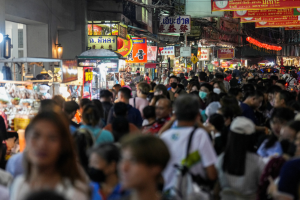
I will fondly remember my visit to Nepal, especially historic Bhaktapur and vibrant Thamel. The warmth and resilience of the Nepali people will always hold special meaning for me.
Sonali Jain-Chandra, I understand this is your first visit to Nepal. What is your first impression of Nepal and what do you see will be the IMF's next role in Nepal?
Sonali Jain-Chandra
I have had the privilege to visit Nepal over 20 years ago. On this visit, like the last one, I have been deeply touched by Nepali’s amazing culture, including at the Pashupatinath Temple, where I had the privilege of visiting during this stay in Kathmandu. During this visit, I had the opportunity to engage with many stakeholders to get a sense of the aspirations of the Nepali people for their country and the challenges they could face in reaching that goal.
The IMF has been a steadfast partner to Nepal for nearly 65 years. We will continue to work closely with the Nepali authorities through providing tailored policy advice in the context of our annual consultation, and help to build capacity through technical assistance, and training. Although the IMF-supported programme has ended, Nepal’s homegrown reform agenda remains ongoing. The program has created momentum to advance key reforms, including addressing remaining financial sector vulnerabilities, strengthening social safety nets, and,most importantly, achieving inclusive growth grounded in good governance and equal opportunity for all. We look forward to our sustained partnership in support of a more resilient and prosperous Nepal.




 14.82°C Kathmandu