Nepal’s rhino census is getting a scientific makeover
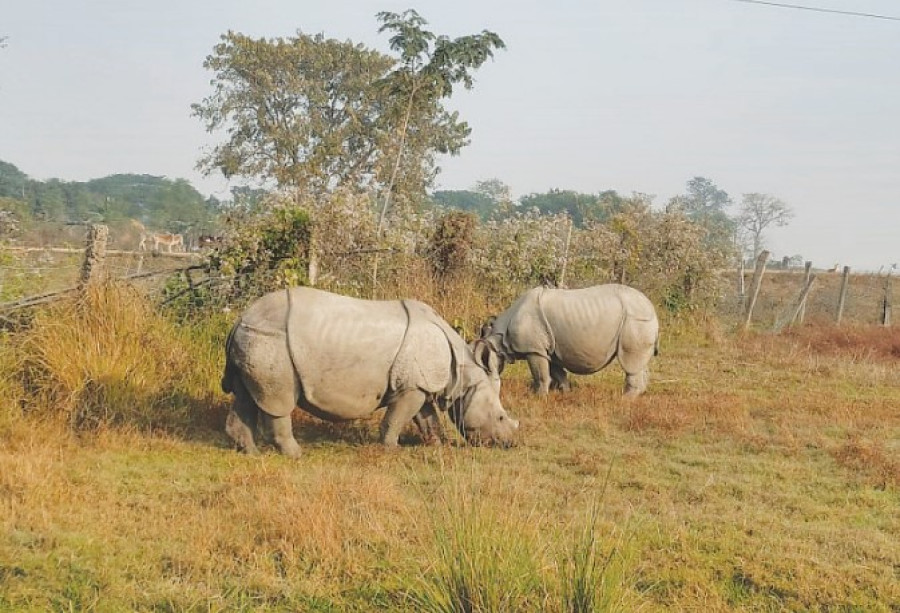
Authorities are considering DNA sampling and camera traps to replace a decades-old method that relies on elephants and direct sightings. Pushpa and Anjali, the two rhinos that were brought to Koshi Tappu Reserve from Chitwan, are seen grazing in this file photo. As the major rhino habitat in Chitwan is overcrowded, Nepal has been trying to relocate the rhinos, particularly to Bardiya National Park in the west. Photo: Courtesy of Birendra Gautam, Nepal Trust for Nature Conservation
Nepal is preparing to overhaul the way it counts its one-horned rhinos, moving away from a decades-old system that sends people into the jungle on elephants to spot and record the conserved animals.
The move comes as Nepal seeks better data on a rhino population that has recovered from historic lows but continues to face significant threats.
Nepal’s rhino population has risen sharply since it fell to about 100 in the 1960s, but 133 rhinos have died in and around Chitwan National Park over the past five years.
Authorities say the existing counting method is risky for survey teams and does not produce the kind of scientific data now needed to manage the population.
The Department of National Parks and Wildlife Conservation is considering genetic sampling, camera traps or a combination of the two for the next census. A committee will first prepare a protocol and conduct pilot studies before recommending a methodology.
“The department is preparing to revise the old method and adopt a new one,” said Haribhadra Acharya, a senior ecologist at the department. “We will conduct pilot studies to develop the methodology.”
Nepal currently has 752 one-horned rhinos, according to department data. More than 92 percent of them live in Chitwan National Park, making the park the centre of the country’s rhino conservation effort.
The 2021 census counted 694 rhinos in Chitwan, 38 in Bardiya National Park, 17 in Shuklaphanta National Park and three in Parsa National Park.
The next census is normally due after four or five years, but authorities are now preparing to change how it is conducted.
For decades, survey teams have divided rhino habitat into blocks and moved through them on elephants, spotting and counting the animals directly. Under the so-called ‘sweep operation’, elephants carrying the surveyors are positioned close enough for one team to see another as they search their assigned areas.
The method has become increasingly difficult to defend.
About 40 elephants were deployed each day during previous counts, with two counters riding on each elephant. The animals had to work from morning until evening and could become tired and aggressive.
There was also the danger of encounters with wild elephants.
During the 2021 census, a male wild elephant encountered one of the elephants being used by the survey team. The elephant carrying the counters bolted, throwing and dragging a technician who was injured. He remains disabled, Acharya said.
“Risk is high, and it is also difficult to obtain the actual data,” he said.
The department also says the equipment used in previous counts was inadequate and that the technology was not sufficiently scientific or reliable.
That is prompting officials to look beyond the traditional approach. Camera traps are already used to estimate tiger populations, while rhinos have generally been counted through direct observation.
“Tiger numbers are determined digitally through camera trapping, whereas rhinos have been counted by people seeing them directly,” Acharya said. “The tiger census is therefore considered scientific, while the rhino census has mainly been aimed at finding out the number of animals.”
A recovery with continuing threats
The proposed change in census methodology comes against the backdrop of a remarkable but uneven recovery.
Nepal had about 800 rhinos in the 1950s. By the following decade, their numbers had collapsed to around 100. Conservation programmes subsequently helped the population recover, turning the one-horned rhino into one of the country’s most recognisable wildlife species.
But the animals continue to die from a range of causes.
Chitwan recorded 22 rhino deaths in the fiscal year 2025–26, including 20 inside the national park and two in the surrounding national forest. The park recorded 30 deaths in 2024–25, 21 in 2023–24, 23 in 2022–23 and 37 in 2021–22.
Rhinos die naturally as they age, but deaths also result from fights between animals, getting trapped in marshes and mud, electrocution and, occasionally, tiger attacks. Poaching remains a conservation concern, although no rhino has been killed by poachers in Chitwan since October 2023, according to park officials.
“Conservation has not produced the results we had hoped for because of habitat-management problems and the limited resources available,” said Abinash Thapa Magar, information officer and conservation officer at Chitwan National Park.
Human-rhino conflict is another problem. Rhinos sometimes enter agricultural land and damage crops, increasing tensions between communities and wildlife.
Thapa Magar said awareness campaigns, greater vigilance and tighter security had helped reduce poaching.
“We do not have any concrete evidence yet about where the horns of poached rhinos end up or what they are used for,” he said.
The department has a 2024–34 action plan for rhino conservation.
More than a tourist attraction
For Nepal, the stakes go beyond the survival of a charismatic animal.
The greater one-horned rhino is found only in parts of Nepal and India. Its horn can grow to between 20 and 100 centimetres, while its massive body, thick folds of skin and distinctive appearance make it a major draw for wildlife tourists.
Hundreds of thousands of visitors come to Nepal each year, and rhino sightings are an important part of the country’s wildlife tourism industry.
“The rhino is a flagship species of riverine areas, so its ecological importance is equally significant,” said Dr Naresh Subedi, a former member-secretary of the National Trust for Nature Conservation.
Rhinos also alter the environment around them. By feeding on large grasses, they help keep forests and grasslands open and create habitat for smaller animals. For that reason, conservationists refer to them as ‘ecosystem engineers’.
Their relationship with other wildlife is also significant, according to Dr Ghana Shyam Gurung, a WWF Nepal representative.
“Saving rhinos also helps save tigers, and vice versa, so the species has a distinct importance,” Gurung said. “Rhinos are prehistoric animals, which is another reason people are fascinated by them.”
For tourists, the appeal is simpler. Nature guide Dinesh Giri said visitors often take elephant-back or jeep safaris to watch rhinos moving through their natural habitat, their massive bodies swaying as they walk or wallow in mud.
The animals are generally peaceful when left alone. But that can change quickly when they feel threatened. A frightened or angry rhino can run at high speed and attack.
Chitwan is the world’s second-largest habitat for the greater one-horned rhinoceros after Kaziranga National Park and Tiger Reserve in Assam, India.




 15.71°C Kathmandu