



 22.06°C Kathmandu
Tue, Oct 20, 2026
Money
Weak private investment deepens pressure on Nepal’s revenue and public debt
As the government prepares next fiscal year’s policy agenda and budget, economists and business leaders say restoring investor confidence will be critical to reviving private sector investment and easing dependence on public borrowing.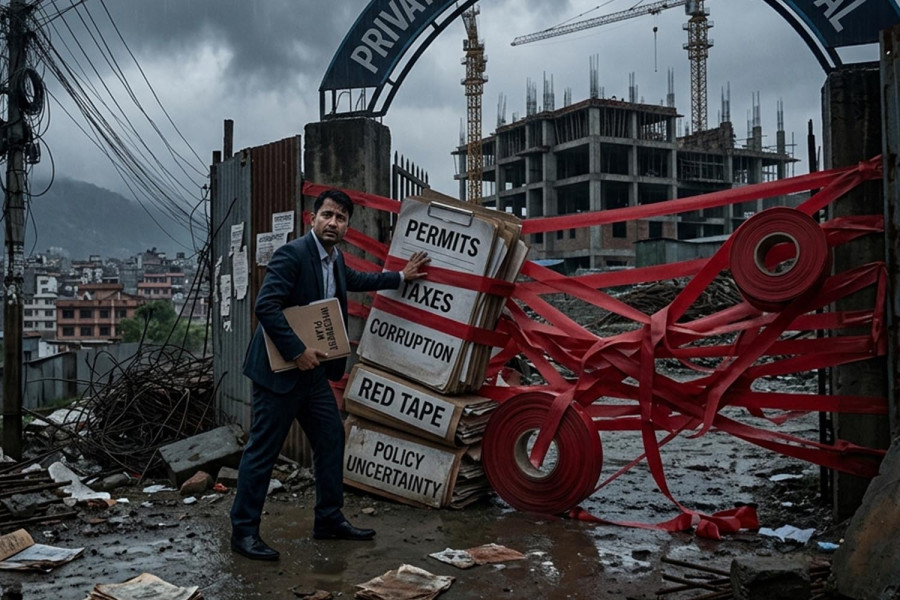
bookmark
Yagya Banjade
Published at : May 10, 2026
Updated at : May 10, 2026 09:55
Kathmandu
The government, currently preparing its policy and programmes for fiscal year 2026-27, which is viewed as the base year for Nepal’s long-term ambition to build a $100 billion economy, faces the challenge of restoring the private sector’s confidence and creating conditions for greater investment.
The private sector, which typically accounts for up to 25 percent of total investment in the economy, saw its share fall to 19 percent last year. The decline significantly affected revenue collection, leaving the government increasingly dependent on public borrowing even to finance routine expenditures.
The private sector had already been weakened by the Covid-19 pandemic and the government’s subsequent demand-suppression policies. Businesses also suffered losses of more than Rs30 billion during the Gen Z protests. Although the nearly two-thirds majority government formed after the March 5 elections has raised expectations within the business community, investors are still waiting to see the government’s policy agenda and budget before making commitments.
Economists say private investment was largely affected by the government’s post-pandemic policies aimed at controlling demand, despite signs of economic recovery after Covid. While the National Statistics Office has projected some improvement in investment during the current fiscal year, analysts say further incentives for the private sector will be necessary if the ruling Rastriya Swatantra Party hopes to achieve its election pledge of 7 percent economic growth.
According to Dhundiraj Lamichhane, deputy chief statistician and spokesperson at the National Statistics Office, total gross fixed capital formation at current prices has increased by 19 percent this year. However, he noted that this increase reflects a statistical anomaly: because government investment plummeted by 33 percent, the private sector's contribution appears proportionally larger on paper
“When estimating gross fixed capital formation, indicators such as construction activity, imports of machinery, domestic production of machinery, breeding livestock, cultivated trees for fruit or long-term production, research and development, computer software and data, and weapons are taken into account,” Lamichhane said. “These investments may come from the government, public enterprises or the private sector. So when overall capital formation rises while public investment declines, the remaining share is interpreted statistically as an increase in private investment.”
He said government gross fixed capital formation had increased in fiscal years 2023-24 and 2024-25 but dropped by nearly 33 percent in 2025-26. As a result, private gross fixed capital formation appears to have increased. The same trend, he added, is also visible in calculations based on constant prices.
“If capital formation is delayed in one year, it is likely to materialise in the following year, which often creates this kind of statistical pattern,” Lamichhane said.
Economist Nar Bahadur Thapa said declining business confidence, the shift of investors away from productive sectors towards trade and services, and the slowdown in real estate investment were the main reasons behind weaker private sector investment.
Although there has been a slight improvement compared to the previous fiscal year, he said stronger and more credible reforms would be required through the upcoming policy statement and budget to sustain recovery.
The National Statistics Office estimates that the private sector will invest around Rs1.25 trillion this fiscal year. In the previous two fiscal years, annual private investment remained below Rs900 billion.
Ram Prasad Gyawali, head of the Central Department of Economics at Tribhuvan University, argued that the declining share of private investment in national capital formation is primarily due to the failure to create an investment-friendly environment.
“In recent years, private sector confidence has weakened for several reasons,” he said. “There are also frequent informal claims of capital flight, although there is no official data to verify that.”
Gyawali said the problem is not only policy-related but also rooted in cumbersome administrative procedures such as company registration and tax payments, which discourage investors. He also pointed to growing corruption in recent years.
“Although there may not be statistical evidence to prove it, corruption is a social reality,” he said. “Investment has not fallen because people lack money, but because of declining confidence and practical obstacles.”
Government data show that revenue collection has consistently fallen short of targets over the past five fiscal years. During that period, annual revenue collection averaged only 81.7 percent of the target. Revenue performance was strongest in fiscal year 2020-21, when 92.5 percent of the target was achieved, and weakest in 2022-23, when only 69.3 percent was collected.
For the current fiscal year, the government has set a revenue target of Rs1.48 trillion. By mid-April, corresponding to the first nine months of the fiscal year, it had collected around 60 percent of the annual target and 83.61 percent of the target set for that period.
To meet the annual goal, revenue collection during the remaining three months of the fiscal year would need to average 13.33 percent of the annual target each month.
The shortfall in revenue has steadily increased Nepal’s reliance on public debt. Outstanding public debt reached Rs2.93 trillion by mid-April, equivalent to 48.04 percent of gross domestic product in the previous fiscal year.
Government reports indicate that federal revenue is increasingly insufficient even to finance recurrent expenditure, forcing the state to borrow simply to cover day-to-day spending obligations.
Gyawali said the first step towards reversing the situation would be rebuilding trust with the private sector.
“The state must assure businesses that if they invest and pay taxes, their investments, their personal security and their families will be protected,” he said. “That requires improving the investment climate, simplifying practical procedures and implementing a one-door policy.”
Chandra Prasad Dhakal, outgoing president of the Federation of Nepalese Chambers of Commerce and Industry, said private investment has weakened due to a decade of economic stagnation, the impact of the Covid-19 pandemic, the Russia-Ukraine war, previously high interest rates, liquidity shortages and widespread investor pessimism.
He added that frequent changes in government had also created policy uncertainty, further weakening business confidence and investment appetite.
According to Dhakal, the continued contraction in private investment reflects both the absence of an improved investment climate and weak demand for investible capital.
“Interest rates on loans have been declining steadily in recent months,” he said. “Excess liquidity in banks and financial institutions has pushed deposit rates to their lowest level in a decade. But investment has still not increased because investor confidence remains weak.”
Dhakal said the upcoming policy statement and budget should include special measures aimed at restoring business confidence.
“State policies and the way they are implemented directly affect private sector investment,” he said. “The government’s policies and programmes must therefore be designed to encourage greater private investment.”
Yagya Banjade
Banjade covers government finance, banking, capital markets, and the economy for Kantipur Daily.

Most Read from Money
Nepal travel agents threaten to stop selling Thailand trips over visa rules

Why does an hour long flight to Dhangadhi cost more than a flight to New Delhi?
Malaysia rejects Nepal’s demand to open recruitment to all manpower agencies
No school, but a graduation cap for women dairy farmers
Nepal arrests four medical service providers as Malaysia recruitment row deepens
Editor's Picks




E-PAPER | October 20, 2026

×