



 22.94°C Kathmandu
Thu, Oct 22, 2026
Money
Cardamom exports surge 62.5 percent, set to hit record
Rising prices, expanded cultivation and strong demand from India push Nepal’s large cardamom exports toward a historic Rs11 billion.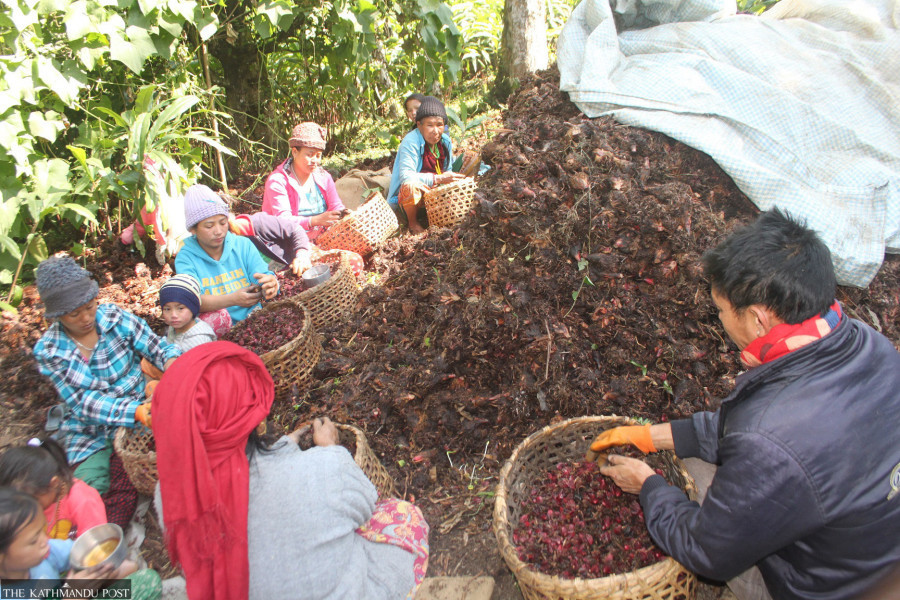
bookmark
Post Report
Published at : March 29, 2026
Updated at : March 29, 2026 08:45
Kathmandu
Nepal’s large cardamom exports jumped by 62.5 percent in the first eight months of the current fiscal year, with traders expecting shipments to exceed Rs11 billion by year-end—a record high.
According to the Department of Customs, the country exported 4,605 tonnes of large cardamom worth Rs9.49 billion in the eight months ending mid-March. This marks a sharp rise compared to the same period last fiscal year.
In the entire previous fiscal year, Nepal exported 4,301 tonnes of the spice valued at Rs7.68 billion.
Exporters attribute the surge primarily to a steady rise in prices over the past three years, driven by increased production and growing demand in India and other international markets.
“The cardamom price ranged from Rs2,000 to Rs2,600 per kg during this fiscal year’s harvest, up by Rs150 to Rs200 per kg compared to last season,” said Nirmal Bhattarai, immediate past president of the Federation of Large Cardamom Exporters. “Farmers received good returns from the start of the harvest, while expanded cultivation boosted output.”
Production increased by an estimated 20 to 25 percent this year, even as output in India and Bhutan remained relatively unchanged. Farmers earned around Rs100,000 per mann (40 kg) during the harvest season, reducing the tendency to hold back stock.
October and November remain the peak harvest months for the spice.
Higher prices in recent years have encouraged farmers to expand cultivation despite limited government support. The crop is now grown in around 52 districts, up from about 42–43 districts previously. The cultivation area has also expanded from roughly 16,000 hectares to about 20,000 hectares.
Traders expect demand to remain strong in the coming years, particularly due to growth in India’s spice processing industry.
“The demand for Nepali large cardamom has increased in India with the expansion of spice factories in recent years,” Bhattarai said, adding that consumption has also grown in other foreign markets.
Birtamod serves as the main trading hub for large, or black, cardamom—one of the world’s most expensive spices.
The spice is also cultivated in India’s Sikkim and Darjeeling regions as well as in Bhutan. It was introduced to Ilam from Sikkim in 1865.
Major producing districts in Nepal include Ilam, Panchthar, Taplejung, Sankhuwasabha, Tehrathum, Bhojpur and Dhankuta.
India remains the dominant buyer, absorbing about 99 percent of Nepal’s large cardamom exports. From there, the spice is re-exported to Pakistan and the Middle East, where it commands premium prices due to strong consumer preference for Nepali varieties.
Pakistan is the largest importer of cardamom via India, accounting for roughly 60 percent of India’s exports. The spice is widely used in biryani and other dishes, where it is associated with prosperity and flavour.
Nepali black cardamom is known for its distinctive smoky aroma, produced through a traditional post-harvest drying process in bhattis (ovens). This method gives the spice a deep, roasted flavour that is particularly valued in savoury dishes.
According to the Market Intelligence Series jointly produced by the Food and Agriculture Organization and the Economic and Social Commission for Asia and the Pacific, Nepal is the world’s fifth-largest producer of cardamom.
It is also the country’s third-largest agricultural export, after soybean and palm oil. However, in terms of net foreign exchange earnings, large cardamom ranks first due to Nepal’s heavy reliance on imports of soybean and palm oil.
Nepal ranked fourth among global cardamom exporters in 2023, accounting for 8.3 percent of total exports. The country’s cardamom exports nearly tripled over the past decade, rising from $23.6 million in 2014 to $66.6 million in 2023.

Most Read from Money

Nepal travel agents threaten to stop selling Thailand trips over visa rules

Why does an hour long flight to Dhangadhi cost more than a flight to New Delhi?
Malaysia rejects Nepal’s demand to open recruitment to all manpower agencies

No school, but a graduation cap for women dairy farmers

Nepal arrests four medical service providers as Malaysia recruitment row deepens
Editor's Picks




E-PAPER | October 22, 2026

×