Valley short on LPG as refinery maintenance, transport delays bite
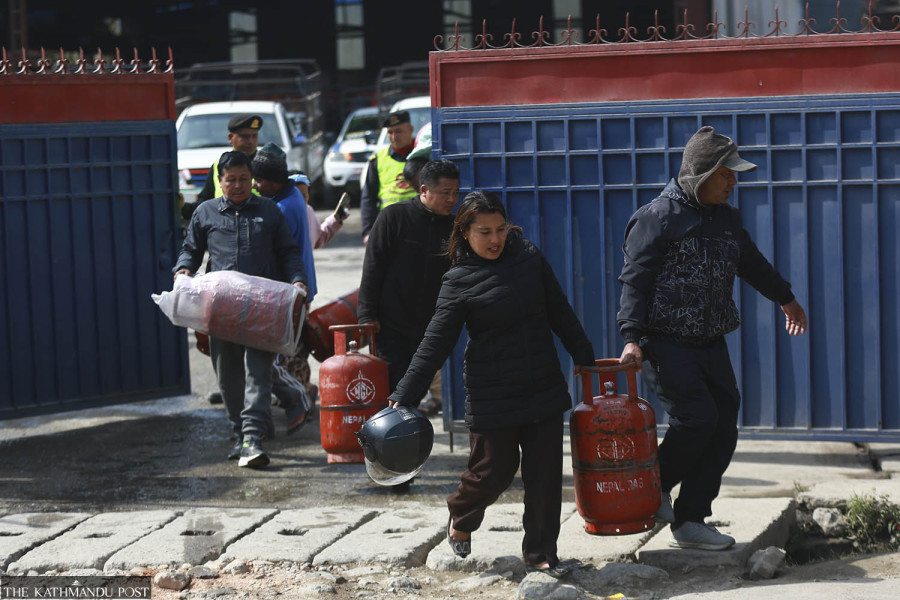
Nepal Oil Corporation blames irregular imports from India and panic hoarding. People leave the Balaju depot of Nepal Gas with filled cooking gas cylinders, in Kathmandu on Tuesday. Dipen Shrestha/TKP
Jaya Yadav of Kapan, Kathmandu has been looking to buy a cooking gas cylinder since last Saturday.
Living in a rented room with limited space, Yadav does not keep an extra LPG cylinder. Her husband works abroad and she lives alone with her two-year-old daughter.
“We ran out of cooking gas on Saturday morning,” Yadav said. “I went to the nearby grocery shop from where I usually buy gas, but the shopkeeper said he had none.”
Yadav and her child had to make do with noodles, water and biscuits. Without any other recourse, she contacted her relatives.
“One of my relatives brought us an induction stove,” she said. “But the electricity supply is also not reliable. I have been facing a lot of hassles while cooking in the past few days.”
For more than two weeks, consumers across the Kathmandu valley have been facing a shortage of cooking gas.
The state-owned Nepal Oil Corporation attributes the problem to irregular supplies caused by maintenance work at the Barauni Refinery in India, which led to cuts in Nepal’s regular quota.
However, the corporation maintains that the shortage is not as acute as it appears and suspects panic-driven hoarding by consumers.
Manoj Kumar Thakur, NOC’s deputy director, said refinery maintenance had disrupted supplies but insisted there was no shortage. “Consumers appear to be hoarding LPG cylinders, which may have created an artificial shortage in Kathmandu Valley,” he said.
Thakur added that there had also been transport-related problems, which have now been resolved.
According to the corporation, the Barauni Refinery in India underwent maintenance for nearly 10 days, forcing Nepal to source LPG temporarily from the Paradip Refinery in Jagatsinghpur district of Odisha.
The shift to an alternative refinery created logistical challenges, including delays in transport permits. Barauni, the nearest refinery to Nepal, is around three days away, whereas shipments from Paradip take around 10 days.
“This increases the turnaround time, and when gas does not arrive on time, the market faces shortages,” Thakur said. He added that Barauni Refinery resumed operations a week ago and gas cylinders have already started reaching the market. The supply situation will ease within a week, he said.
Officials said the national capital was particularly affected as Nepal Gas, which has a larger customer base in the Valley, received fewer gas cylinders due to loading problems. Other brands like Om Gas and Sai Gas were also affected.
Consumers return with filled Nepal Gas cylinders at the bottler’s head office at Balaju Industrial Area in Kathmandu on Tuesday. Dipen Shrestha/TKP
Demand for LP gas typically rises in both Nepal and India during the winter months—especially from mid-December to mid-February—as households use heaters and geysers. Nepal imports LPG from India through bullet tankers, and when demand rises in India, supply to Nepal is cut, according to cooking gas traders.
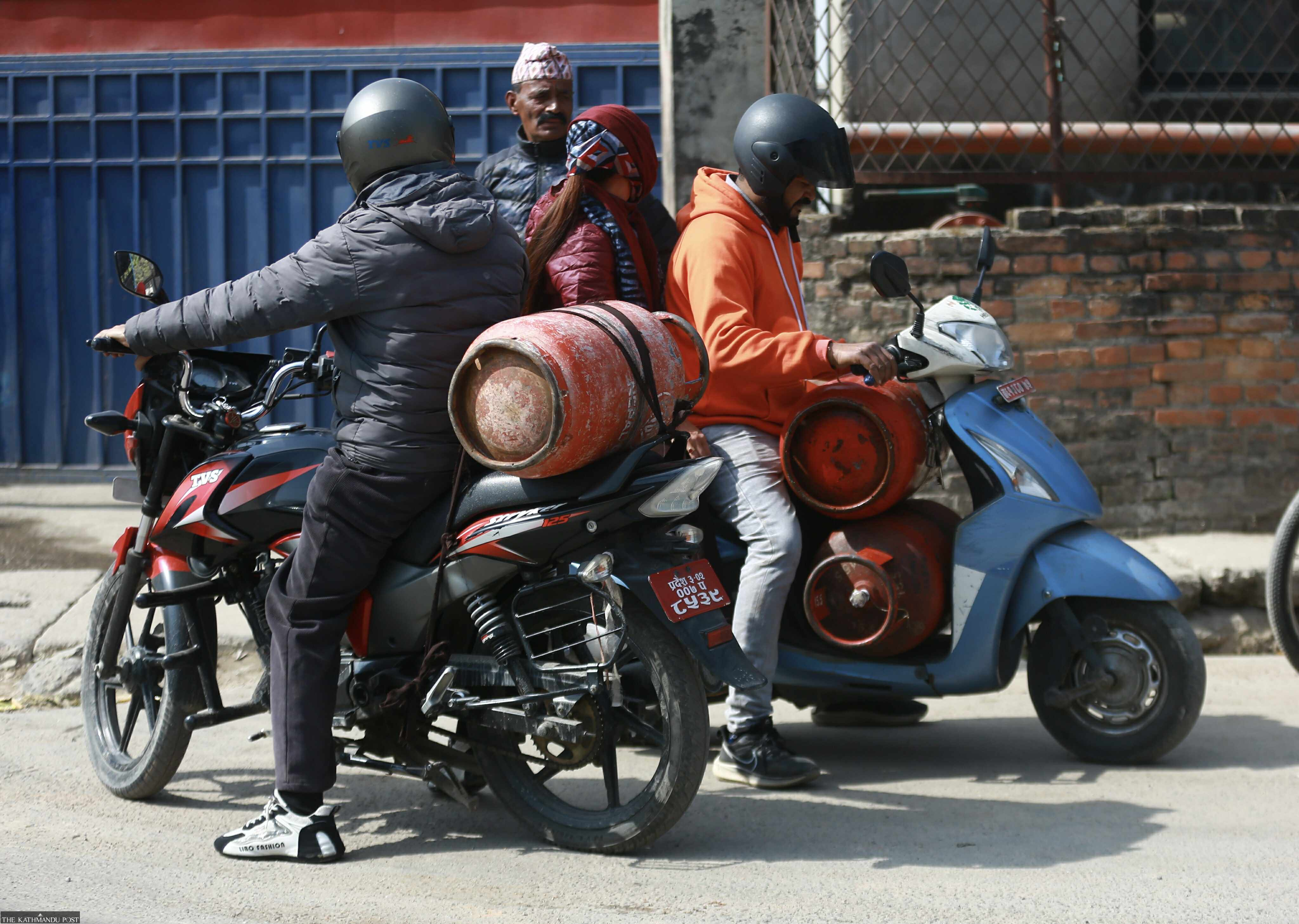
With news of a gas shortage going viral, consumers panicked and started hoarding cylinders, which worsened the situation, an industry insider said.
Thakur said the corporation has discussed the issue with the Nepal LP Gas Association, which has assured that the problem will be resolved within a week. The NOC has also instructed gas dealers to prioritise supply in the Kathmandu valley.
Shiva Prasad Ghimire, immediate past president of Nepal LP Gas Association, said high transport costs in India have cut the number of vehicles transporting gas to just 20-25 percent. The transport cost for an LPG bullet in India is higher than the rate fixed by the Nepal Oil Corporation, discouraging transporters.
“Transport costs have been piling up in the past four months, and we are seeing its impact now,” Ghimire said. He added that traders are using new transporters, and supply is expected to normalise within two weeks.
“Moreover, when people hoard three to four cylinders, it becomes very difficult to stabilise supply quickly,” he said.
According to the NOC, while daily LPG consumption in the country stands at 70 to 75 bullets, 80 to 90 bullets are being cleared from customs each day. Nepal consumes around 100,000 cylinders of LP gas daily, with demand rising by 10–15 percent for around two peak winter months.
In light of the upcoming elections, the corporation has increased LPG orders by 2,000 tonnes for February, in addition to the usual monthly quota of 49,500 tonnes.
Department of Customs data show that Nepal imported 274,805 tonnes of LPG worth Rs27 billion in the first six months of the current fiscal year until mid-January. LPG imports declined by 9 percent in this period compared to the same period last year.
In the last fiscal year, Nepal imported a total of 554,612 tonnes of LPG worth Rs62.58 billion.
Krishana Prasain is a business reporter for The Kathmandu Post covering markets. Before joining The Kathmandu Post in 2018, she spent 3 years in New Business Age magazine covering business.




 25.92°C Kathmandu