Karnali students haven’t been taught in full, yet they will sit for SEE next week
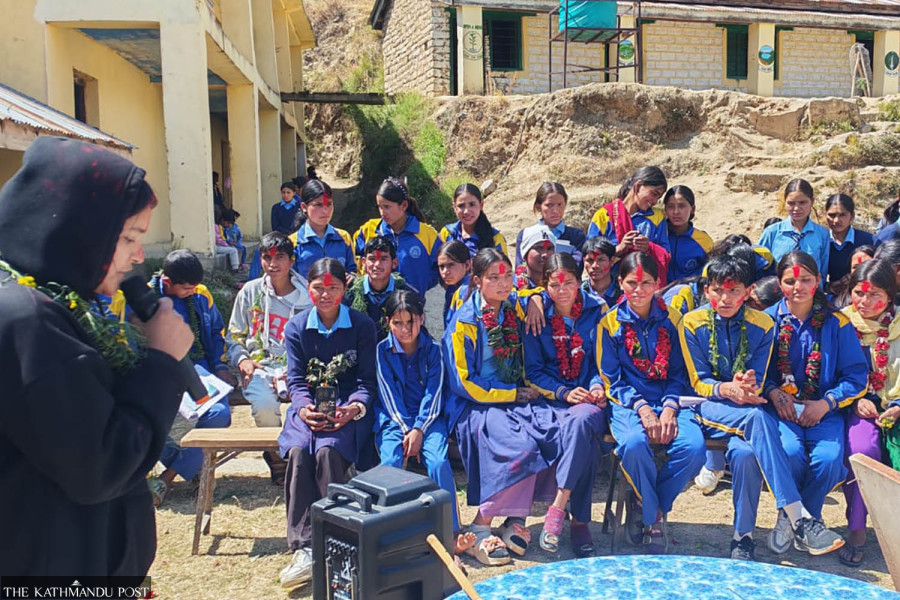
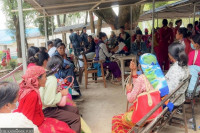
Some opt for private tuition away from their villages paying high costs. A farewell event organised at the Panchadeval Secondary School in Sannitriveni Rural Municipality, Kalikot for SEE-appearing students. Tularam Pandey/TKP
With the Secondary Education Examination (SEE) around the corner, Jamuna Rokka, a tenth-grader at Janata Secondary School in Subhakalika Rural Municipality-1, Kalikot, finds herself in a predicament shared by thousands of students across Karnali Province. While her peers in urban centres have long completed their revisions, Rokka is struggling to grasp the fundamentals of subjects that were never taught completely.
“We only had seven units in English covered, thirteen in science and ten in mathematics when the winter holidays began,” Rokka told the Post. Instruction had stalled long before the school closed for the cold season. “Once the holidays started, many of my classmates rushed to Surkhet or the district headquarters Manma to attend private tuition classes. After that, regular classes at school effectively ceased. The school did eventually organise some coaching sessions, but they were too little, too late. We were nowhere close to finishing the syllabus,” she lamented.
The case of Janata Secondary School points to a systemic failure in the country's decentralised education framework. In a school where the number of permanent teachers for grades nine and ten is zero, the burden of secondary level teaching falls on two teachers paid with municipal and federal grants for English and mathematics. For science, the students must rely on Dipendra Adhikari, a primary-level teacher who has been pushed into a role he did not train for.
“Our academic year was marred by a series of interruptions. We had the summer break in July and August, followed immediately by two weeks of disruptions during the Gen Z movement. Then came the major festivals of Dashain and Tihar in October, and finally the winter holidays in December and January. Every time we gained momentum, the calendar worked against us,” said Adhikari.
The crisis is not merely anecdotal. On Tuesday, Nawaraj Acharya, head of the education unit at Subhakalika Rural Municipality, led a monitoring team to Rokka’s school. The findings were stark—of the 28 students enrolled in grade 10, only 16 were present. The remaining 12 had joined the exodus to urban centres in Manma or Surkhet, desperate to pay for the education their local government is constitutionally mandated to provide for free. Acharya noted that five of the seven secondary schools in his local unit lack permanent positions for secondary-level teachers.
This geographical remoteness has created a lucrative but exploitative market for private tuition. Nabina Bohara, a student at Durga Secondary School in Tilgupha Municipality-2, Kalikot, has been living in Surkhet for five months, specifically to prepare for the SEE.
“By the time the autumn festivals arrived, it was clear we wouldn't finish the course at school,” said Bohara. “In mathematics, we hadn't even started geometry. In English, grammar was untouched, and in science the chemistry chapters were not even started till Dashain. I will return to the village in a day or two just to sit the exams,” she said.
The cost of this educational migration is staggering for rural families. Bohara pays 3,000 rupees per month for three subjects, with an additional 10,000 rupees for food and accommodation.
For Man Bahadur Shahi, a parent from Tilagupha-2 whose son Prakash is also appearing for the SEE, the financial strain is a heavy price to pay for a basic right. “Sending a child to Surkhet costs at least 20,000 rupees a month,” said Shahi. “I had to take out a loan. It is a compulsion; we cannot let our children fail because the state failed to provide a teacher.”
Historically, Karnali consistently lags behind in the national average for SEE results—often referred to as the ‘Iron Gate’. Various reports have highlighted that while federalism promised to bring ‘Singha Durbar to the village’, the management of teachers remains stuck in bureaucratic limbo. The transition of power to the local level has often resulted in a vacuum where neither the federal nor the local government takes full responsibility for permanent teacher appointments, leaving schools dependent on temporary relief quotas or private funding.
The data available at the Directorate of Education Development in Karnali paints a grim picture. A 2024 study of 110 schools revealed that, on average, barely 60 percent of the curriculum is completed by the end of the academic session. Deepa Hamal, acting chief at the directorate, attributes this to a combination of teacher shortages, inadequate infrastructure, delayed textbook delivery and chronic absenteeism.
The quality of education in Karnali is on a downward trajectory, warned Hamal. Last year, 35,061 students sat for the SEE from the province but only 20,384 passed. In 46 schools across the province, not a single student passed the exams. The number of students achieving a GPA between 3.61 and 4.0 was just 402. The pass rate has plummeted from 64.8 percent in 2024 to 58.13 percent last year.
The root of the problem is a staggering vacancy rate. Balbir Sunar, head of the Education Division at the Ministry of Social Development in Karnali, said that the province is short of 654 teachers for core subjects—English, maths and science—alone. Out of 3,109 sanctioned secondary-level positions across 3,034 community schools in the province, as many as 1,749 remain vacant. Currently, only 1,360 teachers are working across permanent, temporary, and relief capacities.
Teacher appointment is another hurdle. In remote districts like Humla, schools struggle to attract candidates even when funds are available. Jay Bahadur Bam, headmaster of Saraswati Secondary School in Sarkegad, Humla, has been searching for science and mathematics teachers since last August. “We have advertised the positions nine times. Nobody applies. Our students are forced to prepare for the SEE entirely on their own,” said Bam. Similarly, Rupa Devi Secondary School in Naraharinath Rural Municipality-1, Kalikot, only found a mathematics teacher after advertising the vacancy 19 times.
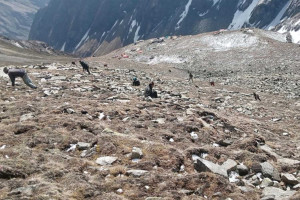
Geography and socio-economic structure also play a role. In the high-altitude regions of Humla, Dolpa and Mugu, the Yarsagumba (Ophiocordyceps sinensis) season sees entire families, including students, migrate to the highlands for two months to harvest the caterpillar fungus. Chhiring Kyapne Lama, chairman of Mugum Karmarong Rural Municipality in Mugu, argues that the national academic calendar is disconnected from the reality of the mountains.
“For us, the academic session starting in April is impractical,” said Lama. “Before the Covid-19 pandemic, we ran sessions from February to November to avoid the heavy winter snow. Now, between the harsh weather, the harvest seasons, and the fact that teachers from outside the district often stay away on long leaves, the students never stand a chance,” he added.
As a total of 38,379 students sit the SEE this year across 161 centres in Karnali, the question remains whether these students are being tested on their knowledge or their resilience in the face of systemic neglect.




 19.27°C Kathmandu