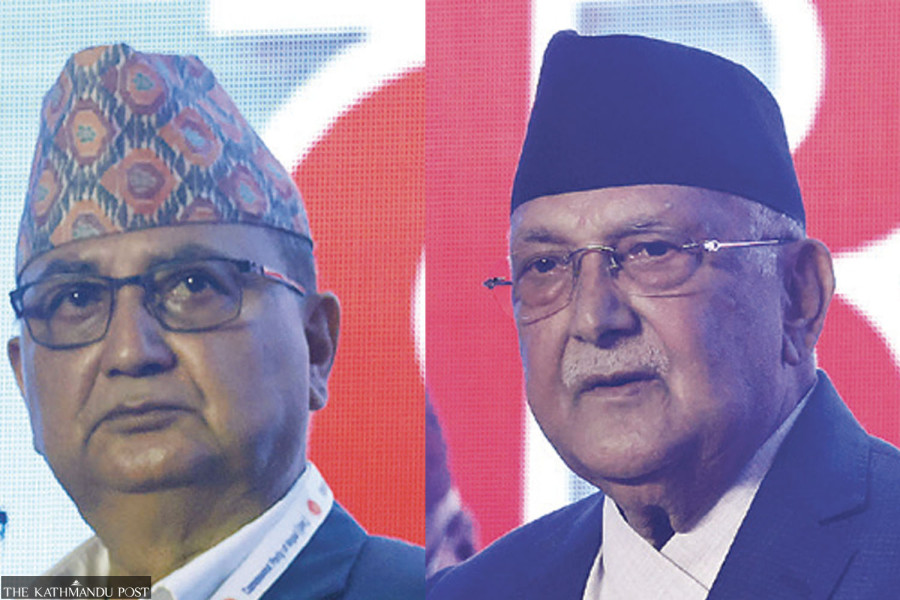
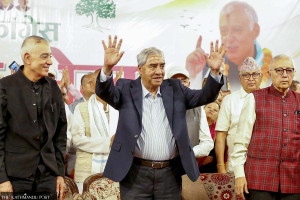
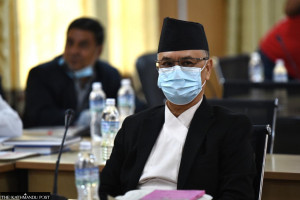
Replacement of UML chair KP Oli with Ishwar Pokhrel or any other old generation leader will be meaningless. Ishwar Pokhrel (left) and KP Oli Post File Photos
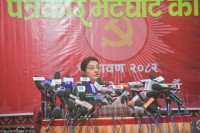
Two months after the Gen Z movement, one of the three established political parties, the CPN-UML, remains the least interested in internalising the movement’s spirit. Trying to swim against the national political tide, it still questions the legitimacy of the interim government and asks for the reinstatement of the dissolved House of Representatives. The Gen Z-ers’ cry for an end to corruption and initiation of good governance practices has yet to reach the ears of the top UML leadership. Party chair KP Sharma Oli, who was the prime minister when state forces killed 19 demonstrators, mostly youngsters, still shrugs off responsibility for the mass murder. Instead, he continues to undermine the protest and to foster narratives detrimental to holding the March elections on time.
By contrast, the Nepali Congress, the biggest of the three established parties, seems more accommodative of the Gen Z movement’s spirit. Despite infighting, a significant number of the party’s central committee members and convention representatives have started demanding reform, including generational transfer of power from the almost octogenarian generation of party president Sher Bahadur Deuba to, say, the quinquagenarian pair of party general secretaries Gagan Thapa and Bishwa Prakash Sharma. The duo has taken up the agenda of the ‘Gen Z for 7D’ group in the Congress and advocated progressive changes, including better youth representation in the party structures. Thapa, in particular, has proposed a dialogue between the mainstream parties and the Gen Z representatives to craft a charter that will provide the basis for reform in the state mechanism in line with the Gen Z agenda of anti-corruption and good governance.
Meanwhile, the only challenge to septuagenarian Oli’s stronghold in the UML is speculated to come from another septuagenarian, Ishwar Pokhrel, a senior vice-chair. While the change in the party’s top leadership is in line with the Gen Z agenda of doing away with the old heads of the three traditional parties, it also reeks of the continuation of the old ways of doing things. Pokhrel’s claim that his probable push for party presidency is driven by the party’s need to ‘reach out to the people with fresh faces and ideas’ is ironic. For he is neither a fresh face in Nepali politics nor has he proposed any fresh idea for party reform. The resignation of Sujan Kadariya, the president of the ANNFSU, the UML’s student wing, after the Oli-led government’s mishandling of the Gen Z protest, seemed to be a rare principled move by a youth leader in the party. Yet his return to the party fold under the same UML leadership raises doubts about his own motive as well as on the ability of young UML leaders like him to challenge old leadership.
This is a tragedy, for the UML has been a major force in Nepali politics since the restoration of democracy in 1990. Its significance is not limited to its role in establishing a democratic system, consistent participation in elections and influence on national policy; it also offers the potential of a strong, moderate leftist pole capable of standing up to more market oriented outfits.
Old UML leaders must face the reality: If they refuse to relent their hold on power, the party might soon be an irrelevant force. And if the old guard is not ready to make way, it is the duty of the party rank and file to protect their institution.




 20.85°C Kathmandu