



 18.11°C Kathmandu

Sun, Oct 25, 2026
Columns
Will Nepal’s lights stay on at 7pm in the winter?
The Bhotekoshi flood and the Kaligandaki landslides exposed a grid that depends on a few valleys and on river flow. Winter evenings, when demand peaks and India’s imports stop, will show how much of Nepal’s power is dependable.
bookmark
Ankit Mishra
Published at : October 25, 2026
Updated at : October 25, 2026 03:27
On September 27, landslides damaged pylons on the 220kV Kaligandaki corridor and forced 12 hydropower plants, which generated 358.2 MW of power, to shut down. A month earlier, the Bhotekoshi flood had cut off 432.1 MW along the Trishuli corridor. With the grid about 1,000 MW short, the Nepal Electricity Authority (NEA) cut roughly 300 MW of supply to factories from Birgunj to Butwal. Industry was losing power again, eight years after the NEA declared the country free of load-shedding.
Dirghayu Kumar Shrestha, the NEA’s managing director, has ruled out load-shedding this winter. That promise rests on India. The NEA plans to import 1,154 MW, almost half the expected winter peak of about 2,300 MW, against a deficit of more than 1,100 MW. India's current approval covers 654 MW, from midnight to 6pm, until December 31, and New Delhi will review the January quantity in December. India has not allowed imports during Nepal’s evening peak, when demand runs highest.
Nepal often measures its power sector by installed megawatts and export earnings, which reached a record Rs29.32 billion last fiscal year. But a better way to judge energy security is to ask how much power the country can rely on at 7pm on a January evening, if one corridor is down and there are no imports from India. The recent flood revealed two main weaknesses in this regard.
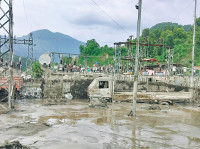
The first weakness is concentration. In Rasuwa, the flood affected four operating plants with 231 MW and three projects under construction with 342 MW. In Nuwakot, it damaged four more installations with 123 MW, including a 25 MW solar plant. The flood also destroyed the 220 kV Trishuli-3B hub substation, causing generation to stop even at plants that were not directly hit by the water. When plants share a valley and a transmission line, they can all fail at once.
The second is storage. More than 70 percent of the system runs on the flow of rivers, so the NEA expects winter output of only about 1,218 MW. The 106 MW Kulekhani cascade, which the NEA traditionally keeps for the dry months, ran round the clock after the flood. “We are running all three plants 24 hours a day despite the long-term risk to our winter reserves,” a senior Kulekhani-I official told the Post, speaking anonymously, in the news report.
Meanwhile, Nepal had 63,280 registered electric vehicles by the end of fiscal year 2025-26, and the National Transport Policy 2026 says more than seven in ten private cars that Nepal imports are now electric. Each of those cars trims the fuel import bill. A driver who plugs in at home after work, however, draws power at the evening peak, when the NEA has the least to spare.
A plan for the evening peak
The NEA can start by publishing its numbers. Before each winter, ENTSO-E, the association of Europe’s grid operators, releases a Winter Outlook that tests whether supply can meet demand across the continent. The NEA and the Electricity Regulatory Commission should publish a similar outlook every October, with stress cases for a corridor outage and a closed evening import window.
The NEA can also use its queue of 281 projects, 16,426 MW in all, waiting for power purchase agreements. It already signs agreements at Rs8.40 a unit for dry-season energy and Rs4.80 for the wet months. It should tie more of what it pays to output at the evening peak and move the seven storage schemes in the queue, about 5,170 MW, ahead of ordinary run-of-river plants. Before it signs, the NEA should screen every site for flood risk across the whole river basin.
The new generation should be encouraged to spread out; installing solar panels on factory roofs and using spare land at substations in the Tarai area is a good idea since this land is close to where the power is needed and is away from the flood zones of the Himalayas, and the daytime power generated in this way allows Kulekhani to save water for use in the evening. Charging homes at different times of the day would shift EV users away from the evening peak, and the batteries located at the substations in the Kathmandu Valley could take care of part of that demand. The NEA should provide factories with discounted interruptible contracts before winter instead of making sudden cuts. Each corridor that supplies power to the Kathmandu Valley also requires a second route.
The government estimates that restoring the energy and grid systems will cost about Rs390.62 billion. If that money puts the old plants and lines back where they stood, the next flood can take out the same supply. The energy ministry and the NEA have until December 31, when India’s approval lapses, to put their winter numbers before the public.
Ankit Mishra
Mishra is an ICSSR Fellow at Govind Ballabh Pant Social Science Institute, India.




Most Read from Columns


Editor's Picks


E-PAPER | October 25, 2026

×