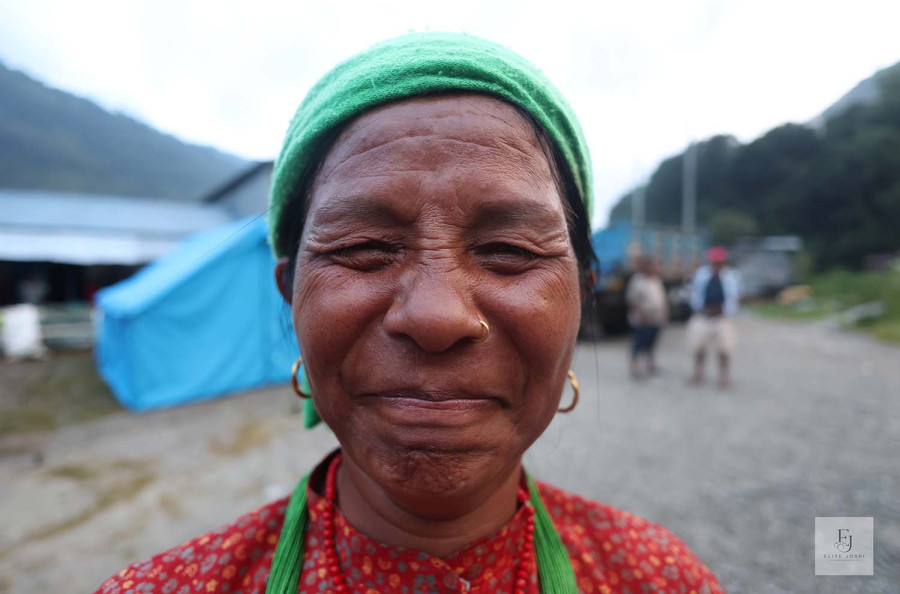
She is somewhere in her early fifties. One morning, she lost fourteen members of her family.
She was smiling when she told me this.
I want to be precise about that smile because I haven’t been able to think about anything else since. It was neither calm nor acceptance. It was the expression a person adopts when there is nothing left to arrange. She held it steady as she spoke, the way you hold a door shut against the wind.
No budget line in any damage assessment covers that smile; no fund can be submitted to, and no ministry can evaluate whether it ever heals. In the language of climate finance, she is an externality.
On the morning of August 26, bedrock and glacial ice broke away at about 5,200 metres near the Langtang range and fell more than two kilometres into the Lhende River, damming it. The dam then failed. Within minutes, a wall of water, ice, and rock crossed the border, destroyed the Rasuwagadhi crossing, and raced down the Bhote Koshi and Trishuli corridor. The flood swept away four hydrological monitoring stations that were built to detect it. Bodies were recovered as far south as the Indian border.
By mid-September, 1,385 people were confirmed dead, and 5,130 were still missing. Nepal’s disaster authority estimated preliminary losses to property, housing, and infrastructure at roughly $2.56 billion.
Read that last figure again. It counts buildings.
The UN system has a term for everything else: non-economic loss and damage. Grief, health, identity, culture, a daughter, a field that four generations have walked. The official literature concedes, without embarrassment, that there is no agreed unit of measurement for any of these.
I have stopped treating that as a technical gap. A missing metric is a convenience. What cannot be measured cannot be invoiced, and what cannot be invoiced cannot be owed. In the political economy of disaster, uncounted becomes unclaimed, and thus unpaid. The absence of a number for that woman’s smile is not a methodological failure. It is a shield, protecting the people who would otherwise be billed.
The world that owes
Nepal emits less than 0.1 percent of the world’s greenhouse gases. Our per capita carbon dioxide emissions were 0.57 metric tons in 2023, compared with a global average of 6.76. We have committed to net zero by 2045, five years ahead of the global target, meaning we have promised to solve a problem we did not cause sooner.
Glaciers across the Hindu Kush Himalaya lost ice 65 percent faster from 2011 to 2020 than in the previous decade. In 2020, ICIMOD and UNDP published an inventory identifying 47 potentially dangerous glacial lakes in the Koshi, Gandaki, and Karnali basins, with 21 in Nepal and 25 across the border in Tibet. What happened on August 26 was not a bolt from the blue. It was on a list that had been circulated, presented, footnoted, and then shelved.
Consider what Nepal has asked for. Twenty million dollars from the UN’s Fund for Responding to Loss and Damage. Twenty million, against 2.56 billion in physical damage alone and a human toll no one has attempted to price.
That request tells you something bleaker than any refusal could. It is the request of a country that has learned exactly what it is permitted to want.
Even this will be difficult. The fund holds roughly 822 million dollars in pledges worldwide, with less than half paid in, against estimated global needs of about 400 billion per year. Created in the wake of Pakistan’s 2022 floods, it has not disbursed a single dollar for any climate disaster since then. Civil society has asked its board to convene an emergency session regarding Nepal, noting that the Fund’s rules already permit rapid response.
The reluctance is not administrative. As one scholar told Al Jazeera, wealthy states resist compensation largely because it would set a precedent and the queue behind Nepal is long. The calculation being made in capitals right now is not whether Nepal deserves the money. It is how much cheaper it is to let this one pass than to concede the principle.
In July 2025, the International Court of Justice held that states have binding obligations to prevent significant climate harm and that breaches may require full reparation, including compensation for injured states. The opinion is advisory and unenforceable. It is still firmer ground than Nepal has ever stood on, but it remains theoretical until a country like ours decides to be inconvenient about it.
The state that governs
But I cannot stand in Rasuwa and point only outward.
A few of us went north in early September after watching essential relief accumulate in Bidur, the district headquarters of Nuwakot, because the road still reaches Bidur. Some moved onward. A great many stayed. Within a week, Nepali editorials warned that an abundance in an accessible town was creating a false impression that the district had been served. Local officials told reporters the same: relief stacked at the centers, wards behind broken bridges, and a helicopter slot, with federal and local agencies mostly duplicating each other or prioritising only rescue.
Accessibility was deciding who ate.
So we went where no one had gone before. Through the administrative officer and various elected members of Uttar Gaya Rural Municipality, we learned about Simle Primary School, which was sheltering more than 150 people, including about 45 children, who had lost their homes and were short on rations. This was not an exception. Thousands were sheltering across Rasuwa and Nuwakot that first week, most in school buildings, with family tracing and psychosocial support among the needs the UN flagged as the most urgent and least met.
We drove two trucks for two days to Shanti Bazar. From there, it is a five-minute walk to the Trishuli 3A hydropower project, where 557 workers were listed as missing, with about 115 believed to be inside the main tunnel. The day before we arrived, two men had been rescued alive after nine days underground.
Cabinet ministers had been coming through that site. Members of Parliament had been coming through. Cameras had been coming through. And four kilometers away, at a school full of displaced families, people lacked food, medicine, and a road.
The road is the detail I would put in front of every negotiator. Four or five kilometers, buried under debris. We borrowed a mini excavator and, with local residents, built it. It took two days.
Two days, four kilometers, in the same week, Nepal’s president was appealing to the world for climate justice.
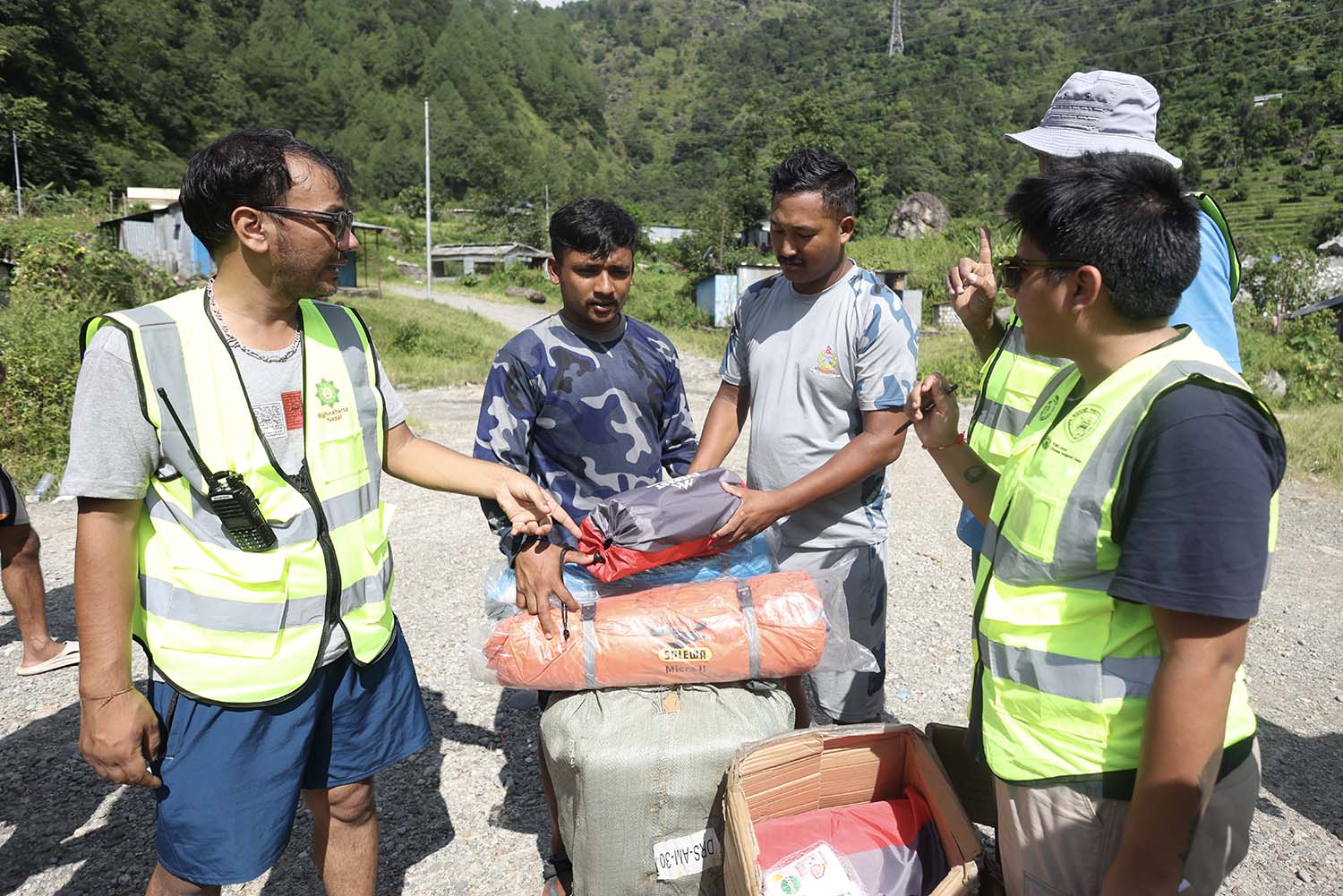
The soldiers and police there were doing exhausting, dangerous work, and we resupplied them because no one else did. No individual is to blame. It is a system that has yet to decide whether disaster response is a logistics problem or a visibility problem. The question matters far beyond Rasuwa: a state that cannot get rice past a landslide cannot absorb loss and damage finance if it ever arrives, and every donor knows that.
There is no climate justice for Nepal abroad without justice within its borders. If relief follows the road rather than the need, we are reproducing at home the very inequity we protest in New York.
And one more thing almost nobody says. The people entombed in those tunnels were workers, Nepali and foreign, employed on infrastructure projects meant to secure our climate-safe future. More than 600 foreign nationals from dozens of countries are among the missing. No loss-and-damage framework exists to compensate a labor migrant’s family across a border. We are building the energy transition on people’s bodies; the transition itself does not count.
The industry that responds
Then there is the sector I work in.
We had planned to airlift supplies, volunteers, a medical camp, and a community kitchen to Simle. The flights a private operator had promised us never arrived. I will not speculate on the reason. I will note the structure: when the roads are impassable, the sky becomes a market with very limited capacity, and a school full of hungry people is not a paying customer.
The deeper problem is not the helicopter. It is what the aid economy rewards.
It rewards arrival. It rewards the photograph of the sack changing hands. It rewards beneficiaries reached during the reporting period, which is why so much material stops at the first accessible point and is counted as delivered. It funds the emergency, not the aftermath, which is why the site was carpeted with water bottles, noodle wrappers, and biscuit packages left by everyone who had come to help. All of it was one rainfall away from the river and outside anyone’s mandate. We filled ten sacks by hand.
That plastic is the sector’s candid self-portrait. Everybody came. Everybody helped. Nobody stayed for the part that was not photogenic.
It also rewards certainty, so needs assessments are written to satisfy proposals rather than to uncover anything. Let me be clear about our own work. We ran a medical camp that served more than 600 people over three days, and we donated the remaining medicines to the nearest health post and to Trishuli Hospital. We resupplied the rescue teams with food, mattresses, blankets, and medical supplies. We are still assessing because we do not yet know what rebuilding should look like. I would rather write that than make a claim I have not earned.
What is not being counted?
An older man told me he survived by clinging to a broken pole. The water took his wife, his parents, and his children. Later, his daughter returned, having found something to hold on to.
A woman told me she had lost her land, her farm, her husband, her daughter, and her in-laws. She now lives with her sister and her sister’s in-laws. She spoke little about the flood and much about being a burden. That is the loss she bears each day: not only the dead, but also the conviction that her very presence is an imposition on someone else’s household.
A former teacher told us she is alive thanks to poultry feed. Someone called her to open her shop. She was closing up when the water came, and the customers who had come to buy feed were swept away. She lived because she was working. They died because they were working on the farm as well.
None of that appears in the 2.56 billion. None of it appears in the 20 million. None of it will appear in a single-donor report from this response, including, I expect, ours.
What justice would require
Speed: A fund that reviews Nepal’s request at the next scheduled board cycle has misunderstood the disaster.
Grants, not loans: A country cannot borrow its way out of harm it did not cause.
Money for the losses nobody knows how to price. Psychosocial care, family tracing, dignified handling of the dead, and land and legal standing for a widow now apologising for her presence in her sister’s house.
Early warning across transboundary basins is the single intervention that would have changed the death toll on August 26, and it is one no government upstream or downstream can build alone.
And at home, distribution by need rather than by road. That requires no international negotiation whatsoever, which is precisely why it evaluates whether we mean any of the rest.
I keep returning to the man who held the pole and to the daughter who returned because she had also found something to hold. That is the entire argument. Two people gripped what was within reach, so a family exists rather than nothing. Every siren, every reinforced bridge, every cleared road, every dollar that actually moves is one more thing within reach when the mountain comes down.
We measure this crisis in tonnes, degrees, and billions because those units were designed for negotiators and have served them well. They cannot capture the loss of a woman who lost fourteen people before breakfast and still wore the (painful) smile with which she greeted a stranger.
Nobody knows how to count a smile like that. That’s not her problem to solve. That’s why the rest of us keep getting away with it.
Chaudhary, a Madheshi Queer human rights advocate, advances gender justice, Dalit rights, and migrant workers’ rights.




 22.14°C Kathmandu